Description
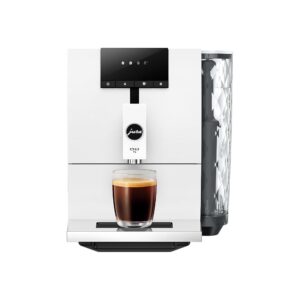
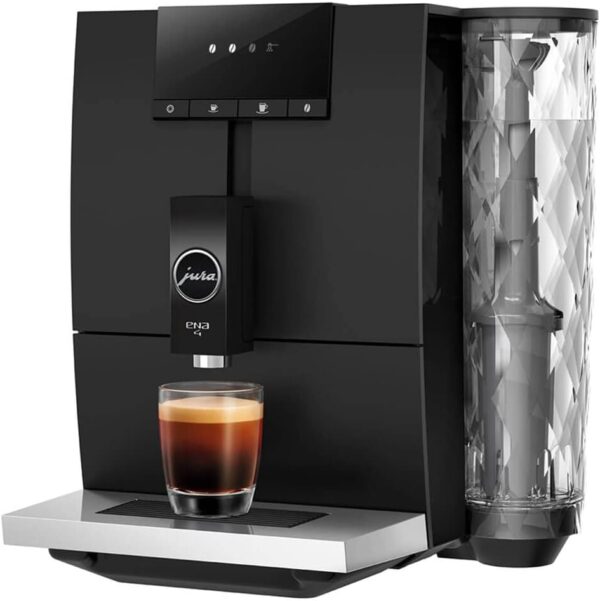
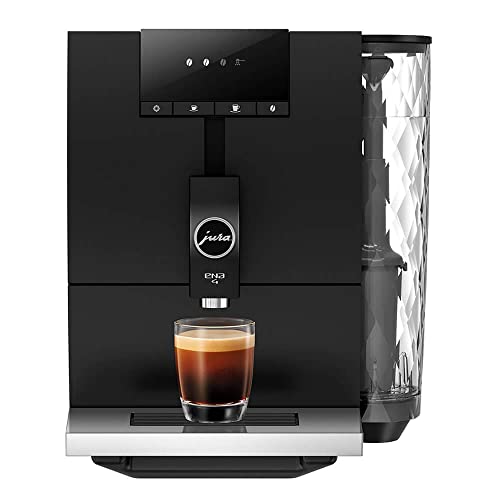
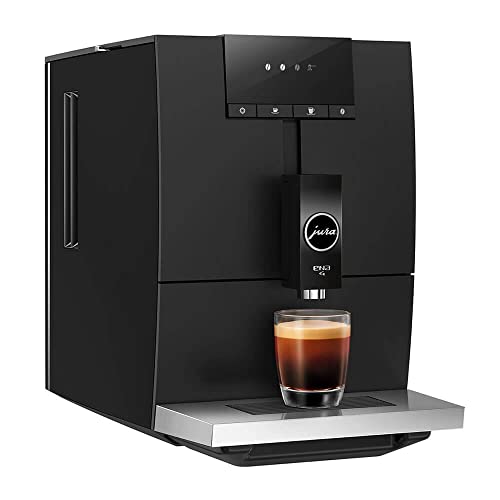
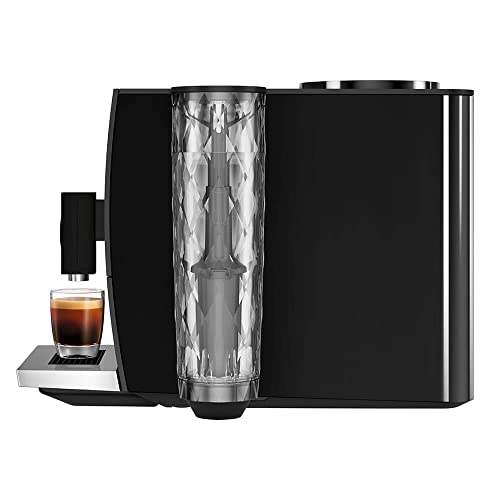
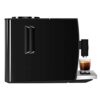
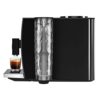
The ENA 4 is the entry point into Jura’s bean to cup line, sold here as the Full Metropolitan Black finish under model number 15374. It is a black coffee machine in the literal sense: the drinks it names are espresso, espresso doppio, coffee and coffee doppio, all pulled from whole beans with no milk circuit anywhere in the design. If you want a cappuccino from this machine you are frothing milk separately, by hand.
That narrowing is the whole point of the model. Jura has kept the grinder, the brewing unit and the Pulse Extraction Process that define the brand, and stripped out the milk hardware, the touchscreen and most of the menu depth. What you get is a compact automatic that turns beans into a short black drink at a button press, positioned against both the larger machines in our super automatic section and, from the other direction, against a capsule brewer for anyone whose real requirement is simply one good cup with no effort.
Drink Range and a Bullet That Contradicts Itself
The listing’s first bullet says the machine prepares five barista quality specialties at the touch of a button, then names four of them: espresso, espresso doppio, coffee, coffee doppio. The fifth is never identified anywhere in the stored data. This is a straightforward copy error rather than a hidden feature, and it is worth naming because the number five gets quoted in comparison tables that then imply a milk drink is included. It is not. Every drink named on this listing is a black coffee of a different length or volume.
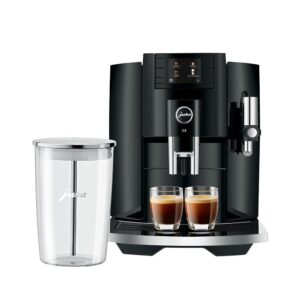
The practical range, then, is a short intense shot, a doubled version of it, a longer cup, and a doubled version of that. For a lot of households that is genuinely all they order. For anyone who wants a flat white without a separate frother, this is the wrong machine and the Jura E8 with Fine Foam Technology is the nearest sibling that solves it.
Grinder, Dose and the Pulse Extraction Process
The ENA 4 carries the Aroma G3 grinder, which Jura describes as running roughly twice as fast as a conventional grinder. The stated reasoning is time in contact with air and heat: a grinder that finishes sooner exposes the grounds to less of both, so more of the volatile aroma survives into the cup. The manufacturer does not publish burr material or grind step count in this listing.
The Pulse Extraction Process is the more consequential feature. Instead of pushing water through the puck in one continuous flow, the machine sends it through in pulses, extending contact time without simply pushing more water through. That is aimed squarely at short drinks, where a continuous flow either under extracts or forces you to run a larger volume than you wanted. It is the same mechanism used on the more expensive Jura models, and it is the strongest argument for this machine over a generic bean to cup unit at a similar price. The other ENA 4 listing carried on this site covers the same platform in a different finish and is worth cross checking on availability.
Water Tank, Bean Hopper and Refill Rhythm
Here the listing does give hard numbers, and they define daily life with this machine more than any feature does. The water tank holds 37 ounces, a little over a litre. The bean container holds 4.4 ounces, which is roughly 125 grams of whole beans.
That bean hopper is small. A typical automatic doses somewhere in the region of seven to eleven grams for a single black coffee, so a full hopper is on the order of a dozen or so drinks before it needs topping up. In a two person household that is a refill every few days; in an office it is a daily chore. The upside is that beans do not sit in the hopper going stale for weeks, which is a real problem on machines with much larger hoppers. The 37 ounce tank sets a similar rhythm, and neither figure is a fault so much as a design decision that matches the machine’s compact footprint. If unattended capacity matters more than size, the 64 ounce tank on the Jura E4 is nearly double.
Footprint, Controls and Build
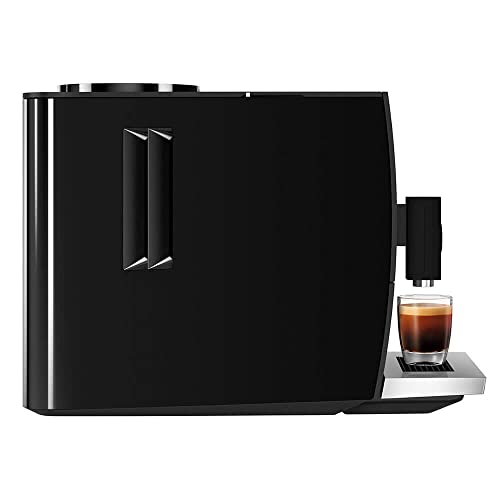
The recorded dimensions are 17.5 inches deep, 10.7 inches wide and 12.7 inches high, at a stated 21 pounds. The width is the number that sells this machine: under eleven inches is narrow for a bean to cup unit, and it will slot into a run of cabinets where a wider machine will not. The depth is the number that catches people out, because 17.5 inches is deeper than a standard counter allows once you account for a backsplash and for pulling the water tank clear.
Control is by buttons rather than a touchscreen, listed in the specification block as human interface input of buttons. On a machine with four named drinks that is a defensible simplification, though it also means no drink customisation menus of the kind the larger models carry. The stored specification also lists a filter type of reusable and an included component of filter. On a Jura that refers to the water treatment cartridge, not a coffee filter, and the distinction confuses buyers regularly enough to be worth flagging.
What the Specifications Do Not Settle
The listing does not state wattage, pump pressure, brew temperature, cup clearance height, the number of grind settings, whether grind strength is adjustable per drink, or whether the brewing unit is removable for cleaning. It also carries the usual filler fields: specific uses of personal and business, recommended uses including coffee connoisseurship, and a manufacturer field that simply repeats the brand. None of that helps a purchase decision.
Published owner feedback on the listing is mixed in a way that deserves stating plainly rather than smoothing over. One owner review praises the cup quality strongly and notes explicitly that the machine has no frother. Another reports the unit failing outright after a period of use, dispensing only a small amount of thick liquid before throwing an error, with cleaning and resetting having no effect. Both accounts are on the same listing. Reliability at this price point is the risk that the specification sheet cannot answer, and it is worth reading recent feedback and checking warranty terms before buying.
Who It Suits and Who Should Look Elsewhere
The ENA 4 suits a one or two person household that drinks black coffee, wants it from fresh beans, values a narrow footprint, and does not want to learn a portafilter. The small hopper and modest tank are a fair trade for a machine that fits where larger ones will not.
Look elsewhere if you drink milk based coffee daily, if you need to serve several people in a sitting, or if you want to adjust the brew yourself. Milk drinkers should move up the range or across to a machine with an integrated milk system such as the De’Longhi Magnifica Evo. Anyone brewing for a group is better served by a carafe machine from the drip coffee maker section, because a single serve automatic making four cups in a row is a slow and expensive way to fill a pot.