
Description
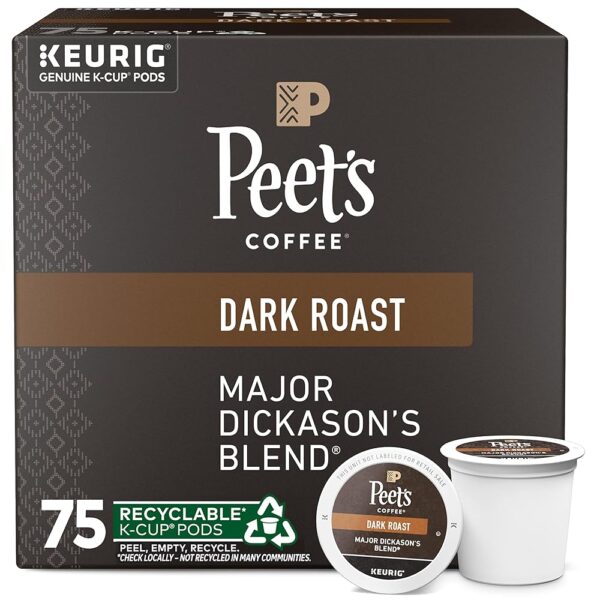
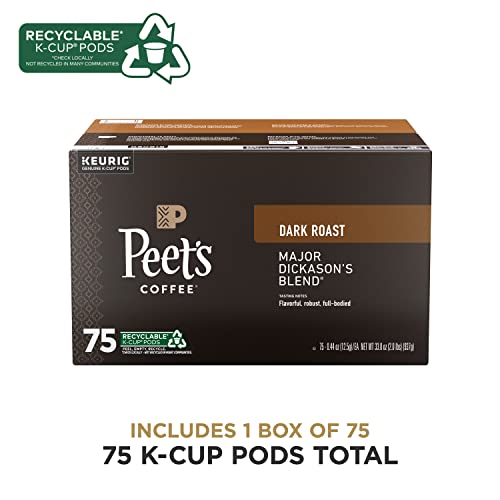
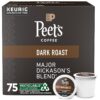
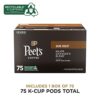
Peet’s Coffee Major Dickason’s Blend in Keurig K-Cup format is a single box of 75 pods listed at 42.98 dollars, a dark roast made from 100 percent Arabica coffee. Peet’s describes it as flavourful, robust and full bodied, states that the pods are fully recyclable with a check locally caveat, and says the company is actively engaged in driving positive impact in the communities where its coffee is grown. At 75 pods for 42.98 dollars it works out at about 57 cents a cup.
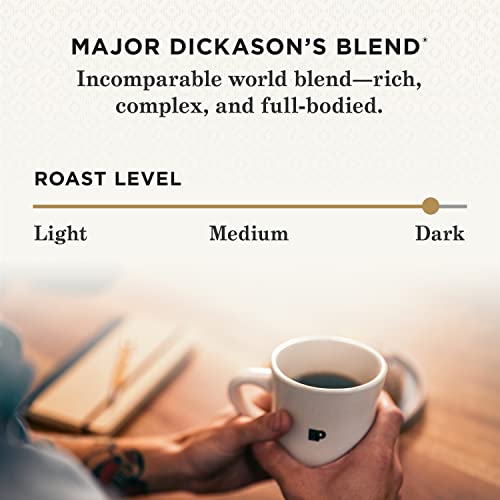
Major Dickason’s is the blend Peet’s is known for, and it occupies a particular position: dark roasted in the way Peet’s has done since 1966, but built around richness and complexity rather than around the roast level itself. That is a meaningful distinction in a category where dark roast usually means smoke and bitterness, and it makes this the more approachable of the two Peet’s dark roasts in the pod category here.
The Same Brand, Two Prices Per Pod
Peet’s sells a second dark roast in this catalogue, the French Roast pods in a 54 count box at 39.34 dollars. That is about 73 cents a pod against 57 cents here, a difference of 22 percent for coffee from the same roaster in the same format.
The cause is box size rather than coffee. Seventy five pods against 54 is enough of a difference to move the per pod economics, and it repeats a pattern that runs through this entire category: the larger box of the same brand is consistently cheaper per cup, often by a quarter or more. For a single daily drinker the difference between these two Peet’s boxes is around 58 dollars a year.
The two coffees are not interchangeable, so this is not simply a case of buying the bigger box. French roast is a roast level at the darkest end of the scale, dominated by smoke and bitterness. Major Dickason’s is a blend built for depth and body. But if you are indifferent between them, the arithmetic points clearly one way. The same effect shows up on the Starbucks Sumatra pods, where a 60 count box pushes the price to 71 cents.
What the Blend Is
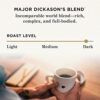
Peet’s says Major Dickason’s Blend was developed by Mr. Peet and his most discerning customer, and that it epitomises the rich, flavourful taste of Peet’s. That is brand history rather than a specification, and unusually for this category it is history that explains the product.
A blend developed against a single demanding palate rather than against a market research profile tends to end up somewhere specific rather than somewhere safe, and Major Dickason’s is noticeably heavier and more assertive than the chain coffees in this category. The tasting descriptors given are flavourful, robust and full bodied, which describes weight without describing flavour. There is no origin, no blend composition and no acidity note, so what the individual components contribute is not something this page establishes.
What is stated, and what several competing dark roasts in this catalogue do not state, is 100 percent Arabica. That is a real specification and its absence elsewhere is worth noticing.
Dark Roast and the Fixed Pod Dose
Every K-Cup holds a dose set at the factory, generally nine to twelve grams, and the machine varies only the water. That makes brew size the single largest influence on how any pod tastes, and it interacts with roast level in a predictable way.
Dark roasts survive dilution far better than light ones. Their character comes from roast derived compounds that remain assertive at a weak brew ratio, where a light roast’s acidity and delicacy simply thin out. A 12 ounce cup from this pod will be less concentrated than an 8 ounce cup but it will still taste like the coffee it is meant to be. That makes Major Dickason’s a sensible choice for anyone who drinks large mugs, and a particularly good one for anyone who takes a lot of milk, since a full bodied dark roast holds its own where a lighter coffee disappears.
Fully Recyclable, With the Caveat This Time
The recyclability bullet reads that Peet’s K-Cup pods are fully recyclable, with the instruction to peel, compost or dispose of the grounds and recycle the pod, followed by check locally, not recycled in all communities.
That caveat is worth pointing out because Peet’s own French Roast listing in this same catalogue makes the identical fully recyclable claim and omits it entirely. Same company, same pod construction, same wording up to the final sentence, and one page qualifies the claim while the other does not.
This version is the accurate one. A K-Cup body is polypropylene, resin code 5, which is a recyclable material accepted by many kerbside schemes in principle. The obstacles are that the pod arrives contaminated with wet grounds under a bonded foil lid, and that even cleaned it is small enough to fall through the sorting screens at many facilities. Peeling and emptying solves the first and does nothing about the second. Fully recyclable describes what the pod is made of; the caveat describes whether it gets recycled.
What the Specifications Do Not Settle
The specification block runs to five category labels: brand, item form, flavour, caffeine content and roast level. There is no weight, no dimensions, no country of origin and no date first available.
There is no origin or blend composition, which on a blend this famous is a real omission. There is no dose per pod in grams and no caffeine content in milligrams. There is no kosher certification, which several competitors carry. The sourcing claim, actively engaged in driving positive impact in communities where our coffees are grown, names no programme, no standard and no auditor, which puts it below the Fair Trade Certified options elsewhere in this category and level with the corporate commitments most brands make. And nothing states whether the 75 pods arrive loose in one tray or in sealed sub packs, which determines how well they keep over the two and a half months the box lasts.
Who It Suits and Who Should Look Elsewhere
This suits someone who wants a serious dark roast rather than a merely dark one, drinks large mugs or takes a lot of milk, and is willing to pay above the supermarket brands for it. Major Dickason’s is a genuinely distinctive blend, 100 percent Arabica is stated where competitors stay silent, the recyclability claim is honestly qualified, and at 57 cents a cup it is meaningfully cheaper than Peet’s own French Roast box. The Green Mountain Dark Magic capsules are the other dark roast in this category.
It suits you poorly if cost per cup is the deciding factor, since the cheaper end of this category runs at around 40 cents. It suits you poorly if you want brightness or acidity, which dark roasting removes. And it suits you poorly if you want documented sourcing rather than a stated commitment. Anyone drinking dark roast pods daily should also weigh whether the refillable pod filters and Peet’s ground coffee would give the same cup for roughly a quarter of the price. The GoodCups reusable filter is one such filter.