

Description
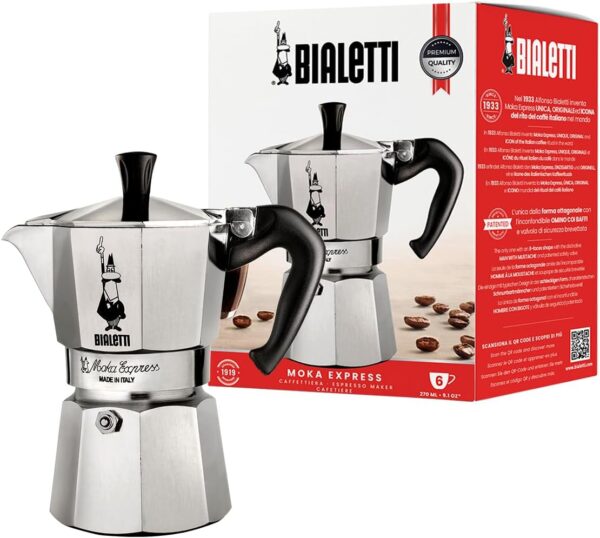
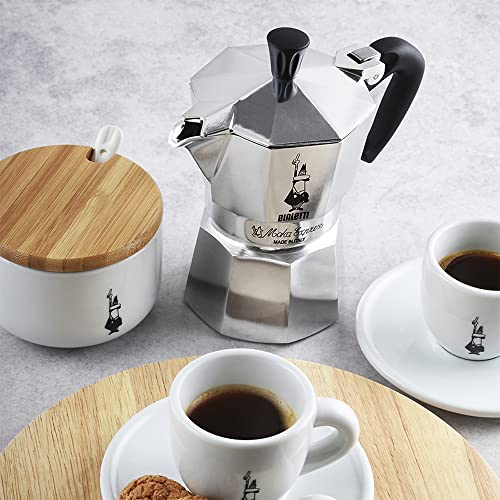
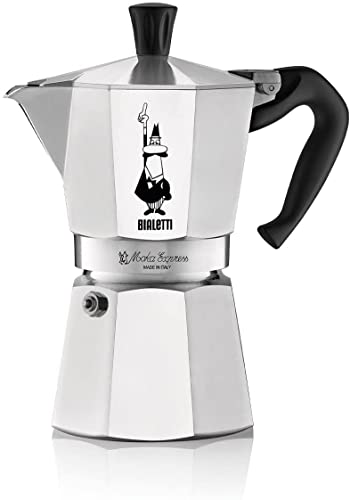
The Bialetti Moka Express is the aluminium octagon that most people picture when they think of Italian coffee. Alfonso Bialetti designed it in 1933, the shape and the moustachioed figure on the side have barely changed since, and this is the six cup size, listed at 41.42 dollars under model number 06800. It is made in Italy, has a patented safety valve, and has no electrical parts at all.
What it makes is not espresso, despite the category name, and being clear about that improves the experience of owning one. A moka pot builds roughly one to two bars of steam pressure in a sealed lower chamber and pushes water up through a bed of ground coffee into an upper chamber. Espresso requires around nine bars from a pump. What comes out of a moka pot is a strong, dark, full bodied concentrate with real intensity and no crema, closer to a very strong filter coffee than to a shot. It is excellent on its own terms, and the pump espresso machines covered here are what you buy if you want the other drink.
Capacity and the Espresso Cup Convention
Bialetti states plainly that Moka Express sizes are measured in espresso cups. Six cups therefore means six small Italian cups rather than six mugs. The listing gives the capacity as 270, which puts a full brew at roughly nine fluid ounces of finished coffee, or two generous mugs of something you would probably want to dilute.
That is the single most misunderstood thing about buying a moka pot. People buy the three cup expecting three mugs and end up with a shot glass. Six cup is the sensible size for one or two people who drink it strong, or for two who lengthen it with hot water.
The Brewing Method, Written Out
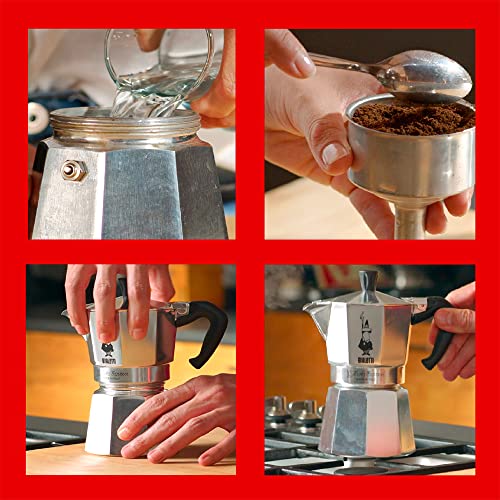
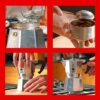
Bialetti gives an actual method on this listing, which puts it ahead of most products in this catalogue. Fill the boiler with water up to the safety valve, fill the funnel with ground coffee without pressing it down, close the pot and place it on the stove. As soon as it starts to gurgle, turn the heat off. The coffee is ready.
Two details in that instruction carry most of the outcome. Without pressing is the important half of the dosing step: tamping the grounds, as you would on an espresso machine, raises resistance beyond what one or two bars of steam can push through, and the result is either a stalled pot or a bitter one. Turning the heat off at the gurgle is the other. The gurgle is steam breaking through behind the last of the water, and anything that comes out after it is scorched. Leaving the pot on heat past that point is the most common reason people conclude moka coffee is bitter.
Materials, Heat Sources and the Induction Question
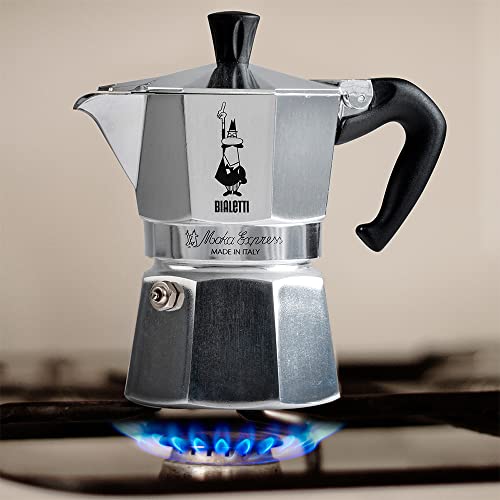
The body is aluminium, which conducts heat quickly and evenly and is the material Bialetti has always used for the Moka Express. It is also the reason for the one real compatibility limit: aluminium is not magnetic, so the pot will not work on an induction hob without Bialetti’s separate induction adapter plate. The manufacturer description states this clearly, listing gas, electric and induction with the adapter.
The specification block then contradicts it. Special feature reads Gas Stovetop Compatible and nothing else, which reads as though gas is the only option. Both statements are on the same page. The description is the accurate one, and the adapter plate is a separate purchase that the listing does not price or link. On a gas hob the practical advice is to keep the flame within the base diameter so the handle does not sit in the fire, since the handle is not metal.
The Safety Valve and the Gasket
The patented safety valve is the small brass fitting on the side of the boiler, and Bialetti presents it as making the pot easy to clean. Its real job is more important than that: it releases pressure if the filter plate blocks, which prevents the sealed lower chamber from becoming a hazard. It also doubles as the fill line, since the instruction is to fill water up to the valve and no higher.
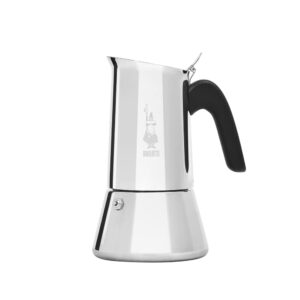
What the listing never mentions is the rubber gasket, and that omission matters more than anything else on the page. A moka pot seals with a rubber ring between the two chambers, and that ring hardens and shrinks with heat over months of use. When it fails, the pot leaks steam sideways, pressure never builds and the coffee stops working. Gaskets are cheap consumables sold in packs, along with the perforated filter plate they sit against, and knowing they exist is the difference between a pot that lasts twenty years and one you throw away after two. The same wear parts apply to every pot of this design, including the stainless bodied Bialetti Venus, which is the induction ready alternative within the same brand.
Cleaning, and Why the Instruction Is Unusual
Bialetti’s cleaning instruction is specific and contrary to normal kitchen habit: rinse with water after use, do not use detergent, and do not put it in the dishwasher, both because it damages the pot and because it affects the taste of the coffee.
The reasoning is chemical rather than superstitious. Untreated aluminium develops an oxide layer and holds a thin residue of coffee oil, and alkaline dishwasher detergent strips both, dulling the metal and leaving a metallic taste that takes several brews to clear. A hot water rinse and a proper dry is the correct maintenance, and the pot should be stored with the two halves separated so the gasket does not compress.
Specification Errors on This Listing
The dimensions are given as 2 inches deep by 2 inches wide by 2 inches high. A six cup Moka Express is around eight inches tall to the top of the lid and roughly four inches across the base. A two inch cube would not hold a single espresso. The figure is wrong by a factor of four in every direction and no reading of the product rescues it.
The capacity field reads Capacity 270 Millimeters equals Capacity 270 Millimeters, which fails twice over. The field name has been written into the value as well as the label, and the unit is wrong: millimetres measure length, not volume. The intended figure is 270 millilitres. The weight field breaks the same way, reading Item Weight 7.7 ounces equals Item Weight 7.7 ounces, and 7.7 ounces is light for a six cup aluminium pot, which typically runs closer to a pound. Treat both figures as unverified. No filter type is recorded at all, despite the pot depending on a metal filter plate and a gasket.
Who It Suits and Who Should Look at Another Format
This suits someone who wants strong concentrated coffee, has a gas or electric hob, and likes owning a tool with no electronics to fail. It is close to indestructible, the consumable parts cost a few dollars a year, and the design has been in continuous production for ninety years, which means gaskets and filter plates will be available for as long as you own it. As a way to make a strong base for milk drinks it asks for very little equipment. The Easyworkz EZ-CP500A is the stainless pot that ships with a reducer for smaller doses.
It suits you poorly if you want espresso with crema, if you have an induction hob and do not want an adapter, or if you want to walk away while it brews, since the pot needs taking off the heat at the right moment. It also suits you poorly if you want volume, because nine ounces is the ceiling. Anyone who wants the same drink without standing over a stove should look at the electric steam brewers such as the Bene Casa BC-95511, and anyone wanting a smaller or differently finished moka pot will find several in the stovetop section. The Primula Classic stovetop espresso maker is one of the smaller pots in that group.