






Description
The Zulay Kitchen Milk Boss is a handheld frothing wand, which places it in the simplest tier of milk equipment this site covers. There is no jug, no heating element and no pump anywhere in the design. A battery driven motor spins a coiled stainless steel whisk fast enough to drag air into milk that has already been warmed somewhere else, and a single button on the housing is the whole control scheme. The manufacturer describes the model as a drink mixer as well as a frother, and mechanically that is an accurate description of what the tool is.
That places the format a long way from a steam wand, which heats and textures milk in one pass, and further still from a heated frothing jug that runs to a set temperature and stops. A spinning whisk produces dry, bubbly foam that sits on top of a drink rather than the wet microfoam that latte art depends on. Anyone chasing that texture should be reading about the espresso machines covered on this site. Anyone who wants a cap of foam on drip coffee, hot chocolate or a matcha drink will find a wand sufficient, and this is the stand equipped version of one of the more widely stocked wands on the market.
Whisk, Housing and the Stand
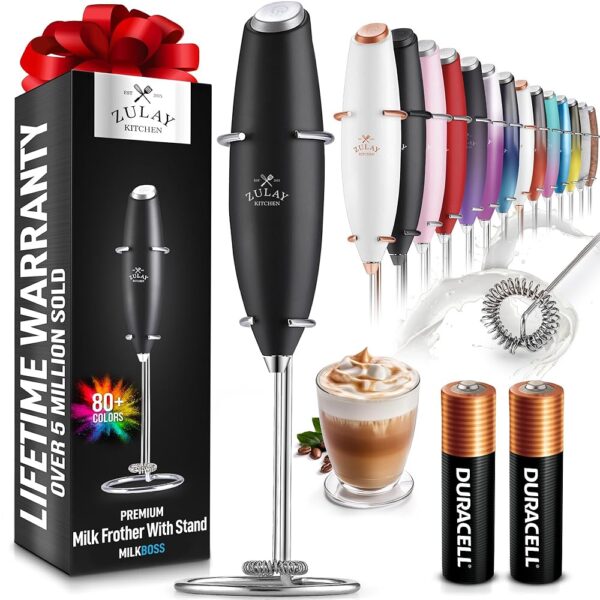
The specification block gives the material as stainless steel and the color as midnight black. Both entries are partly true in the way listing data usually is. The whisk coil and the shaft are steel; the section a hand actually holds is plastic, because that is where the battery compartment and the button have to live. The distinction matters for durability rather than looks, since the parts that fail on wands of this design are the button and the battery contacts rather than the steel coil.
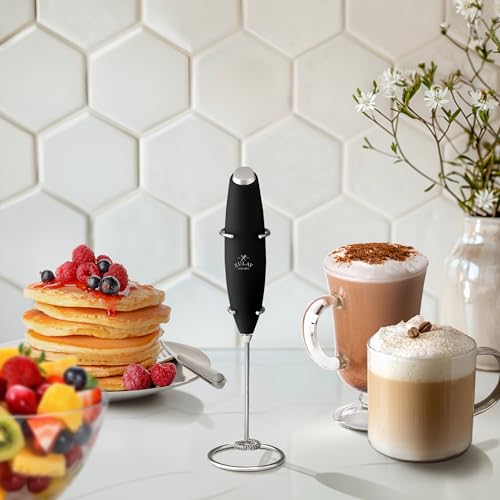
The listed special feature is a durable stand, and that stand is the only meaningful difference between this model and the cheaper Zulay wand sold without one. It is a weighted base the wand drops into, which keeps a damp whisk off the counter and stops the tool rolling. Buyers comparing options within the same brand should know that the version sold without a stand is otherwise the same instrument, and that there is also a Milk Boss supplied with a holster style stand that mounts rather than sits. The choice between the three is a choice about storage, not about frothing.
Batteries and Running Costs
The listing title states that two Duracell AA cells are supplied, which is unusual enough at this end of the market to be worth noting. Nothing in the specification block confirms the battery count, the chemistry or an expected run time, so the title is the only source for any of it. Alkaline cells lose voltage gradually as they discharge rather than cutting out, and a brushed motor turning a whisk slows in step with that voltage.
The practical consequence is that a wand of this type gets slower before it stops working, and published owner feedback repeatedly mentions exactly that pattern being mistaken for a failing motor. There is no charging port, no cable and no mains option, so batteries are the running cost of the tool and the only serviceable consumable in it.
Getting Usable Foam
A wand adds air. It does not add heat, so milk for a hot drink has to be warmed on a stovetop, in a microwave or through a machine first, and that extra step is the main compromise the format asks for. The whisk should be submerged before the button is pressed and kept below the surface while it runs, because a coil spinning in open air throws milk across the counter rather than folding air into it.
Vessel shape does more for the result than technique. A tall, narrow container gives the foam somewhere to climb and keeps the whisk away from the walls, which is why a dedicated frothing pitcher is a sensible companion purchase. Milk composition matters as much: whole milk gives a denser head and skimmed milk a taller, drier one.
Cleaning and Daily Handling
Cleaning is the strongest argument for the format. Milk protein sets hard once it dries, so the whisk needs a rinse immediately after use, and spinning the coil briefly in a mug of warm soapy water clears the gaps between the loops better than wiping does. The housing must stay dry, since it holds the motor, the switch and the cells, which rules out running the whole tool under a tap or putting any part of it in a dishwasher.
The stand earns its place at this point in the routine, because a wet whisk parked upright drips into its own base rather than onto a counter. There is nothing to descale, no gasket to replace and no filter to buy, which keeps ongoing maintenance down to battery changes.
What the Listing Gets Wrong
The specification block for this model runs to five fields: brand, special feature, color, material and a recommended use of Residential. It carries no length, no weight, no motor speed and no power draw, which for a device whose entire sales pitch is speed is a striking omission. Recommended Uses For Product set to Residential is a catalogue classification rather than a specification, and it tells a buyer nothing that the product photograph does not.
It is worth setting that against the sister listing for the stand free wand, which does publish a wattage figure and gives it as 13 KW. Two AA cells cannot deliver 13 kilowatts; that number is the motor speed of 13,000 revolutions per minute entered into the wrong box. One listing in this family omits the figure entirely and the other prints it as a unit that would run a small workshop, which is a fair summary of the data quality across handheld frothers generally.
What the Specifications Do Not Settle
A buyer cannot establish the motor speed of this particular variant from the listing at all, so any comparison against wands that do quote a figure is guesswork. Run time per set of cells is not published, and neither is the current draw that would let anyone estimate it. No noise level is given, which matters for a motor that spins a coil in an open mug at kitchen level rather than inside a sealed housing.
The listing also leaves open whether replacement whisks or spare stands can be bought separately, what the warranty covers, and whether the shaft seal keeps milk out of the motor housing over time. Nothing states the whisk head diameter, so cup compatibility has to be judged from photographs. These are the questions that separate a wand lasting two years from one lasting two months, and none of them are answered on the page.
Who It Suits and Who Should Look Elsewhere
The Milk Boss suits a household that brews drip coffee or pod coffee and wants foam on top of it without adding an appliance to the counter. It suits matcha, drinking chocolate and powdered supplements, where the job is dispersing a powder rather than building milk texture, and the stand makes it tidy enough to leave on display. It is a reasonable first purchase for anyone unsure whether they will use a frother often enough to justify a machine.
It is the wrong tool for anyone who wants microfoam for latte art, anyone unwilling to heat milk in a separate step, and anyone who would rather not manage batteries. Those buyers are better served by a machine that steams and textures in a single operation, such as the Mr. Coffee ECM160 steam espresso maker, or by a heated electric frothing jug that runs unattended to a set temperature and switches itself off.