Description
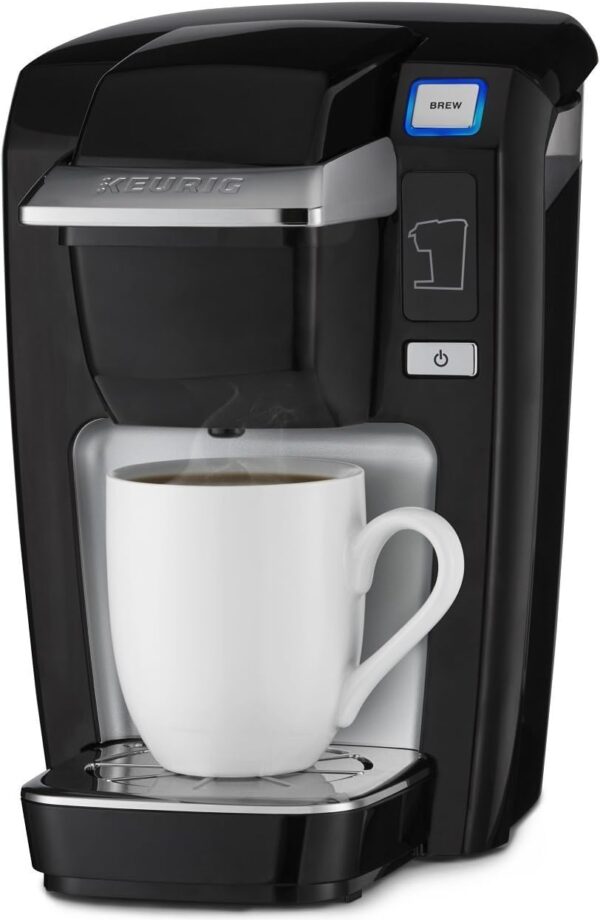
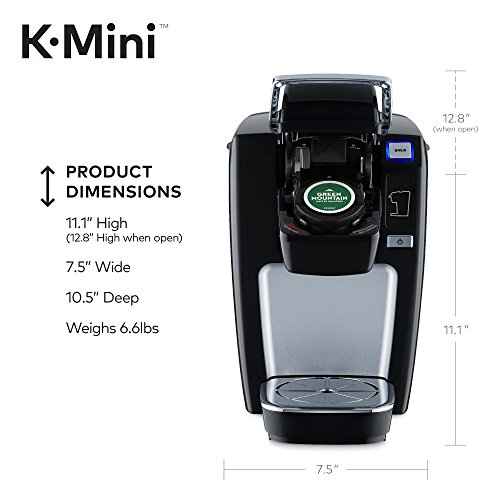
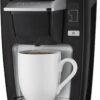
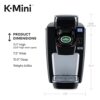
The Keurig K15 is the smallest brewer Keurig has sold under the K-Cup format, a single cup machine with no standing reservoir at all. Water is poured in for each drink, heated, and pushed through one pod. The specification gives a 6.9 by 10.7 by 10.8 inch body, brew sizes from 6 to 10 ounces, a removable drip tray and cord storage, and it has been listed since December 2015, which makes it one of the older designs still circulating in the range.
That fill for every cup design is the whole argument for and against the machine. It means nothing sits in a tank going stale, the footprint is tiny, and the brewer can be packed for a trip. It also means the routine involves measuring water each time, which is exactly the convenience most pod owners were trying to buy their way out of. Anyone deciding between this and a tank model should settle that question first and treat everything else as detail.
Single Cup Reservoir and Brew Sizes
The listing states brew sizes of 6, 8 and 10 ounces, and on this design the size is decided by how much water is poured in rather than by a button. Whatever goes into the chamber comes out through the pod, so the strength of the cup is controlled directly by the fill. Published owner feedback consistently reports that the 6 ounce fill gives the strongest and most balanced cup with a standard pod, and that 10 ounces stretches the same grounds thin. That is a useful and honest characteristic of the format rather than a fault, and it is a point of difference against a tank machine like the Keurig K-Express single serve brewer, where the machine measures the dose for the drinker.
Pods, Reusable Filters and Grind
The machine takes standard K-Cup pods, which is the widest pod supply in the market and the main reason the format persists. It is also compatible with a refillable basket, so ground coffee can be used instead, and that is the route to controlling cost and to using a local roaster’s beans. The one technical caution that comes up repeatedly in published owner feedback concerns grind size: a fine espresso grind restricts flow through a refillable basket and causes overflow around the pod holder, and a medium grind avoids it. A refillable option such as the GoodCups reusable K-Cup filter pays for itself quickly at more than one drink a day, and it removes the plastic pod from the routine entirely.
Footprint, Travel Mug Clearance and Cord Storage
At under seven inches deep this is a genuinely small machine, and the two design details that support portability are cord storage in the base and a drip tray that lifts out to clear a taller travel mug. The exterior is plastic throughout, which keeps the weight down and is the honest trade for the size. Because the chamber is filled by hand, the machine can be used anywhere there is a socket and a source of water, which is why published owner feedback so often mentions hotel rooms, offices and recreational vehicles. Sitting under a wall cabinet is not a problem either, since the lid opens forward rather than straight up on this body shape.
Power Behavior and Descaling
The brewer heats water only when a cup is requested rather than holding a tank hot, and it powers down after brewing, which is the main practical reason a fill for every cup design draws less standby power than a tank machine. Scale is still the thing that eventually kills these brewers. The heating path is narrow and a small blockage shows up as a weak or slow brew, so descaling on a regular schedule with a proper solution, and using filtered water in a hard water area, are the two habits that decide the machine’s lifespan. Rinsing the pod holder and the exit needle matters as well, since grounds trapped at the needle are the usual cause of a brew that sputters.
Water quality matters more on this design than on a tank machine, for a simple reason: every cup is measured by hand, so tap water goes straight into the heater with nothing standing in a reservoir first. In a hard water area that shortens the interval between descaling runs noticeably. A jug filter costs little, removes most of the scale problem, and also removes the chlorine note that shows up clearly in a light roast brewed at a small volume. Owners who skip both steps tend to report the same sequence: a slower brew, a smaller cup than requested, and eventually a machine that heats water but will not push it through the pod.
What the Listing Gets Wrong
Item Weight is given as 1 pound for a brewer measuring nearly eleven inches in both width and height, which is a packaging data error rather than the real weight of a machine containing a heating element, a pump and a plastic housing. Coffee Maker Type reads Drip Coffee Machine, which is wrong for a single serve pod brewer. Filter Type reads Reusable while Included Components lists only the brewer itself, so the reusable basket the field implies is not in the box. Operation Mode reads Fully Automatic on a machine that has to be filled by hand for every cup. Exterior Finish is recorded as Matte or glossy plastic, and a field that hedges between two answers is not a specification at all.
What the Specifications Do Not Settle
Brew temperature is not stated, and published owner feedback frequently mentions that the coffee arrives below the temperature a drip machine gives, which is a known characteristic of small single serve brewers rather than a defect. Wattage, brew time, noise level and warranty terms are all absent. Nothing states which refillable basket generation fits, which matters because the format changed across Keurig’s range. Parts availability for the pod holder and the drip tray is unstated on a design first listed in 2015. Anyone comparing pod costs across brands will get further from the pod listings gathered under the single serve capsules and pods archive than from this specification block.
Who It Suits and Who Should Look Elsewhere
This suits one person, a desk, a dorm, a caravan or a guest room, and it suits anyone who values a small footprint above every other consideration. It suits a household that already has a full size brewer and wants a spare that never holds stale water. It does not suit two or more coffee drinkers in a morning rush, because filling by hand for each cup gets old quickly, and it does not suit anyone who wants programming or a hot plate. Those buyers should compare it with the tank based Keurig K-Classic single serve brewer, or with the equally compact Keurig K10 Mini Plus brewer, which shares the same fill for every cup approach.