
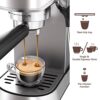
Description
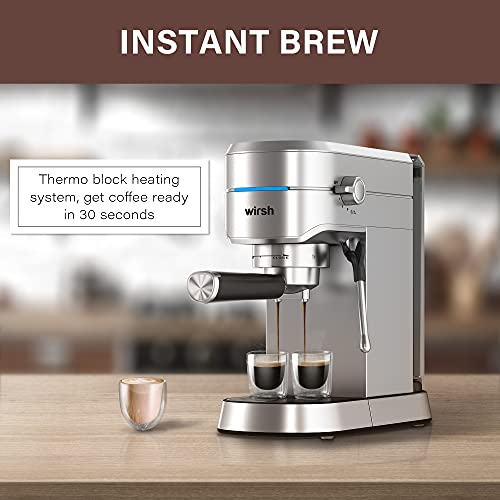
The Wirsh Home Barista CM5418 is a narrow semi automatic pump espresso machine specified with an ULKA Italian pump rated at 20 bar, a 1350 watt thermoblock heating system, a stainless steel steam wand and a 42 ounce removable water tank. It measures 12.2 inches deep, 5.5 inches wide and 11.9 inches tall at 9 pounds, and is ETL safety approved with BPA free water and coffee contact parts.
Two details raise this above the generic stainless boxes it sits among. Wirsh names the pump manufacturer, ULKA, which is the Italian firm that supplies vibration pumps to a very large share of the espresso industry including many machines costing several times as much. And the listing explicitly states the machine targets 9 bar extraction pressure rather than implying the 20 bar pump figure is what reaches the coffee. Both are unusually straightforward for this price band.
The 9 Bar Claim and Why It Matters
Almost every listing in this category quotes a pump maximum of 15 or 20 bar and leaves the reader to assume that is the brewing pressure. It is not. Espresso extracts at around 9 bar at the puck, and a pump only reaches its rated maximum against a closed valve. Wirsh states the 20 bar pump delivers the ideal 9 bar extraction pressure, which is the correct description and the honest one.
Naming ULKA as the pump supplier is similarly useful. It is a component specification rather than a marketing adjective, and it tells you the machine uses the same class of vibration pump found throughout the industry rather than an unbranded unit. Neither fact makes the coffee better on its own, but both indicate a listing written by someone who understands the product. The CASABREWS CM5418 carries the same model number and appears to share a chassis, which is common in this segment where several brands sell the same underlying machine.
Thermoblock Heating and Temperature
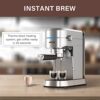
A 1350 watt thermoblock heats water as it passes through rather than storing a hot volume, which is why machines of this type are ready quickly from cold. The trade is thermal mass: a thermoblock has less stored heat to draw on, so temperature stability across consecutive shots depends on the control electronics.
Wirsh publishes no brew temperature, no stability figure and no heat up time in seconds. Owner feedback reports that coffee can arrive cooler than expected, which is the characteristic symptom of a low mass heating system feeding a cold group and a cold portafilter. The remedy is preheating: run water through the empty group and portafilter before the real shot, and warm the cup. That habit matters more on this machine than on one with a heavy brass boiler.
Portafilter, Baskets and Controls
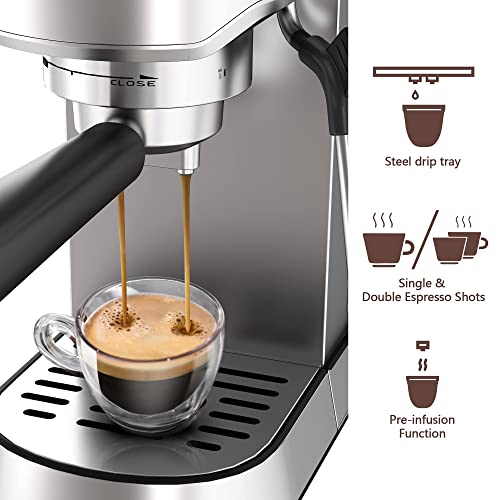
The machine uses a two in one portafilter with single and double filters, selected by swapping the basket, and shots are started with a button. LED indicator lights show machine state, which is the extent of the interface: there is no display, no shot timer and no programmable volume.
Owner feedback identifies the absence of a pressure gauge and of adjustable temperature as the main functional limitations, and both are fair. A gauge tells you whether the grind is right; adjustable temperature lets you match the machine to the roast. Machines at a similar price that provide one or both, such as the Gevi ECMG0 with its pressure gauge, give a learner more to work with. The listing does not state the portafilter diameter or whether the baskets are pressurised.
Steam Wand and Milk
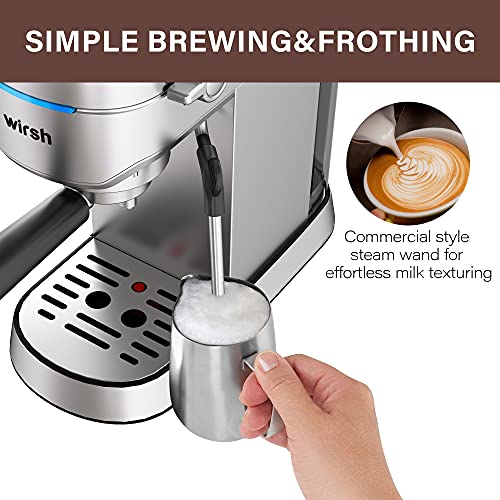
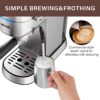
The steam wand is described as commercial grade stainless steel, which in practice means a bare metal wand rather than a panarello sleeve. That is the right hardware for anyone who wants to learn microfoam, since a bare tip gives control that an aerating sleeve does not.
No steam pressure, tip hole count or recovery time is published. As on any single heater machine, brewing and steaming are sequential: the machine has to switch modes and climb to steam temperature, then purge back down. Expect a wait between pulling a shot and texturing milk. The wand should be purged and wiped after every use; milk residue baked onto a tip is the most common failure on machines in this class.
Tank, Footprint and Daily Handling
The 42 ounce removable tank is generous for a machine 5.5 inches wide and should cover several drinks between refills. The drip tray is removable. At 5.5 inches this is one of the narrowest machines in this catalogue, which is the main practical reason to choose it.
Two consistent points appear in owner feedback. The machine is light enough at 9 pounds that it can slide when the portafilter is locked in, so a hand on the body or a non slip mat helps. And there is no water level indicator on the tank, meaning the machine can run dry without warning; on a thermoblock, running dry is worth avoiding. Checking the tank as a habit rather than waiting for a signal is the workaround.
What the Specifications Do Not Settle
The included components field reads Scoop and Tamper only, which is plainly incomplete against a machine that ships with a portafilter and two baskets. Also absent are the brew temperature, the heat up time, the portafilter diameter, the basket dose in grams, whether the baskets are pressurised, and the warranty term.
The specific uses field lists thirteen drink names including a misspelling, which is keyword stuffing rather than product information. Also unstated is the boiler or thermoblock arrangement beyond the wattage, and there is no descaling interval despite scale being the main long term threat to a thermoblock’s narrow water path.
What the machine does have in its favour is time on sale. Available since February 2021 with a substantial body of published owner feedback, it has a track record that newer arrivals in this price band do not, and recurring themes in that feedback carry more weight than they would on a model with a few dozen reviews. Those themes are consistent: simple, narrow, adequate coffee for the money, and dependent on the operator preheating properly.
Who It Suits
The CM5418 suits a buyer whose constraint is counter width and who wants an honest, simple pump machine with a real steam wand and a large tank. The named ULKA pump, the accurate 9 bar description and several years of owner feedback make it a lower risk purchase than most machines at this price. Paired with a burr grinder it will make genuinely good espresso. The QJA EM625 is the closest narrow alternative with a larger tank.
It is the wrong machine for anyone who wants feedback and adjustment, since there is no gauge, no timer and no temperature control, and for anyone making several milk drinks in a row. Buyers who want instrumentation should compare the Spacekey CM5080 with its PID control, and buyers who want the whole thing handled for them should look at the super automatic espresso machine category. The HiBREW H10B publishes adjustable brew and steam temperatures in a body of similar width.