

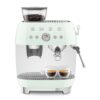
Description
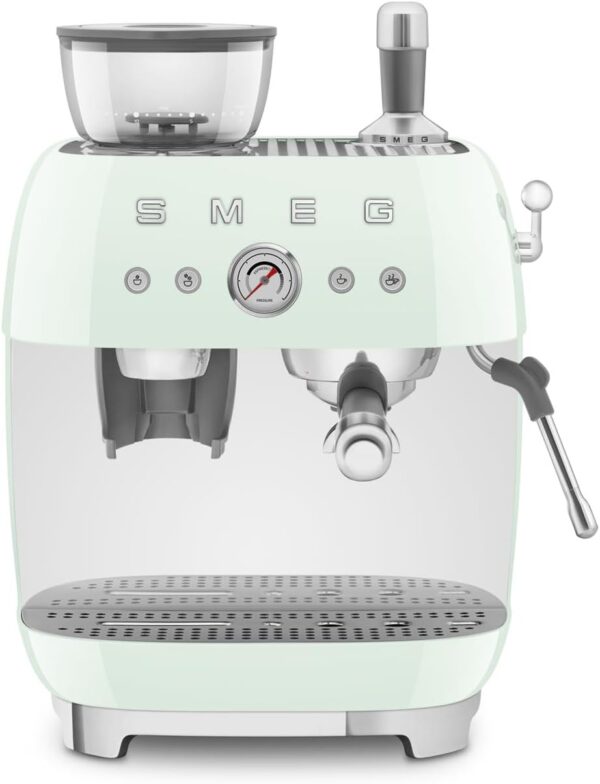
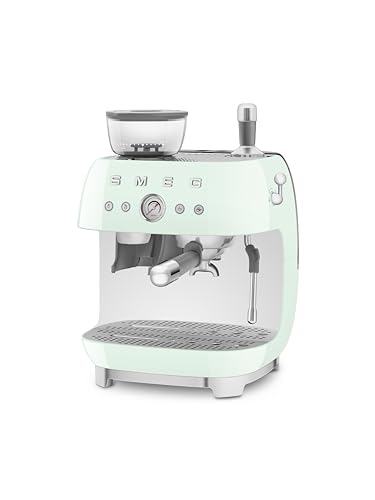
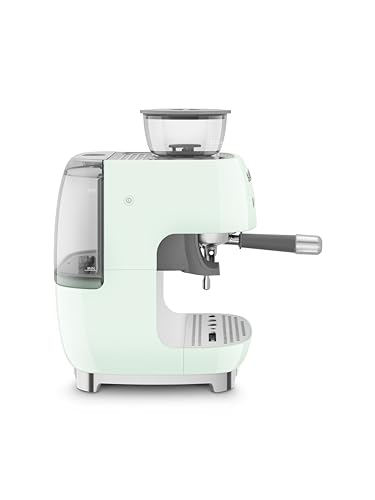
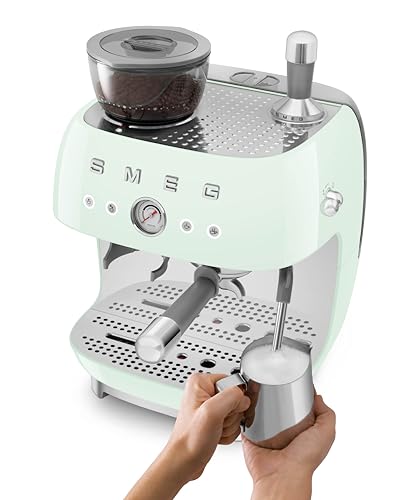
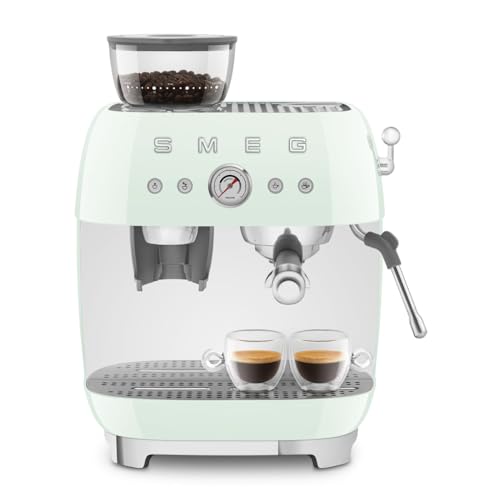
The Smeg EGF03 is a semi-automatic espresso machine in Smeg’s retro styling, listed here in pastel green. It weighs 28 pounds, measures 14 inches deep, 14 inches wide and 18 inches high, and ships with a stainless steel milk jug, a tamper, a cleaning kit and a water hardness test strip. The specification lists an auto shut off, a cup warmer, a water filter and a milk frother, and the listing highlights an integrated pressure manometer and a rapid heat up.
Two of those details are worth separating from the styling, because they are what actually distinguish the machine. A pressure gauge and a properly sized tamper and jug in the box place this above the entry level regardless of what colour it is. At 28 pounds it also has real mass, which matters more on an espresso machine than most buyers expect. Against the rest of our espresso machines category, that weight puts it closer to the prosumer end than the countertop end.
The Pressure Manometer
A manometer is a gauge showing the pressure at the group during a shot, and it is the single most useful instrument a home espresso machine can carry. Without one, a shot that runs fast and a shot that runs slow look the same until you taste them. With one, you can see whether the grind is too coarse, whether the puck is channelling, and whether the machine is reaching working pressure at all.
That is genuinely a learning tool rather than a decoration. It also lets you diagnose problems that would otherwise be invisible: a gauge that never climbs points to a coarse grind or an under dosed basket, and one that pins immediately points to the opposite. Most machines at this price have no gauge, and the ones that do tend to be the machines people keep. The listing does not state the gauge’s range or whether it reads brew pressure at the pump or at the group, which is a technical distinction that affects how you interpret it.
Build, Weight and Footprint
Twenty eight pounds is substantial. Mass on an espresso machine is thermal mass and stability: a heavy machine holds its temperature better through a shot and does not move when you lock a portafilter into the group. It is also the reason this machine is not something you shift around a counter, and at 14 by 14 inches with 18 inches of height it needs a permanent position with headroom above it.
The 18 inch height is the figure to check first. It will not fit under a standard wall cabinet, and the water tank and bean area are accessed from the top, so the real clearance requirement is more than 18 inches. The retro styling is the reason most people look at this machine, and there is nothing wrong with buying an appliance because it looks right in the room, but the dimensions are those of a serious machine rather than a decorative one.
Grinding, Heat Up and the Milk Wand
The listing’s own highlights refer to controls that simplify brewing and grinding, and earlier copy describes an integrated grinder and a dual thermoblock system. Neither appears in the structured specification: the product title says only Semi-Automatic Espresso Machine, and no grinder, burr type or grind setting count is listed anywhere. That is a significant gap, because whether the grinder is built in changes what else you need to buy and it changes the machine’s whole proposition. Confirming it before ordering is worthwhile.
A dual thermoblock arrangement, if fitted, means separate heating circuits for brewing and steaming, which removes the wait between pulling a shot and texturing milk. That is the constraint that makes single circuit machines frustrating for anyone making more than one milk drink, and it would explain the rapid heat up claim in the highlights. The included stainless steel milk jug is a real inclusion rather than a token one, since a properly shaped pitcher is what makes microfoam possible at all. Machines that automate the texturing instead, such as the Breville Bambino Plus, trade that control for repeatability.
Water Filter, Cleaning Kit and Maintenance
A water filter and a hardness test strip in the box tell you Smeg expects the machine to be configured to your supply. That strip is not a throwaway: it sets the descale interval, and getting it right is the difference between descaling twice a year and every other month. The cleaning kit inclusion suggests brushes and possibly a blind basket for backflushing, though the listing does not itemise it.
On a machine of this weight and price, maintenance is what determines whether it lasts. Backflushing the group with a blind basket, replacing the group gasket periodically, and descaling on schedule are the three jobs that matter. Suitable products are covered in our cleaning and descaling section, though a machine at this level generally wants a dedicated espresso detergent rather than a general purpose descaler alone.
What the Specifications Do Not Settle
The included components field contains a typographical error, listing a water hardnss test strip, which is a data entry fault rather than a product issue. More substantively, the listing does not state the portafilter diameter, which determines every accessory that will fit and is the first thing a buyer at this level should know. It does not state the pump pressure, the boiler or thermoblock architecture as a confirmed field, the water tank capacity, the heat up time, whether an integrated grinder is fitted, the number of grind settings, the cup clearance, the auto shut off interval, or the warranty term.
It also does not say whether the supplied baskets are pressurised or single wall. On a machine with a pressure gauge that omission is unusually consequential, because a pressurised basket generates its own back pressure and makes the gauge reading almost meaningless as a diagnostic. If you buy this machine for the manometer, confirm that single wall baskets are supplied or available.
Who It Suits
This suits someone who wants a machine that looks like a piece of furniture and still works properly, and who is prepared to give it a permanent position with headroom. The manometer, the included jug and tamper, and the substantial weight are the three things that make it more than styling, and together they suggest a machine you can learn on rather than outgrow. The KitchenAid KES6503 is the other design led machine with a metal body and a commercial diameter basket.
It suits you poorly if counter height is limited, because 18 inches plus top access rules out most under cabinet positions. It suits you poorly if you want automation, since there is no drink menu and no milk automation. And it suits you poorly if the price is being justified by the finish alone, because the same money buys considerably more capability in a plainer machine. Anyone who wants coffee at the press of a button should look at the bean to cup machines in our super automatic espresso machine section instead. The Smeg DCF02 drip coffee maker carries the same styling into a simpler format.


