
Description
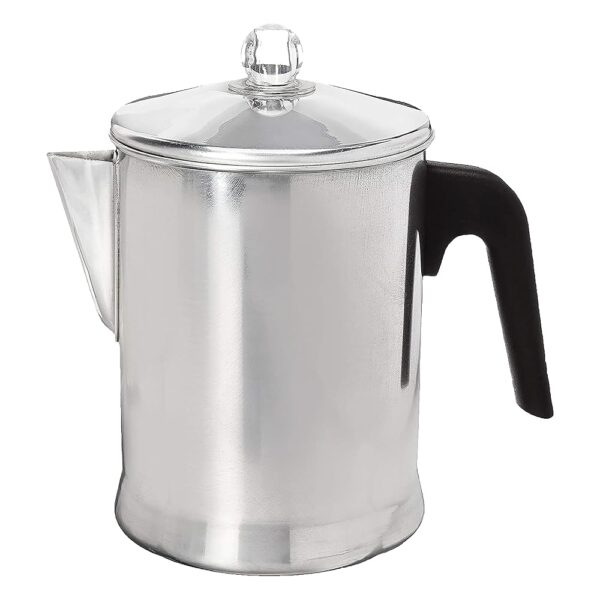
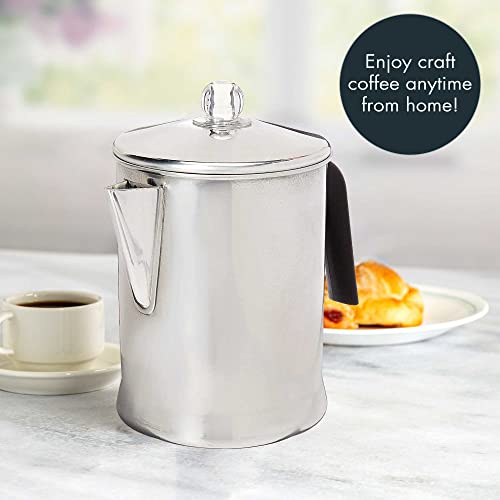
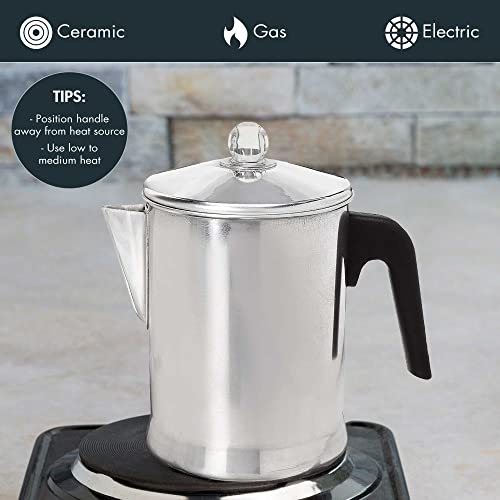
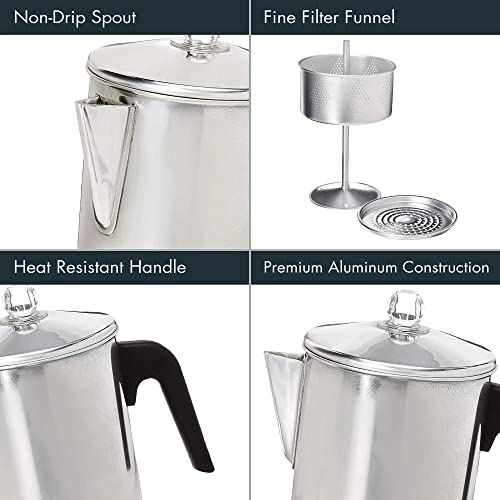
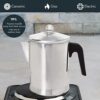
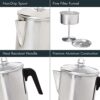
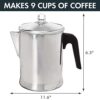
The Primula Today is a nine cup stovetop percolator in aluminum, with a matching lid, a lipped spout and a stay cool black plastic handle. There is no electrical element and no cord. You fill the lower chamber with water, fill the basket with ground coffee, put it on a heat source and wait for the pot to start bubbling. It works on electric, ceramic and gas hobs including propane, and on grills and campfires.
That last point is the reason this product exists. Everything else in the percolator category on this site needs mains power. This one needs heat, from any source, which makes it the only brewer here that works on a camping stove. Its closest relatives are the stovetop pots in the moka pot section, which use pressure rather than percolation.
How Stovetop Percolation Works
Water in the lower chamber is heated until it boils, forcing it up a central tube where it showers over the coffee bed and drains back down. That loop repeats for as long as the pot stays on the heat, so the coffee gets stronger the longer it runs. Unlike an electric percolator there is no thermostat, no cutoff and no indicator light. You watch the clear knob on the lid, see the coffee darkening as it perks, and take the pot off when it looks right.
That makes the stovetop version both more demanding and more controllable than an electric one. Nothing decides for you when the coffee is done, which means you can stop it early for a lighter cup or let it run for a stronger one, and it also means walking away produces something close to tar. Primula does not give any guidance on timing anywhere in the listing.
Capacity and What Nine Cups Means
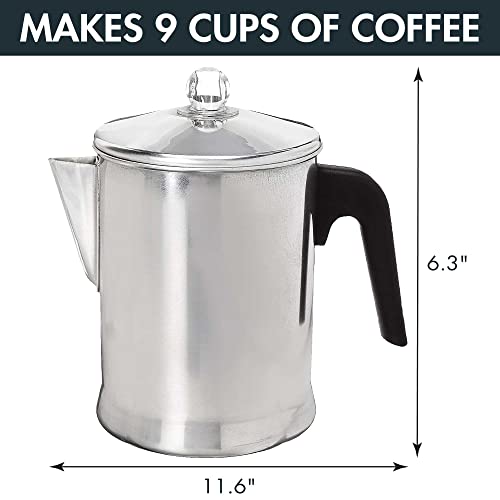
The listing says nine cups and never states the volume in ounces. That is the significant omission on this product, because percolator cups are conventionally five or six ounces and nine of them is somewhere between 45 and 54 ounces. The Unit Count attribute records 9.0 Count, which is the cup figure leaking into a field meant to count how many pots are in the box, so it confirms nothing.
Assume roughly four to five ordinary mugs. The dimensions of 5.2 inches deep by 8.15 inches wide by 8.23 inches high are consistent with a pot of that size, and the weight of 12 ounces confirms how light an aluminum body is: this is a third of the weight of the stainless electric percolators covered here, which is exactly why it is the one you take camping.
Aluminum, and What the Listing Does Not Say About It
Primula describes the aluminum as providing thorough and even heat distribution for enhanced flavour, which is a fair claim about the metal: aluminum conducts heat far better than stainless steel, so the pot heats evenly and quickly over a camp stove flame.
What the listing never addresses is care. Bare aluminum discolours and can pit if left wet or washed with harsh detergent, and no dishwasher guidance appears anywhere in the record, which is the first question anyone asks about an aluminum vessel. There is also no statement about whether the interior is coated or bare. On a pot bought partly for camping, where it will be washed badly in cold water, that matters more than it would on a kitchen appliance.
The Basket and Running Costs
The filter basket is permanent and takes ground coffee directly, so there is no paper consumable and nothing to buy again. Primula makes the running cost argument explicitly, framing the pot as a way to get a craft coffee experience without electric machines or single use pods.
The grind is where people go wrong. Percolator baskets have larger perforations than paper filters, so a fine grind passes straight through and leaves sediment in the cup. Percolators need a coarse grind, coarser than drip, and standard supermarket pre ground coffee is usually too fine. Nothing in this listing mentions grind at all, which for a product aimed partly at first time percolator owners is a real gap.
Where the Record Breaks
The Special Feature field on this product contains a broken string. It reads as stovetop compatibility followed by a stray quotation mark, the word or, another quotation mark and the letters NA. That is a template variable that never resolved, left in the record with its punctuation intact, and it is the clearest evidence on this site that these attribute tables are machine generated rather than checked.
The first bullet point is worse. It is a note about espresso extraction, warning about grind, dose and tamping pressure and discussing how much espresso is extracted. A stovetop percolator has no tamper, no portafilter and no pressure system in the espresso sense at all. The same text appears on several unrelated products on this site, including two electric percolators and a Zojirushi drip machine, so it is a seller template rather than a mistake specific to this listing. The Human Interface Input field says Buttons, on a pot with no electronics whatsoever.
Manufacturer, Origin and Other Fields
The Manufacturer field reads Epoca while the brand is Primula. Epoca International is the parent company that owns the Primula brand, so both are correct and the pairing is not an error, though it does confuse anyone searching for a warranty contact. The item model number TPA-3609 is a genuine part number and is the identifier to use.
The Country of Origin field reads USA, which is unusual for a product at this price and is worth verifying against the packaging before relying on it, since the same field reads China on almost every comparable item covered here. The Recommended Uses field says Traveling and Camping, which for once is an accurate description rather than the nonsense that field usually contains: a corded appliance cannot camp, and this pot can.
What the Specifications Do Not Settle
There is no volume in ounces, no brew time, no grind guidance, no dose guidance and no dishwasher advice. There is no statement about induction compatibility, which is the one hob type the listing does not name and the one aluminum does not work on without a steel base. Anyone with an induction hob should assume this pot will not work on it.
There is no warranty term. There is nothing about whether replacement baskets or lids are available, and on a pot with a plastic handle bolted to an aluminum body, the handle is the part that eventually fails.
Who It Suits
This suits campers, caravanners and anyone who wants coffee without electricity, and it suits a household that likes percolator coffee and does not want a counter appliance for it. It is light, cheap, has nothing electrical to break and works on almost any heat source. As a second brewer for a cabin or a boat it makes a great deal of sense. The Farberware Yosemite 50124 is the stainless stovetop alternative.
Look elsewhere if you have an induction hob, if you want the pot to decide when the coffee is ready, or if you want a bright, clean cup rather than a strong one. The Coletti nine cup percolator is the stainless alternative at the same capacity, and the Bialetti Moka Express is the other way of making coffee on a stove entirely. The Bialetti Venus is the stainless pot that works on an induction hob.