
Description
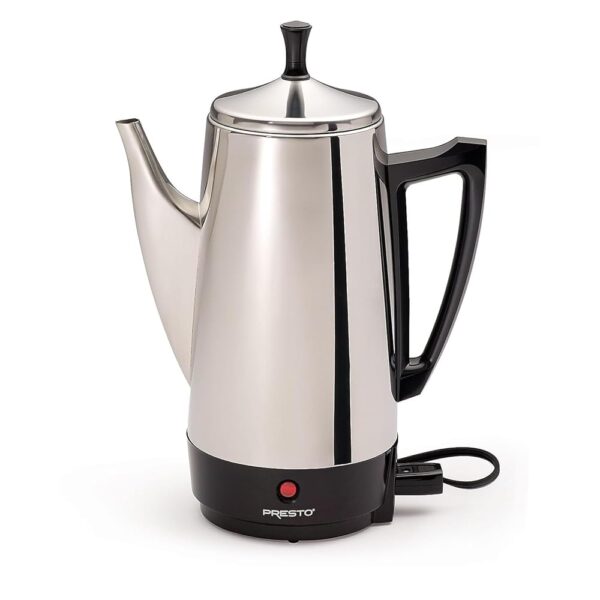
The Presto 02811 is a twelve cup stainless steel electric percolator with a signal light, an automatic keep warm mode and an easy pour spout. The filter basket and the perk tube are stainless as well as the body, and Presto claims a brewing rate of about a cup a minute. It has been on sale since 2003, which makes it the oldest listing covered on this site.
Percolators recirculate: water boils up a central tube and showers over the grounds again and again, so the coffee strengthens as the cycle runs. It is a strong, hot, old fashioned cup and it over extracts by the standards of modern brewing. That is why the percolator category remains small, and why the people who prefer it prefer it emphatically.
The Listing Disagrees With Itself About Capacity
One of the manufacturer’s bullet points says the machine makes 2 to 12 cups of coffee. The longer product description on the same listing says it makes 4 to 12 cups. Those are different machines in practice, because the minimum is the number that determines whether one person can use it daily.
The difference matters. Percolators need enough water to cover the element and reach the pump tube, and a four cup floor on a twelve cup pot means a single drinker is brewing more than they want every time. A two cup floor would make it usable for one. Presto does not resolve which is correct anywhere on the page. The company’s smaller six cup model states a two cup minimum explicitly, which suggests the four cup figure on this larger pot is the more likely one, but that is inference rather than a stated fact. Anyone buying this to brew small quantities should treat four cups as the working assumption.
A Cup a Minute
Presto states the brewing rate as fast as a cup a minute, which on a twelve cup pot implies roughly twelve minutes for a full brew. That is a genuinely useful figure and almost nothing else in this category publishes one, though it is worth reading as a rate rather than a promise, since a percolator has to bring the whole body of water to the boil before percolation starts at all.
No wattage is given, which is the number that would let you check the claim. The company’s six cup model publishes 500 watts; this larger pot must draw considerably more to move 60 ounces or more at that rate, and the record does not say how much. The signal light in the base tells you when the coffee is ready rather than any timer.
Stainless Basket and Perk Tube
Presto specifies stainless steel for the filter basket and the perk tube as well as the body, which is worth more than a general stainless claim. Those two parts do the work: the tube carries boiling water up from the element and the basket holds the grounds through repeated soakings. Plastic or aluminum versions of either discolour, warp or taint the coffee over time.
The basket is permanent, so there is no paper filter and no consumable at all beyond the coffee. The trade is grind size. Percolator baskets have larger perforations than paper filters, so fine grounds pass straight through and settle in the pot. Percolators need a coarse grind, coarser than drip, and standard supermarket pre ground coffee is usually too fine. Nothing in this listing mentions grind anywhere, which is the most consequential omission on the page.
Keep Warm and Serving
The machine keeps the coffee piping hot automatically once brewing finishes. On a percolator that automatic hold is essential rather than convenient: the coffee sits in the same vessel it was brewed in, directly above the element, and without a controlled hold it would keep percolating and keep extracting until it was undrinkable.
Presto describes the styling as traditional and suitable for table service, and the API description calls it hotel style. That is the actual use case. A percolator that can be unplugged and carried to a table is doing something no drip machine can, and one owner describes the supplied cord as the detachable two prong type also used on waffle irons, rice makers and slow cookers, which means a replacement is easy to find if the original is lost.
The Espresso Note and the Empty Fields
The first bullet on this listing is a note about espresso extraction, warning about grind, dose and tamping pressure, and it has nothing to do with a percolator, which has no tamper, no portafilter and no pump. The same text appears on at least three other unrelated products covered on this site, including the Primula stovetop percolator. Its advice about grind is also precisely backwards for this machine, since a percolator needs a coarse grind and the note warns against one.
The attribute table is unusually sparse. It contains seven fields and none of them describe the machine: dimensions, weight, department, manufacturer, country of origin, model number and a discontinued flag. There is no brand field, no capacity, no coffee maker type, no filter type and no voltage, all of which the comparable West Bend and Presto records do carry. The Department field reads Unisex-Adult, a clothing taxonomy value. The Manufacturer reads National Presto Ind, which is the correct corporate name in truncated form.
The Dimensions Describe a Box
The stated dimensions are 13.1 by 9.7 by 6.2 inches, given without labels for which axis is which. A twelve cup percolator is a tall vessel, and no arrangement of those numbers puts a 6.2 inch figure anywhere plausible as the standing height. The comparable West Bend twelve cup pot measures 11.82 inches high.
Read the figures as a shipping carton laid flat rather than as the appliance standing up. Expect something in the region of thirteen inches tall and nine to ten inches across, and check the listing photographs before planning a cupboard around it. The item weight of 2.9 pounds is credible for a stainless pot of this size and matches the six cup Presto closely enough to be believable.
What the Specifications Do Not Settle
There is no wattage, no volume in ounces to check the cup count against, no grind guidance, no dose guidance and no descaling instruction on a vessel that boils water directly, though the cleaning and descaling products covered on this site will do that job. No warranty term is given. Nothing states whether the pot, basket or tube is dishwasher safe, and the comparable West Bend listing does answer that question for its own parts.
One owner account is worth repeating because it captures why people buy these. The owner describes growing up with a percolator, switching to drip machines in the 1990s, going through several that lasted three to five years each, and returning to a percolator after a power surge killed the last drip machine. That is a durability argument as much as a flavour one, and a product listed continuously since 2003 lends it some weight.
Who It Suits
This suits a household that brews a large pot, prefers percolator coffee, and wants a serving vessel they can unplug and carry. The stainless basket and perk tube, the published brew rate and the sheer longevity of the model are the strongest arguments for it, and the running cost after purchase is nothing but coffee.
Look elsewhere if you want a bright, clean cup, or if you brew for one and the minimum capacity would waste coffee daily. The Presto 02822 is the same brand’s six cup pot with a stated two cup minimum and a published wattage, and the West Bend 54159 is the direct twelve cup rival with dishwasher safe internals and a larger real capacity.

![COLETTI Bozeman Percolator Coffee Pot , NO Aluminum or Plastic [9 cup]](https://idealcoffeeshop.com/wp-content/uploads/2025/04/coletti-bozeman-percolator-coffee-pot-no-aluminum-or-plastic-9-cup-300x300.jpg "COLETTI Bozeman Percolator Coffee Pot , NO Aluminum or Plastic [9 cup]")

