Description
The Amazon Basics basket coffee filters are a 200 count pack of white paper filters for 8 to 12 cup drip machines, listed at 2.53 dollars. That works out at roughly one and a quarter cents per filter, which makes this the cheapest consumable on this entire site by a wide margin and the one with the largest gap between what it costs and how much it affects the cup.
Paper filtration is not a neutral step. A paper filter traps coffee oils and the finest particles, and what passes through is a clean, bright cup with clarity in the aromatics and comparatively little body. A metal mesh passes both, which gives weight and texture and a little sediment. Neither is better; they are different drinks made from the same coffee. Anyone choosing a brewer should decide which they prefer before deciding which machine to buy, and the paperless options in the reusable filter section are the other half of that decision.
Basket Shape and What It Fits
Basket filters are flat bottomed with fluted sides, as opposed to cone filters which are folded to a point. The two are not interchangeable: a cone filter in a basket brewer collapses and a basket filter in a cone holder folds badly and lets grounds past. This pack is described as fitting most 8 to 12 cup basket coffeemakers, which covers the great majority of American drip machines including most Cuisinart, Hamilton Beach, Mr. Coffee and Black and Decker models.
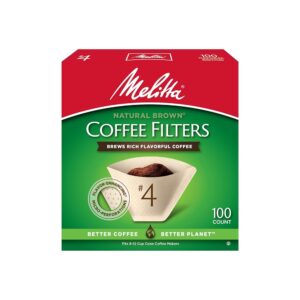
The word most is doing real work in that sentence. Basket filters vary in base diameter and in how tall the fluted wall is, and a machine with an unusually deep basket will need a taller filter. Machines that take a cone need the number 4 cone filters covered here instead, and the number stamped inside the brew basket is generally the quickest way to tell which you have.
Bleached Paper and the Rinse Question
These filters are white, which means the paper has been bleached. That is the one thing about them worth thinking about before you buy, because the alternative is unbleached natural brown paper and the two behave slightly differently.
Modern bleaching for food grade paper uses oxygen or chlorine dioxide rather than elemental chlorine, so the safety concerns that attached to this question decades ago no longer apply in the way people remember. What remains is a taste difference. Unbleached paper has a more noticeable papery character on the first pass and benefits from a hot water rinse before brewing; bleached paper has less of it. Rinsing either one is good practice, since it also preheats the brew basket, but bleached filters are more forgiving if you skip it.
Amazon Basics closes its description by naming the competition directly: if you like Melitta basket coffee filters, we invite you to try Amazon Basics. That is an unusually explicit comparison to put in your own product copy, and it tells you exactly which product this was designed to undercut.
The Compostable Asterisk
One bullet reads that the filters are compostable, followed by an asterisk. There is no footnote anywhere on the page. The asterisk points at nothing.
That matters because compostable is a term with conditions attached. Paper coffee filters with used grounds in them do break down in a home compost heap, slowly, and they break down faster in an industrial composting facility that reaches higher temperatures. What an unexplained asterisk usually signals is exactly that distinction, and the site’s own highlight text expands it to compostable in suitable facilities, which is a narrower claim than the bullet makes on its own.
The honest position is that a paper filter is compostable in the ordinary sense and that the asterisk was meant to qualify it in some way the listing never explains. If municipal composting is your reason for buying these rather than a plastic alternative, check your local scheme rather than relying on a footnote that is not there.
Running Cost, and Why It Is Worth Calculating
At two dollars fifty three for two hundred, a filter costs about one and a quarter cents. Brewing one pot a day, that is around four dollars and sixty cents a year. Two pots a day is nine dollars.
Setting that against a permanent gold tone or stainless mesh filter is the calculation people usually get wrong. A reusable mesh basket costs between ten and twenty dollars and lasts years, so it pays for itself against paper in two to four years of daily brewing. On pure economics the mesh wins eventually. What the economics leave out is that the two produce different coffee, that mesh needs degreasing or it turns rancid, and that paper needs no maintenance at all beyond throwing it away with the grounds. At a cent and a quarter, the running cost is not really the deciding factor.
The other saving is time. A paper filter lifts out with the entire spent puck inside it and goes straight into the bin or the compost, and the basket needs a rinse. A mesh filter needs knocking out, brushing and periodic detergent. Over a year that is a meaningful number of minutes.
A Specification Block With Almost Nothing In It
The feature list for this product contains five entries: material paper, brand Amazon Basics, shape basket, number of pieces 200 and unit count 200. That is the whole specification. Two of the five say the same thing.
There are no dimensions, which for a filter is the single most useful measurement, since basket diameter and wall height determine fit. There is no weight, no paper thickness, no date first available and no country of origin in the specification, although the description states made in the USA of imported and domestic components. There is no filter grade or basis weight, which is the number that governs how fast the coffee drains and therefore how it extracts.
That thinness is not unusual for a two dollar consumable, but it does mean everything anyone knows about this product comes from five sentences of marketing copy, one of which is an invitation to compare it with a competitor. The rival products in the disposable filter section publish little more.
Who It Suits and Who Should Look Elsewhere
This suits anyone with a basket style drip machine who wants clean, bright coffee at a negligible cost per cup. Two hundred filters is six months of daily brewing for under three dollars, the shape is the most common in American kitchens, and bleached paper is the more forgiving option if you do not rinse. As a household staple to buy without thinking about it, this is exactly the right product. The Revelook coffee filters are another disposable option to weigh on paper thickness.
It suits you poorly if your machine takes a cone, in which case these will not seat properly. It suits you poorly if you want body and oils in the cup, which paper removes by design and a mesh basket keeps. And it suits you poorly if compostability is the deciding factor and you need to know precisely what the asterisk meant. Anyone brewing on a machine such as the bella 35206, which ships with a permanent basket, can use either and should try both before deciding. The GoodCups reusable filter is the mesh route that keeps those oils.