


Description
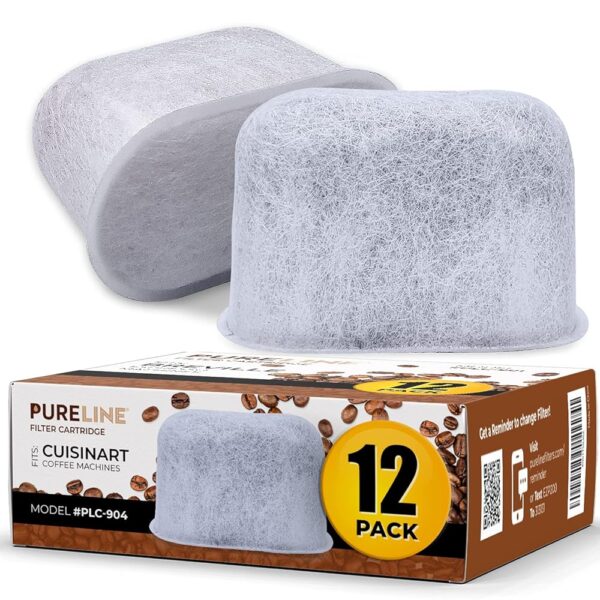
The Pureline PLC-904 is a twelve pack of charcoal water filters for Cuisinart coffee makers, listed at 14.59 dollars, weighing 4.2 ounces for the pack, with a manufacture year of 2020 and a first availability date of July 2020. At roughly one dollar twenty two per filter it is the most expensive of the three Cuisinart compatible carbon packs covered on this site, at nearly double the cheapest.
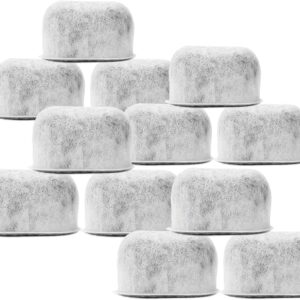
What you are buying is water treatment rather than coffee filtration. The disc clips into a holder inside the reservoir and conditions the water before it reaches the heater and the grounds. The paper or mesh item that holds the coffee is a separate product, covered in the disposable filter listings, and the two get confused constantly because both are sold as filters in packs of a dozen or more.
The NSF Mark and What It Does Not Tell You
The specification block lists an external testing certification of NSF, and that is the most interesting claim on the page because NSF is the relevant body for water treatment in the United States. It is also incomplete in a way that matters.
NSF certification for drinking water treatment units is issued against numbered standards, and the numbers carry the meaning. Standard 42 covers aesthetic effects, which is chlorine, taste and odour, and is what a carbon coffee filter would realistically be tested to. Standard 53 covers health effects such as lead and cysts. Standard 372 covers lead free materials. A product certified to one is not certified to the others.
This listing gives no standard number, no certification number and no scope. NSF on its own could describe a materials certification, an aesthetic effects certification, or a facility registration, and without the number a buyer cannot look it up. It is more than the competing packs offer, but it is not the verifiable claim it first appears to be.
What Carbon Removes, and What It Does Not
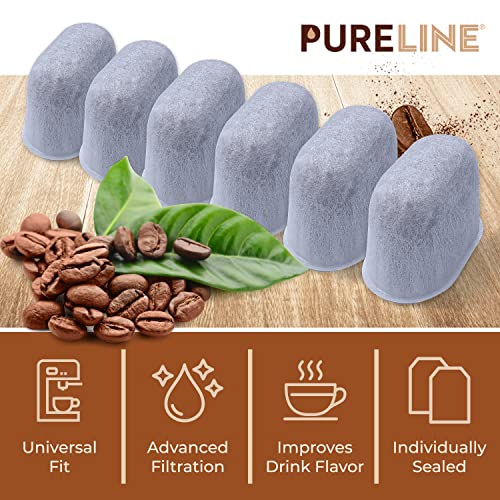
Pureline’s bullets say the filter leaves you with clean, safe, great tasting coffee and that it stops the build up of impurities that could damage your machine. The first half is fair and the second needs qualifying.
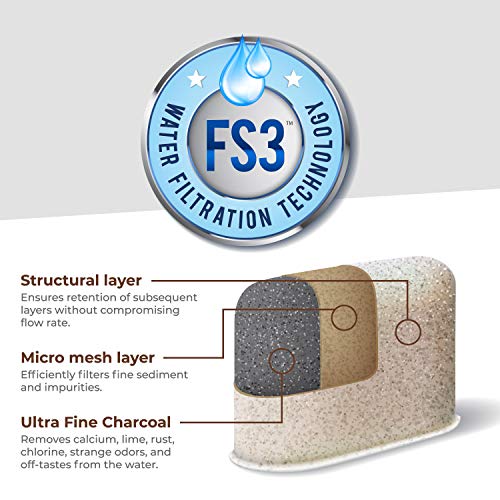
Activated carbon adsorbs chlorine, chloramine and a wide range of organic compounds, which is exactly the set of things that make tap water taste of swimming pool or of nothing pleasant. It does that well and it is why filtered water makes noticeably better coffee. What carbon does not remove is dissolved calcium and magnesium, the ions that constitute water hardness and that precipitate as scale inside a hot machine. Removing those requires ion exchange or reverse osmosis.
So the machine protection claim needs reading carefully. A carbon filter removes chlorine, which is mildly corrosive to some metals and seals over years, and that is a real if modest benefit. It does not prevent scale, which is the failure mode that actually kills drip machines. Descaling remains a separate and necessary job, and the products in the machine cleaning section are what do it.
Compatibility, Stated Very Broadly
Pureline says compatible with all Cuisinart coffee machines, and repeats the claim in the title. That is the broadest compatibility statement of the three packs on this site and it is also the least specific: there is no model list anywhere on the page.
Not every Cuisinart takes a water filter. Machines without a reservoir holder have nowhere to put one, so all Cuisinart coffee machines cannot literally be right, and the competing packs use the more careful phrasing of all Cuisinart machines requiring a filter. In practice the disc format has been consistent across Cuisinart’s filter equipped range for many years, so a machine such as the Cuisinart PerfecTemp DCC-3200 will take any of them. The absence of a list is a documentation gap rather than evidence of a fit problem, but it does leave the owner of an unusual model with nothing to check against.
The title also uses the Cuisinart name twice with a registered trademark symbol attached. Pureline is a third party. Using another company’s registered mark as the leading word of your own product title is common practice in the replacement parts trade, and it is worth understanding that this is not a Cuisinart product and carries no Cuisinart warranty.
The Duplicated Bullet
The manufacturer description on this page has four bullets and two of them are the same bullet. Both are headed Protects the Life of Your Coffee Machine or Brewer, and both say that Pureline’s filter stops the build up of impurities that can eventually cause harm to your machine. The only difference between them is that one ends with the word ruin and the other with the word damage.
That is not a trivial observation. A four bullet description in which half the content is the same sentence twice means the page carries two distinct claims rather than four, and one of those is the taste claim. There is no replacement interval, no filter capacity, no fitting instruction and no materials description anywhere in the text, and the space that could have carried any of them is occupied by a repeated paragraph.
Price, Interval and the Cost That Is Not Stated
Twelve filters at 14.59 dollars is a dollar twenty two each. Whether that is expensive depends entirely on the replacement interval, and this listing does not give one.
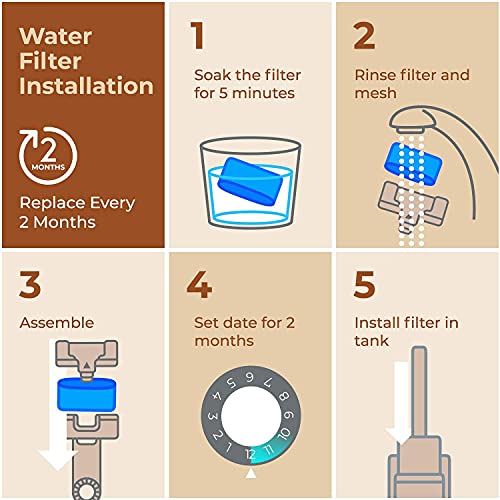
That omission is more consequential than it looks. A competing pack specifying thirty day replacement gives you a year from twelve filters. One specifying two months or sixty tank refills gives you two years. On the same twelve filters that is a difference of a factor of two in annual running cost, and without an interval you cannot calculate Pureline’s at all. Cuisinart’s own general guidance for its filter holders is a change every sixty tank refills or roughly two months, which if applied here puts the annual cost at about seven dollars.
The practical guide is simpler than the numbers. Carbon exhausts by the volume of water it has processed, not by the calendar, and a filter is finished when the water starts tasting of chlorine again. Replacing it anyway is worth doing for hygiene, since an exhausted filter sits damp in a warm reservoir offering no protection at all.
What the Specifications Do Not Settle
The dimensions given, 6.25 inches deep by 6.5 wide by 2.56 high, describe the retail box rather than a filter. The actual disc dimensions, which are the only measurement that determines whether it seats in a holder, appear nowhere. Weight is given twice, as 0.26 pounds and 4.2 ounces, which agree as conversions of each other and describe the pack rather than a filter.
There is no replacement interval, no capacity in gallons or litres, no carbon type and no NSF standard number. There is no country of origin and no warranty. Nothing says whether the filters are individually sealed, which matters because carbon adsorbs from air as well as water and loose packing wastes capacity before use. Buyers who want sealed packaging with a stated interval will find both documented on the Geesta twelve pack at two thirds the price.
Who It Suits and Who Should Look Elsewhere
This suits a Cuisinart owner who wants an NSF mark on the box and is not troubled by paying a premium for it. The compatibility claim is the broadest of the three packs on this site, which suits anyone with an unusual or older machine that does not appear on a competitor’s list, and a twelve pack at under fifteen dollars is still a trivial cost against the machine it serves.
It suits you poorly if you want to verify the certification, since no standard number is given. It suits you poorly if you are comparing running costs, since no replacement interval is stated and the cost per year therefore cannot be worked out. And it suits you poorly if you were hoping a water filter would spare you descaling, because carbon does not touch hardness. Anyone whose machine takes a mesh basket rather than a disc, or who needs coffee filters rather than water filters, should be looking at the reusable filter section instead.