
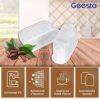

Description
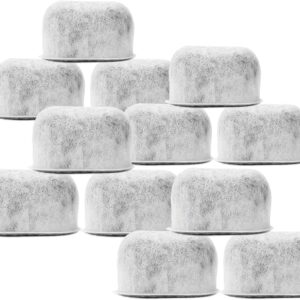
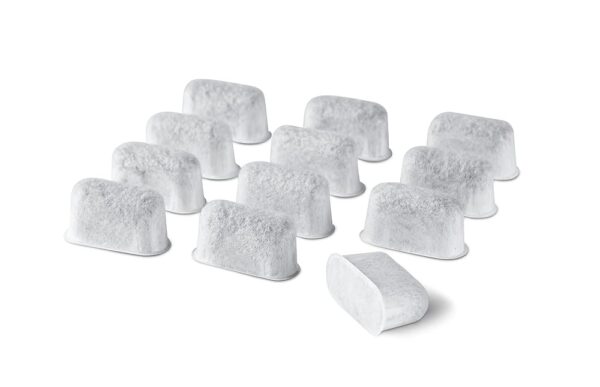
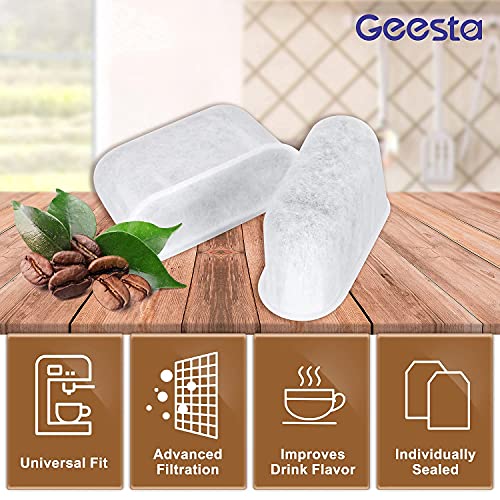
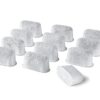
The Geesta Geesta09 is a twelve pack of replacement charcoal water filters for Cuisinart coffee makers, listed at 9.99 dollars, weighing 3.2 ounces for the pack, with each filter individually sealed and supplied in a storage box with instructions. It has been on this listing since May 2017. At around eighty three cents a filter it sits between the two other Cuisinart compatible packs covered on this site.
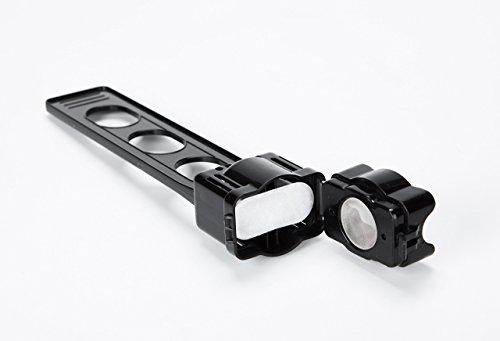
These treat the water, not the coffee. A charcoal filter clips into a plastic holder inside the machine’s reservoir and conditions the water before it reaches the heating element and the grounds. The paper or mesh item that holds the coffee is a different product entirely, and the disposable filter listings cover that. The two are routinely confused because both are called filters and both are sold in packs.
What Carbon Does, and the Calcium Claim
Activated carbon removes things by adsorption. Organic molecules and dissolved gases stick to a very large internal surface area as the water passes through, and it is genuinely effective against chlorine and chloramine, which are the main sources of off taste in treated tap water, and against the organic compounds that make water taste musty.
Geesta’s copy says the filters reduce impurities, calcium, chlorine and odours. Three of those four are fair. Calcium is not. Dissolved calcium and magnesium are the ions that make water hard, and carbon does not remove them; that requires ion exchange resin or reverse osmosis. A carbon filter passes hardness straight through.
The consequence matters for planning. A buyer who reads that claim might conclude the filter protects the machine from scale, and it does not. Descaling remains a separate job on the same schedule it always was, and the products in the descaler and cleaner section handle the part the filter cannot. What the filter genuinely delivers is better tasting water, which is worth having on its own.
Individual Sealing, and Why It Is Not Just Packaging
Geesta’s smart packaging bullet is the most substantive thing on this listing, and it is easy to dismiss as marketing. Each filter is individually packaged and sealed, and the twelve arrive in a box designed to protect them in storage, with an instruction sheet included.
That matters because of how carbon works. Activated carbon adsorbs from air as readily as from water, and a filter left open on a shelf gradually loads itself with whatever is in the kitchen: cooking vapours, cleaning products, ordinary humidity. By the time it goes into the reservoir, part of its capacity is already used up on things you never asked it to remove. A pack of twelve that will be consumed over a year is exactly the case where sealing each one individually makes a measurable difference, and packs that ship loose in a bag do not offer it.
The storage box and the instruction sheet are lesser points but they are more than the competition offers. Instructions in particular are worth having, because the correct procedure includes soaking a new filter before fitting it, which purges loose carbon dust and stops the first pot tasting gritty.
The 60 Refill Interval
Geesta specifies replacement every two months or every sixty water tank refills, whichever comes first, and more often in hard water. That is a considerably longer interval than the thirty days some competing packs specify, and it is stated in a more useful way.
Sixty tank refills is the better of the two measures, because carbon exhausts by the volume of water it has processed rather than by the calendar. A household running twelve cups a day exhausts a filter far faster than one brewing at weekends, and a fixed monthly interval either wastes filters for the light user or leaves the heavy user with an exhausted one. Counting refills tracks the actual load.
Twelve filters at two months each is two years of supply at ten dollars, which works out at five dollars a year. That is the cheapest running cost of the three Cuisinart compatible packs on this site once the interval is taken into account, even though the pack price is not the lowest.
The WRAS Certification, and What It Covers
The specification block lists an external testing certification of WRAS. That is worth explaining rather than repeating, because it sounds more relevant to filtration than it is.
WRAS is the Water Regulations Advisory Scheme, a British body that approves materials and fittings for contact with drinking water. An approval confirms that the materials do not contaminate water they touch, do not encourage microbial growth and do not impart taste or odour of their own. It is a materials safety approval. It says nothing about how much chlorine the filter removes or how long it lasts.
That is still meaningful. Knowing the housing and media are approved for potable water contact is a real assurance on a product that sits in your reservoir for two months at a time. But it is not evidence of filtration performance, and the two kinds of mark answer different questions.
Compatibility and the Fields That Disagree
Compatibility is stated by series rather than by model number: Cuisinart Coffee Grind and Brew, Burr Grind and Brew, Single Cup Grind and Brew, Programmable and PerfecTemp coffeemaker series. That is broad and easy to check against your own machine, and it covers the machines most likely to have a filter holder, including the grinder equipped models such as the Cuisinart DGB-800 Burr Grind and Brew.
The specification fields are less consistent. Number of items reads 1 while number of pieces reads 12 and unit count reads 12.0 count, so the same pack is described as one item and as twelve within a few lines. Batteries included and batteries required both read No, on a carbon disc with no electrical function. Colour reads White, which describes the outer casing rather than the black carbon inside it. Weight is given twice, as 0.09 kilograms and as 3.2 ounces, which are the same figure in two units and at least agree with each other.
What the Specifications Do Not Settle
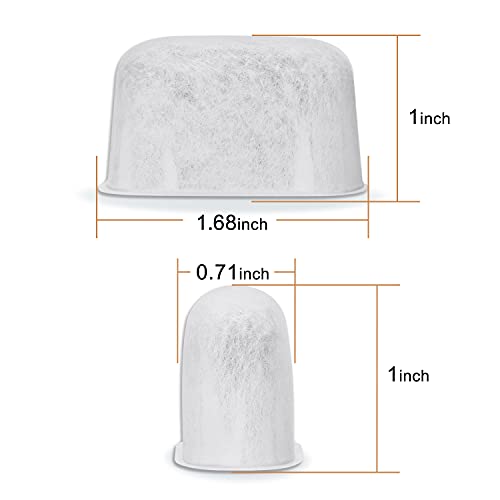
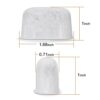
The filter dimensions given, 0.71 inches deep by 1.68 wide by 1 high, appear to describe a single filter rather than the box, which is more useful than the packaging measurements some competitors publish. What is missing is the carbon type, the treated volume capacity in gallons or litres, and any statement of how much chlorine is removed.
There is no country of origin. There is no warranty. Nothing states whether the filters fit the older or newer Cuisinart holder design, and Cuisinart has used more than one over the years. Nothing confirms the shelf life of a sealed filter, which is the natural follow up question once individual sealing is presented as a feature. And nothing says what to do with an exhausted filter, which on a carbon and plastic assembly is a fair question.
Who It Suits and Who Should Look Elsewhere
This suits an owner of a Cuisinart in one of the named series who wants two years of filters for ten dollars and prefers them sealed. The individual packaging is a genuine functional advantage rather than a presentation one, the sixty refill interval is a more honest measure than a calendar month, and a materials approval for potable water contact is more assurance than most packs at this price offer. The Brensten charcoal water filters are the other multi pack for the same holders.
It suits you poorly if you need model level compatibility confirmation rather than series level, or if you want a filtration performance standard rather than a materials one. It suits you poorly if you were buying it to stop scale, which carbon cannot do. And if your machine takes a Keurig style filter rather than a Cuisinart one, none of these fit; the parts and accessories section is the place to check which holder your brewer uses. The PureLine PLC-904 is the other charcoal filter covered here, and the holder it suits is worth confirming first.