




Description
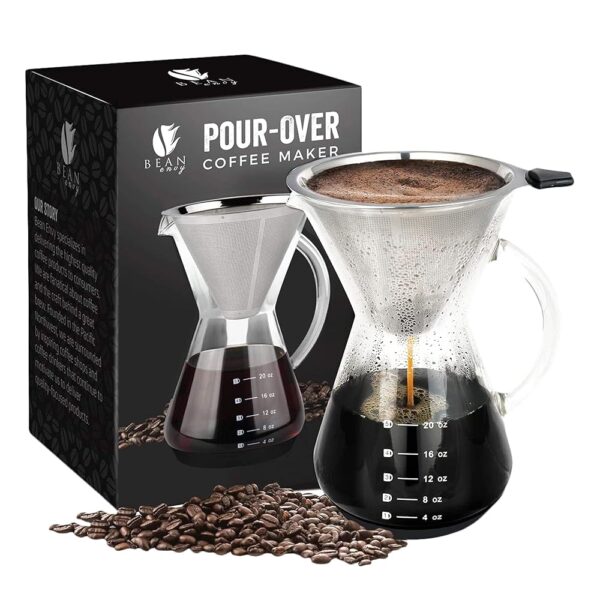
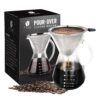
The Bean Envy LLTIFP03 is a two piece manual pour over set: a borosilicate glass carafe with a silicone sleeve around the base, and a laser cut stainless steel mesh dripper that sits on top of it. It is listed at 31.98 dollars, weighs 1.59 pounds, is made in China and has been on this listing since January 2018. Bean Envy describes the capacity as five cups and never once says how many ounces that is.
That omission is the first thing to deal with, because five cups means nothing on its own. Bodum counts a pour over cup as four ounces. Drip machine manufacturers count five. Chemex counts five. If Bean Envy is using the same convention as its nearest competitors, five cups is somewhere between twenty and twenty five ounces, which is one large mug and a refill rather than a brew for a table of people. The listing does not resolve it, and anyone choosing between this and a stated volume brewer such as the 34 ounce COSORI pour over is comparing a number against a guess.
The Laser Cut Mesh and What Paperless Brewing Changes
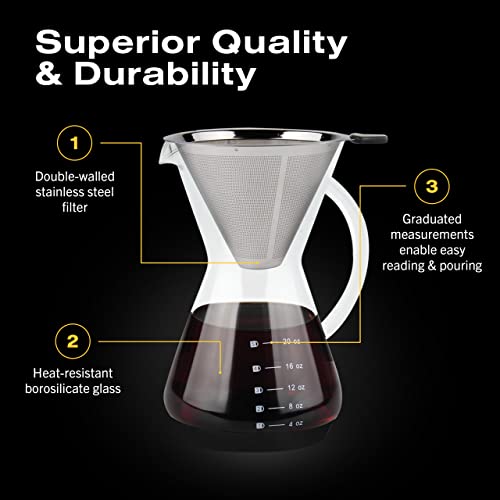
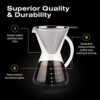
The dripper is a stainless steel micro mesh cone, laser cut rather than woven, which Bean Envy presents as its central advantage. Laser cutting produces uniformly sized holes in a solid sheet, where a woven mesh has openings that vary with the weave and can distort. In principle that gives more predictable flow and more consistent particle retention.
What it does not do is make the coffee taste like paper filtered coffee. Metal passes the oils and the finest solids that paper traps, so the cup has more body, more aroma and a visible haze, with some sediment settling at the bottom. Bean Envy’s copy claims single use filters strip flavour, which is one way to describe it; a cleaner cup is another. Both descriptions are of the same physical difference. Readers who prefer the clean end of that spectrum are better served by a paper design, and the paper filter section covers the shapes that fit standard cones.
Grind and Dose
Because the mesh openings are larger than paper pores, grind size is the variable that decides whether this brewer works for you. Too fine and the fines pass into the cup as silt; too coarse and water runs through before it has extracted anything, giving a thin and sour result. A medium coarse grind from a burr grinder is the target, and a blade grinder will fight you because it produces both extremes at once.
The listing gives no dose recommendation, no ratio and no brew time, which is a real gap on a product sold to people who are new to manual brewing. Coffee input type is recorded as ground coffee, which is the only guidance offered. A starting point of roughly sixty grams of coffee per litre of water is the widely used convention, but that is general practice rather than anything Bean Envy publishes.
The Carafe, the Sleeve and the Kettle That Is Not Included
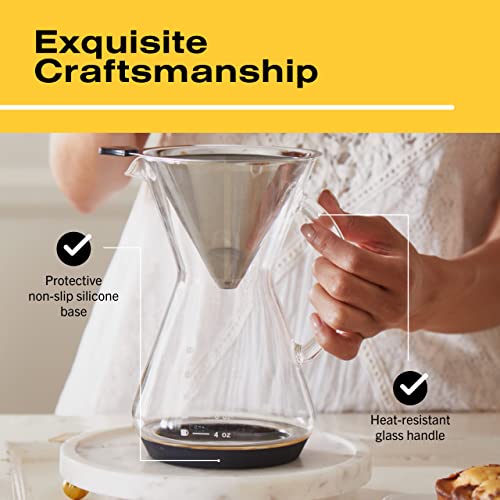
The carafe is borosilicate, described as thick, non porous and resistant to absorbing odours or chemical residues. Borosilicate is the right material for a vessel that takes near boiling water by hand, because its low thermal expansion tolerates sudden temperature change. Bean Envy adds a patent pending silicone sleeve around the base, which serves as a grip, as insulation for your hand, and as protection for the counter.
The sleeve is also the reason to look closely at the dimensions. They are given as 5.25 inches deep by 8.5 inches wide by 5.25 inches high. A 5.25 inch tall carafe that is 8.5 inches wide is a very squat shape, and the width figure most likely includes the dripper sitting on top or the handle. As with the height, the listing does not distinguish between the assembled set and the carafe alone.
One line in the manufacturer description deserves flagging plainly. It instructs you to pour hot water using your Bean Envy Pour Over Coffee Kettle. No kettle is included. Included components are listed as filter and carafe, and the kettle is a separate product. The instructions are written as though you already own it, which is a sales device rather than a description of what arrives in the box.
Cleaning and Longevity
A metal mesh filter holds coffee oils in and around every opening, and those oils turn rancid within days at room temperature. This is the maintenance reality of every paperless brewer and it is the reason some owners conclude the format tastes stale when in fact the filter does. Rinsing under a tap does not remove oil. Detergent, a soft brush or a periodic soak does.
The listing does not say whether the dripper or the carafe is dishwasher safe, which is a straightforward omission on a product whose main ongoing task is degreasing. It also does not say whether the silicone sleeve is removable, and a sleeve that cannot come off is a place for coffee to collect. Against the fully documented cleaning instructions on brewers like the Bodum 34 ounce pour over, this page is noticeably thinner.
Specification Errors on This Listing
The most obvious one is the coffee filter size field, which reads number 2. That is a cone paper filter format, and this brewer takes no paper at all. The whole selling proposition is that it is paperless. The field is a leftover from a paper dripper template and contradicts both the special feature entry, which reads Reusable Filter, and the filter type entry, which reads Reusable.
Style is recorded as Pour Over Coffee Maker and specific uses as Coffee maker, both of which restate the product name rather than describing anything. Colour is listed as Stainless Steel on a product whose visible body is clear glass with a black sleeve, which is the dripper colour standing in for the whole set. None of these affect how the brewer works, but together they mean the specification block was assembled from a template rather than checked, and the missing ounce capacity is part of the same carelessness.
What the Specifications Do Not Settle
Capacity in ounces is the headline absence, and it is the number most buyers need. Beyond that there is no mesh fineness figure, no glass thickness, no temperature rating for the carafe or the sleeve, and no brew time. There is no statement of whether replacement dripper mesh is available, which matters on a part that is the only thing standing between the grounds and your cup.
There is no warranty length. The buy with confidence bullet directs dissatisfied owners to contact the seller through the marketplace messaging system, which is a returns process rather than a warranty. Nothing addresses whether the dripper fits other vessels, which is a reasonable question given that a cone dripper is a fairly universal shape and would extend the product’s usefulness considerably.
Who It Suits and Who Should Look Elsewhere
This suits a solo drinker or a couple who want a full bodied, oil rich cup, like the idea of never buying filters, and are happy to own a burr grinder. The silicone sleeve is a genuinely thoughtful addition on a glass carafe, and laser cut mesh is a real manufacturing difference rather than a slogan. At around thirty dollars for carafe and dripper together it is fairly priced against the field. The Primula Park pour over set is the closest rival with a larger carafe.
It suits you poorly if you want a clean cup with no sediment, if you grind with a blade grinder, or if you need to know exactly how much coffee you are making before you buy. It also suits you poorly if you want brewing that keeps its heat, since a single glass carafe with a sleeve is not insulated in any meaningful sense. Anyone brewing for four or more people at once should be looking at a larger vessel from the pour over range rather than making two rounds with this one. The Chemex CM-8A is the eight cup vessel to move up to.