Description
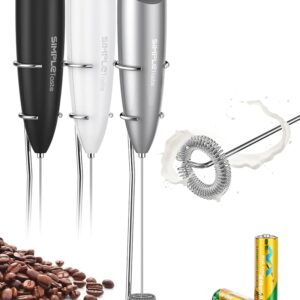
The Bonsenkitchen MF8712-NEW is a handheld milk frother built to the pattern the whole category shares: a plastic housing containing a small motor, a switch and two AA cells, with a stainless steel shaft and coiled whisk projecting from it. The listing dates the product to October 2017, which makes it one of the longer running entries in a category where most items are a season old.
What separates one wand from another at this level is rarely the motor. It is the length of the shaft, the mass of the tool, whether cells and a stand are supplied, and how much of that is disclosed before purchase. On the first of those this model is the shortest reaching wand covered here, and on the second it is the lightest, both of which have practical consequences that the marketing copy does not mention.
Shaft Length and Reach
The listed dimensions are 1.5 inches wide by 9.4 inches high, and the item weight is 2.82 ounces. Nearly all of that overall length is housing and shaft, with the whisk head accounting for the 1.5 inch width. The usable reach, meaning how far the coil can go below the rim of a vessel while the housing stays dry, is shorter than the 9.4 inch figure suggests. At 2.82 ounces this is also the lightest wand covered here, which makes it comfortable to hold through a long mix and easy to sweep off a counter.
That matters for anyone frothing directly in a tall travel mug or a large jug, where the whisk needs to sit near the bottom of a deep column of milk. In a standard mug or a small pitcher it is a non issue. Buyers who intend to froth in taller vessels should compare against longer wands such as the FrothBlast 44 or the BASECENT BC021 before choosing on price alone.
The Ten Watt Claim
The specification block gives the wattage as 10 watts. Unlike the wands in this category that print a motor speed in the power field, this is at least presented in the right units, but the number still does not survive scrutiny. Two AA alkaline cells supply 3 volts nominal, so a genuine 10 watt draw would require better than 3 amps continuously. Alkaline AA cells cannot deliver that; their internal resistance causes the voltage to collapse long before that current is reached.
The realistic figure for a wand of this construction is a few watts at most. The 10 watt entry should be read as a nominal rating rather than a measured draw, in the same way that a stated motor speed is an unloaded figure rather than what the whisk turns at in milk. Neither number lets a buyer predict performance, which is the problem with the entire category rather than with this listing alone. What would actually be useful is a measured current draw or a loaded torque figure, and no wand listing in this category publishes either.
What Is in the Box and What Is Not
The included components field lists a user manual and the frother itself. The power source field reads Battery Operated followed by a parenthetical noting that batteries are not included, which is a stock note pasted into a field meant to record a power type. Taken together the box contains the wand and a leaflet: no cells, no stand.
Both omissions have a cost. Two AA cells are trivial to buy but have to be on hand before the tool can be used at all, and the absence of a stand means a wet, top heavy wand needs somewhere to live. Competing wands at very similar prices include one or both, among them the SIMPLETaste 706-0001, so the comparison is worth making explicitly rather than assuming parity across a category where the photographs all look alike. Cells and a holder are a first day inconvenience rather than a hidden expense, but a buyer who orders this wand alone cannot use it on the day it arrives.
Cleaning and Material Care
The care instruction is hand wash only, which is the correct handling for any tool with a motor and battery contacts in the handle. In practice cleaning means spinning the whisk in a mug of warm soapy water for a few seconds and rinsing, immediately after use rather than later, because milk proteins bond to steel as they dry and become far harder to shift.
The material field lists stainless steel and plastic, correctly identifying that this is a two material product rather than the all steel tool some listings in the category imply. No steel grade is given, which is the detail that would indicate how the coil holds up to repeated wetting; the difference between grades shows as pitting after a year rather than on day one. Drying the coil after a rinse does more for its working life than the grade does, since it is standing water trapped between the loops that eventually marks steel.
What the Specifications Do Not Settle
The model name is given as MF8712-NEW while the item model number field reads simply FROTHER. One of those is a model designation and the other is a category, and a buyer trying to match a spare, a review or an owner report to a specific product has to work with both. Nothing on the page resolves which is authoritative.
No motor speed is published, no run time, no noise figure and no whisk diameter. The listing does not state whether the shaft seal is rated for submersion, whether a replacement whisk can be obtained, or what warranty applies. As with every wand in this category, the questions that decide whether the tool lasts a year are the ones the specification block does not touch, while the fields it does fill are largely marketing adjectives. The special feature entry, for example, consists of five capitalized phrases about being lightweight and compact.
Who It Suits and Who Should Look Elsewhere
This wand suits a buyer working in ordinary mugs and small jugs who wants foam on drip or pod coffee, and it suits powder mixing particularly well, since matcha and cocoa need dispersion rather than reach. Its low weight makes it easy to pack for travel, and the long listing history means the design is a known quantity rather than a new arrival. The small equipment catalogue on this site covers a dozen near identical alternatives for anyone comparing on included accessories.
It is the wrong choice for deep vessels, for anyone who wants cells and a stand in the box, and for anyone chasing pourable microfoam. That last group should be reading about machines with steam arms instead, where milk is heated and textured in one operation and the specification blocks, whatever else they get wrong, at least publish a boiler.