Description
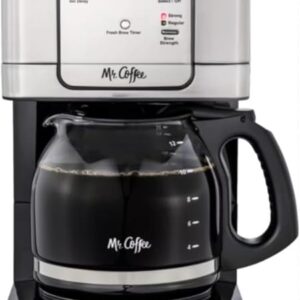
The Cuisinart DCC-3200C is a 14 cup programmable drip machine in a black and stainless finish, sold with a permanent filter and a timer. It belongs to the DCC-3200 family, which is one of the most widely owned drip machine designs in the American market, and the C suffix denotes a variant of that platform rather than a different machine.
The unusual thing about this listing is how little of it there is. The manufacturer description field is completely empty, the product title carries no brand name at all, and the specification table is thinner than for almost anything else in this catalogue. What follows is therefore built from what the fields do say, with the gaps named rather than filled in.
A Listing With No Description
This deserves stating plainly at the top. The recorded manufacturer description for this product contains nothing. Not a short paragraph, not a bullet list, nothing at all. The product title reads simply as a 14 cup black and stainless steel permanent filter coffee maker with timer, with no brand in it, while the brand field says Cuisinart and the model number field says DCC-3200C.
The practical consequence is that the feature set has to be inferred from the attribute table rather than read from the manufacturer. What the table confirms is a timer, programmability, a permanent filter, a reusable filter type, a stainless steel exterior and a carafe. What it does not confirm is brew strength control, a small batch setting, a self clean cycle, an auto shutoff interval or a brew pause, all of which appear on the closely related Cuisinart DCC-3200 PerfecTemp. Do not assume this variant has them without checking the manufacturer listing.
The Permanent Filter
The clearest difference between this listing and the related PerfecTemp entry is the filter. Here the included components field lists a filter alongside the carafe, and both the special features and the filter type fields confirm a permanent reusable filter. On the PerfecTemp listing the filter type is recorded as paper with no filter in the box.
A permanent filter removes the recurring cost of paper entirely, which over a machine of this size and a few years is a real saving. It also changes the coffee, and that is the part worth understanding. A mesh filter lets the coffee oils through where paper traps them, so the cup has more body and a heavier mouthfeel, and it lets fine particles through, which can leave a little sediment. Some people prefer that and some find it muddy. If you decide you want the cleaner, lighter cup paper produces, the disposable filters we cover include the standard basket size, but check the shape of the holder first since cone and basket papers are not interchangeable.
Capacity and What 14 Cups Means
Fourteen cups at the standard American carafe measure of five ounces is around 70 ounces, so a full pot is five or six mug sized servings rather than fourteen. That places this machine at the household or small office end of the range.
It is worth being realistic about whether you need that. A large carafe brewed and then left is a large carafe stewing on a warming plate, and the coffee at the bottom of a 14 cup pot two hours later is not the same drink that came out at the start. If two people drink two mugs each, a 10 cup machine is a better match and there is less waste. If you are brewing for a table, the capacity is exactly the point.
The Dimension Ordering Problem
The recorded product dimensions read 7.8 by 14 by 9 inches, given without axis labels. That is unusual and it matters, because the middle figure is the largest.
Cross referencing the related model, whose dimensions are recorded properly as 7.75 inches deep, 9 inches wide and 14 inches high, resolves it: the 14 inch figure here is the height and the 9 inch figure is the width, so the sequence is depth, height, width rather than the conventional depth, width, height. In practical terms this is a machine roughly 8 inches deep, 9 inches wide and 14 inches high, which is a compact footprint for a 14 cup brewer. The 8.23 pound weight is consistent with a plastic body and a stainless facing.
The Warming Plate Question
The listing does not describe the carafe material or the warming plate, but the combination of a 14 cup capacity, a glass carafe design in this family and a stainless finish means a glass carafe on a heated plate.
That is the standard arrangement at this price and it carries the standard drawback. Coffee sitting on a hot plate continues cooking, and within an hour the aromatics have gone and a flat bitterness has developed. If the pot regularly sits, a thermal carafe machine such as the BUNN Speed Brew Thermal holds heat without applying it and is the proper answer. The auto shutoff interval, which is your only control over how long the plate runs, is not stated in this listing.
Descaling and Maintenance
Scale is the failure mode for every drip machine. It narrows the internal water path, which is why a scaled machine brews slowly and delivers a short pot, and it insulates the heating element, so the water arrives cooler and the coffee tastes weak.
Whether this variant includes a self clean cycle is not stated. If it does not, descaling is manual: fill the reservoir with a descaling solution, run a cycle with no filter in place, then run two full reservoirs of plain water to rinse thoroughly. Set the interval by your water hardness rather than by the calendar, and treat a slowing pour as the signal. Any of the descaling products we cover will do the job, and a tablet is the least fiddly option since there is nothing to measure. The permanent filter also needs its own attention, since a mesh basket accumulates oils that a rinse under the tap does not remove.
What the Specifications Do Not Settle
Almost everything. No brew temperature. No wattage. No brew time. No water reservoir capacity in ounces. No auto shutoff interval. No confirmation of brew strength control, a small batch mode, a brew pause or a self clean cycle. No carafe material. No warranty term. No description of the shower head or how evenly water reaches the grounds.
The colour field reads Stainless Steel while the product title says black and stainless, which is a minor conflict but a real one if the finish matters to you. The only firm dates here are a first availability of July 2017, which tells you the design is long established, and a large body of published owner feedback exists for the DCC-3200 family as a whole.
Who It Suits
This suits a household or office that gets through a large pot, wants a machine from a long established family rather than a new design, and specifically wants the permanent filter included so there is nothing recurring to buy. The DCC-3200 platform has been on sale long enough that replacement carafes and published owner feedback are both easy to find.
The caution is the listing rather than the machine. With no description published, you cannot confirm from this page which of the family features this variant carries, so check the manufacturer specification before ordering if brew strength control or a small batch setting matters to you. And if only one or two people drink coffee, 14 cups is capacity you will never use; something smaller from the drip coffee maker range wastes far less.