Description
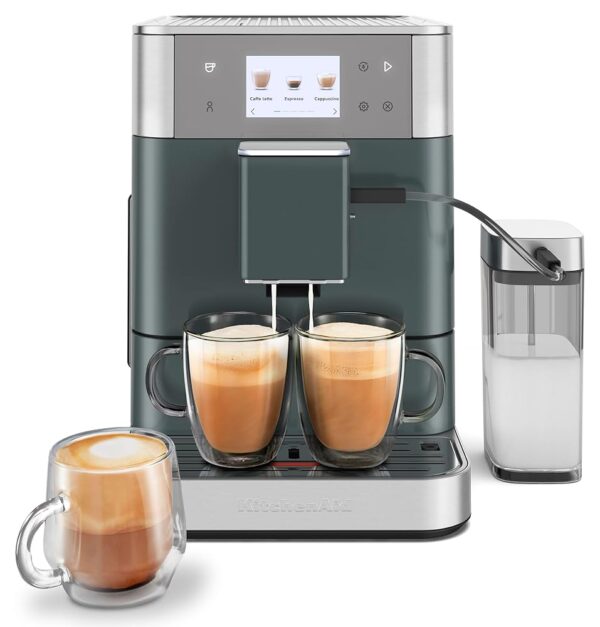
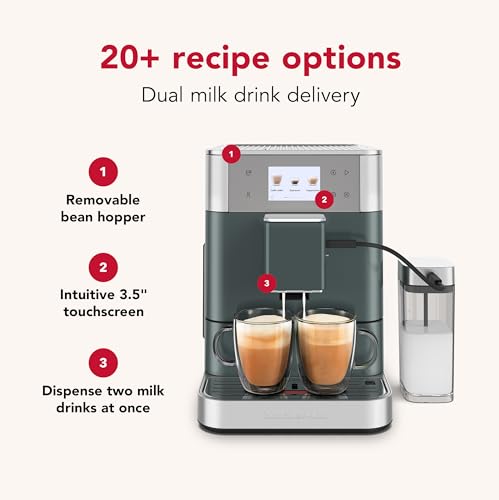
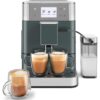
The KitchenAid KES8557JP, sold as the KF7, is a fully automatic bean to cup espresso machine. Whole beans go in a removable hopper, the machine grinds, doses, tamps and extracts internally, and a menu of more than twenty drinks is selected from a touchscreen. There is no portafilter to fill and no puck to knock out.
That is a fundamentally different ownership experience from a machine with a group head, and it is the main thing to be clear about before considering anything else. A super automatic trades away control in exchange for repeatability and speed. You cannot adjust the tamp, you cannot swap baskets, and you cannot pull a shot by feel. What you get is the same drink every time at the press of a button, which for a household where several people want different drinks in the same ten minutes is worth a great deal.
Grinder and Dosing
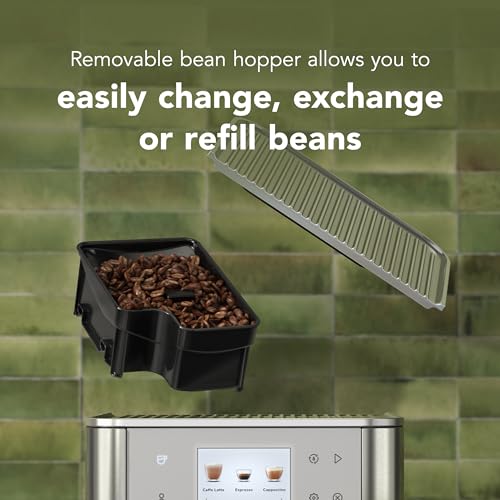
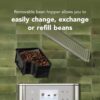
The machine has an integrated grinder fed from a removable bean hopper, described as twist and lift so you can empty, swap or refill the beans. A removable hopper is more useful than it sounds. On most bean to cup machines the hopper is fixed, so switching between a decaf and a regular bean means running the grinder empty or living with a mixed dose.
KitchenAid describes the dosing as automatic smart dosing, producing the right grind volume and consistency for each drink selection without you weighing anything. What the recorded specification does not give is the number of grind settings, which is the figure that tells you how much adjustment you actually have. It also does not say whether the burrs are conical or flat, or what they are made from, and on a machine at this level those are reasonable questions. A machine with a portafilter such as the Ninja ES601 publishes its grind step count precisely because the user is expected to change it.
The Drink Menu
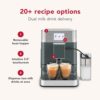
More than twenty recipes are offered, with espresso, Americano, latte and cappuccino named specifically. On a super automatic the recipe list is the interface: each entry is a stored combination of grind dose, water volume, milk volume and sequence, and selecting one runs the whole sequence unattended.
The practical value depends on how many of those twenty you will actually use. Most households settle on two or three. What matters more is whether the individual parameters can be adjusted and saved, because a stored latte that is too milky for your taste is only useful if you can change it. The recorded data does not say whether the recipes are editable, which is a significant gap on a machine sold on its recipe count.
The Milk System
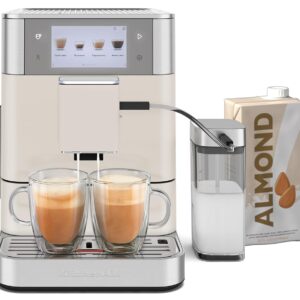
This is the most distinctive design decision on the machine and it deserves attention. Rather than a supplied milk carafe that clips onto the body, the KF7 uses a milk tube that you place into a container of your choice. The dual drink delivery system then draws milk, heats and froths it automatically, delivering the exact quantity the selected drink calls for.
The advantage is obvious: you can draw straight from the milk carton or bottle, so there is no carafe to fill, no carafe to store in the fridge and no carafe to wash. The disadvantage is equally real. A tube that carries milk needs flushing after every session, because milk residue in a warm tube is the least pleasant maintenance failure in the whole coffee appliance world. Machines with a carafe usually have an automated rinse cycle that runs into the drip tray; a tube system needs the same discipline and the recorded data does not describe how it is cleaned. Against a carafe based super automatic such as the Jura E6, this is a genuine design difference rather than a detail.
Build, Size and Origin
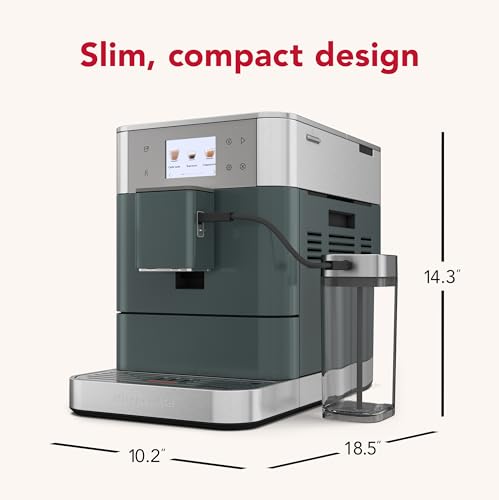
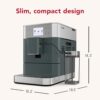
The recorded dimensions are 18.5 inches deep, 10.2 inches wide and 14.3 inches high, with an item weight of 40.4 pounds. Ten inches wide is narrow for a bean to cup machine, and the depth is where the boiler, the grinder and the brew unit have gone instead. The height figure does not include clearance to fill the hopper, and the depth means it will not sit under a standard wall cupboard with the lid opening freely.
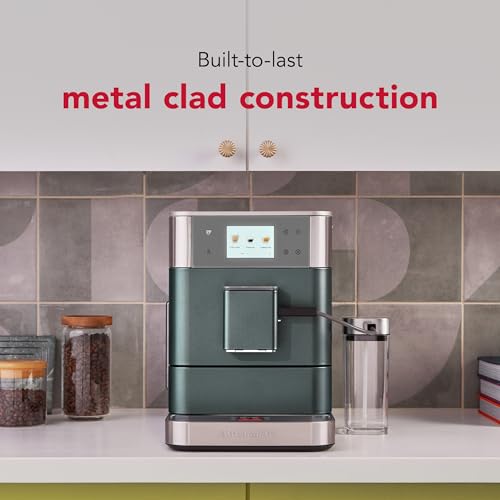
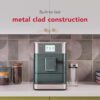
At 40.4 pounds this is not a machine you move around. KitchenAid describes the construction as metal clad, which on this class of appliance usually means metal panels over an internal chassis rather than a solid metal body. The recorded country of origin is Switzerland, which is notable because Switzerland is where most of the established super automatic platforms are engineered, and it is a stronger signal about the internals than any marketing line in the listing.
Water, Filtration and Maintenance
The included components list is specific: a removable bean hopper, a 2.2 litre water tank, a milk tube, two brew unit cleaning tablets and a water filter. Two and a bit litres is a large tank and it matches the machine positioning, since a super automatic serving a household gets through water quickly.
Including a water filter and cleaning tablets in the box tells you what the maintenance regime looks like. The filter reduces the mineral content before the water is heated, which slows scale formation rather than preventing it. The brew unit tablets clean coffee oils from the internal brewing group, which is a part you never see on a super automatic and which absolutely needs cleaning. An auto clean function is listed among the special features, though the data does not describe what it covers. Descaling remains a separate periodic job, and the descaling products we cover handle it once the supplied consumables run out.
What the Specifications Do Not Settle
No pump pressure figure in bars is published. No grind setting count. No burr type or material. No bean hopper capacity. No boiler or thermoblock description and no heat up time. No statement of whether the brew unit is removable for cleaning, which is one of the most important practical differences between super automatic designs and determines how much of the maintenance you can do yourself.
Nothing says whether drink recipes are editable or fixed. Nothing gives the milk tube length, which determines whether it reaches into a fridge or only into a jug beside the machine. And this is a recent model with a correspondingly small body of published owner feedback, so long term reliability reporting is thin compared with the established Swiss and Italian platforms in the super automatic range we cover.
Who It Suits
This suits a household that drinks several different milk based coffees a day and wants them without instruction, practice or cleanup between drinks. The removable hopper is genuinely useful if more than one bean lives in the kitchen, the narrow footprint is unusual for the category, and drawing milk straight from the bottle removes the carafe chore entirely. The KitchenAid KES8558PL is the sibling listing in the same range.
It is the wrong machine for somebody who wants to learn espresso, because a super automatic hides every variable you would want to adjust. A machine with a portafilter and a proper grinder will teach you more and produce a better shot in skilled hands for less money. It is also a poor fit for anyone unwilling to keep on top of the milk tube, since that is the part of this design that punishes neglect fastest. The KitchenAid KES6503 is the portafilter machine from the same brand.