
Description
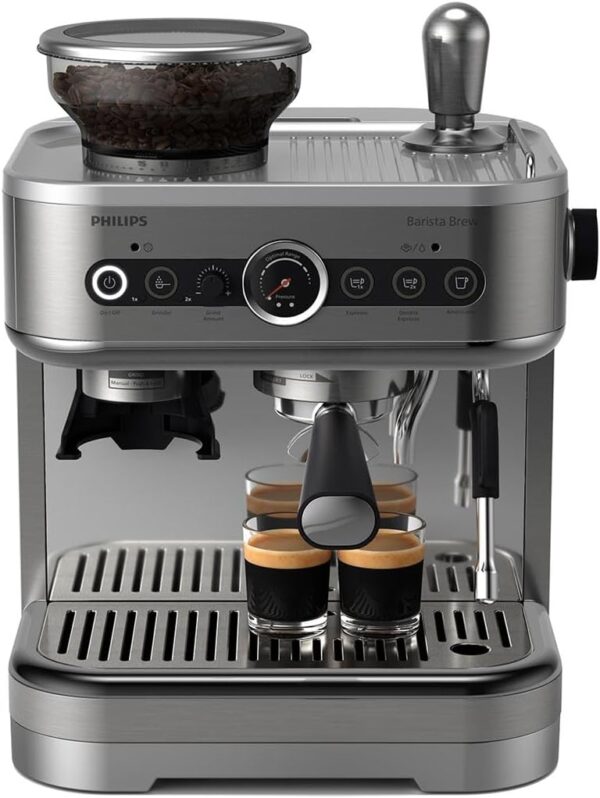
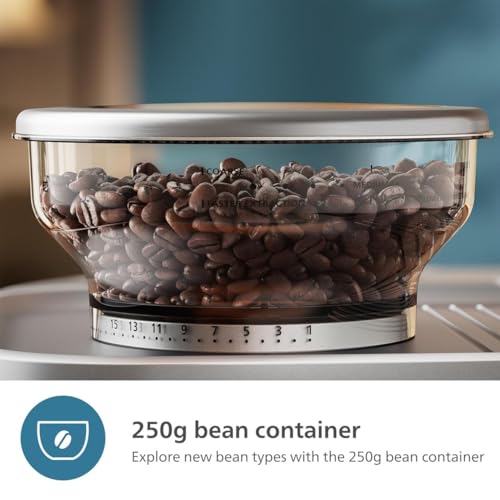
The Philips Barista Brew PSA3218 is a semi automatic espresso machine with an integrated grinder, and unlike almost everything at its price it uses a 58 mm portafilter. Philips supplies single and dual wall filter baskets in one and two cup sizes, a calibrated stainless steel tamper with a countertop safe tamping system, a 250 gram bean container, a 450 ml stainless milk jug with a temperature indicator, a steam wand, an Americano button and an integrated hot water outlet.
Philips is far better known for its fully automatic bean to cup machines, so a portafilter machine from the same brand is worth attention. This is a different proposition entirely: the operator grinds, doses, tamps and steams, and the machine provides the hardware and some guidance rather than doing the work. The 58 mm commercial standard portafilter is the specification that gives it long term credibility.
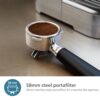
The 58 mm Portafilter and Baskets
Fifty eight millimetres is the diameter used by commercial espresso machines, and domestic machines below the mid range almost never adopt it. The practical consequence is that bottomless portafilters, precision baskets, distribution tools and puck screens made for professional machines all fit, which gives the machine an upgrade path that 51 mm and 54 mm designs do not have.
Philips supplies both single wall and dual wall baskets in one and two cup sizes. That is the right decision: dual wall baskets create back pressure artificially and produce crema from any grind, suiting pre ground coffee, while single wall baskets require a properly dialled grind and reward it. Having both means the machine works on day one and still has headroom once the grinder is understood. The CASABREWS Ultra and the KitchenAid KES6503 are the other 58 mm machines on this site worth comparing.
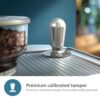
The Calibrated Tamper and Tamping System
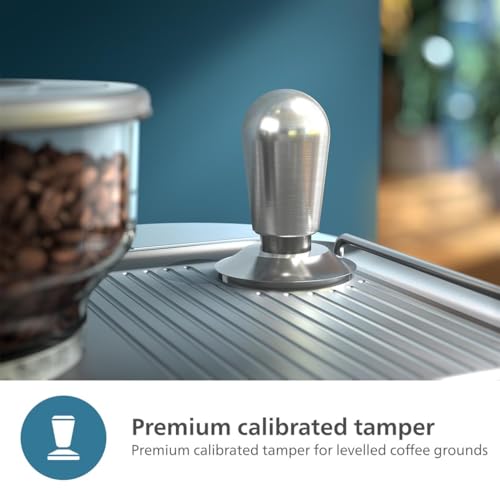
A calibrated tamper is one that releases or clicks at a set pressure, so the operator applies the same force every time rather than guessing. Inconsistent tamp pressure is one of the two variables beginners most often get wrong, the other being dose, and a calibrated tamper addresses it without the machine needing a mechanical lever.
Philips pairs it with what it calls a countertop safe tamping system, which in practice means a surface or stand that supports the portafilter while tamping so the spouts are not resting on the counter. That is a small thing that makes a real difference, because an unstable portafilter produces an angled puck and an angled puck channels. A powder ring is also supplied to stop grounds spraying past the basket during grinding, though owner feedback describes it as flimsy.
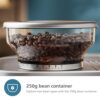
The 250 Gram Bean Container and Grinder
The 250 gram bean container is modest by design. A large hopper simply means beans sitting exposed to air for longer, and 250 grams is roughly a small retail bag, which is about the right turnover for freshness.
What the listing does not provide is the grinder specification: no burr material, no number of grind settings and no dose control method. Philips says grind size and coffee strength can be adjusted, but the range and granularity are unstated. That is a significant gap on a machine whose main claim is that it grinds fresh for every shot, and it is the one thing a buyer would most want confirmed before choosing it over a bare machine plus a standalone grinder.
Milk, Steam and the Americano Button
A steam wand handles milk, supplied with a 450 ml stainless jug that carries a temperature indicator. That thermometer is a genuinely useful inclusion for a learner, because milk texture depends on stopping at the right temperature and judging it by hand takes practice. Most machines leave you to buy a thermometer separately.
A dedicated Americano button and a separate hot water outlet mean long black coffee can be made at the correct dilution without a kettle, and cups can be preheated, which affects the temperature of a finished espresso more than most people expect. Owner feedback reports that the steam wand is loud in operation, which is characteristic of a powerful steam system rather than a fault.
Hot Water, Cleaning and Daily Handling
The integrated hot water outlet is separate from the steam wand, which is a better arrangement than machines that make you switch one wand between functions. It means an americano can be topped up without pushing extra water through the coffee, and cups can be preheated properly, which changes the temperature of a finished espresso more than most people expect.
Philips supplies cleaning tools and an espresso stand for resting the portafilter. The routine on a machine with an integrated grinder has three parts: clear coffee oils from the group and baskets, purge and wipe the steam wand after every milk drink, and clean the burrs as residue accumulates. Oily dark roasts coat burrs faster than lighter roasts and the effect on grind consistency is gradual enough that most owners do not notice until the coffee has already deteriorated. The anti fingerprint metal housing takes care of the outside.
The Dimensions Are Not the Machine
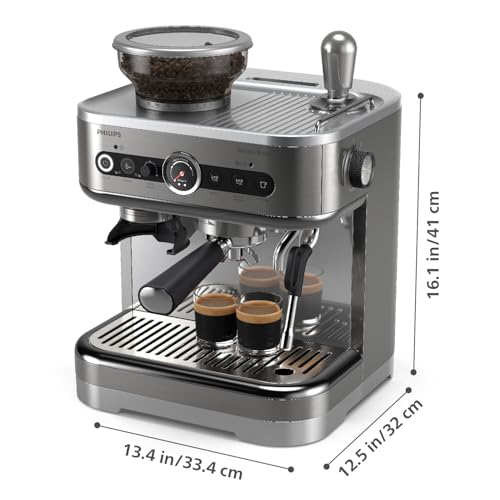
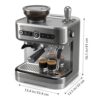
The listing gives dimensions of 19 inches deep, 25 inches wide and 34 inches tall. Those are not the dimensions of a domestic espresso machine; 34 inches is roughly counter height. They describe a shipping pallet or a display unit, not the product, and they should not be used for planning a space.
The weight is given in a corrupted attribute row reading Item Weight 8.6 Kilograms in both the name and value fields. Eight point six kilograms is roughly 19 pounds, which is plausible for a machine with an integrated grinder and a metal housing. The bean container capacity appears in the same corrupted form as Capacity 250 Grams. Anyone measuring a counter for this machine should work from the manufacturer specification page rather than from this listing.
What the Specifications Do Not Settle and Who It Suits
The manufacturer part number field is empty. There is no pump pressure, no brew temperature, no water tank capacity, no wattage, no heat up time and no warranty term anywhere in the data. Descriptions elsewhere credit this machine with PID temperature control, and we could not verify that from the listing data or the manufacturer copy provided, so it is not claimed here; anyone choosing the machine for temperature stability should confirm it independently. Owner feedback also identifies the water tank as small for heavy use, though no capacity figure is published to check that against. The same silence on temperature runs through the Kismile machine with an integrated grinder.
The Barista Brew suits a buyer who wants a portafilter machine with the grinder built in, a commercial diameter basket and enough included tooling to start properly. The calibrated tamper, the milk jug thermometer and both basket types make it a well judged package for someone learning. It is the wrong machine for anyone who wants drinks at one touch, where Philips' own super automatic range is the answer, and buyers wanting a documented alternative with published temperature figures should compare the Breville Barista Pro. The Breville Barista Express BES870XL is the longest running machine of this type.