Description
These are descaling tablets sold in a 34 pack under the USKICH name, individually wrapped, intended for any home coffee machine that heats and moves water internally. The single most useful thing about this product compared with most of its competitors is that the listing publishes the full ingredient list, which is rare in this category and turns a trust exercise into something you can actually check.
Descaling is the maintenance job that determines how long a coffee machine lives. Mineral scale narrows the flow path, insulates the heating element and eventually stops the machine, and the overwhelming majority of dead brewers were scaled rather than faulty. So while a box of tablets is not an exciting purchase, choosing one with a published formula rather than an unnamed one is a reasonable thing to care about.
The Published Ingredient List
USKICH lists the ingredients as PEG 6000, sodium carbonate, citric acid anhydrous, sulfamic acid and starch. Each of those has a clear role, and setting them out is more informative than any marketing bullet in the listing.
Citric acid and sulfamic acid are the descaling agents. Both dissolve calcium carbonate scale, with sulfamic acid the more aggressive of the two and the one used in stronger commercial descalers. Sodium carbonate is an alkaline salt, present to handle the oily residue side of the job that acid alone does not touch. PEG 6000 is a polyethylene glycol used as a binder to hold the tablet together and control how fast it dissolves, which is what the listing means when it says the tablets dissolve slowly for maximum efficiency. Starch is a filler and binder.
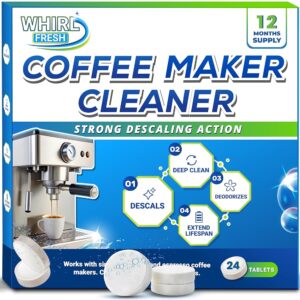
The practical takeaway is the sulfamic acid. It is effective and it is standard in this category, but it is more aggressive than citric acid alone, and a small number of machine manufacturers specify citric acid only descalers for aluminium components. If your machine manual names a required descaler type, check it against this list before use. That is a check you simply cannot perform with a product like the Whirl Fresh tablets, which publish no ingredients at all.
Format And Handling
Individual wrapping is the format argument. There is nothing to measure, nothing to spill and no half used sachet going damp in a drawer. USKICH makes this comparison explicitly against powders, sachets and liquids, and it is a fair one. Liquid descaler in particular is easy to over dose in a small reservoir and easy to under dose in a large one.
The tablets are recorded as unscented, which matters more than it sounds. A scented cleaning product used inside a machine that then makes your coffee is a bad idea, and the listing states explicitly that the formula does not leave an aftertaste or odour. That claim is only as good as the rinse cycle you run afterwards, which the next section covers.
Machine Compatibility
The listing states compatibility with multi cup machines, single cup machines, pod systems, K-Cup coffee makers and espresso machines, and names Keurig, Ninja, Breville, DeLonghi, Nespresso and Miele among the brands. That is the whole home market, which is normal for a universal descaler.
The usual caution applies: several manufacturers, Jura and Miele in particular, sell their own branded descaler and may treat use of a third party product as grounds for refusing a warranty claim on a scaled boiler. For an ordinary drip machine such as the Cuisinart DCC-3200 or a pod brewer like the Keurig K-Slim, no such restriction exists and a universal tablet is entirely appropriate.
The Frequency Question
USKICH recommends deep cleaning monthly, and states that 34 tablets work out to a two year supply or more. Those two figures broadly agree with each other, since 34 monthly uses is a little under three years.
Monthly is still more often than machine manufacturers advise. Keurig recommends every three to six months, and most drip machine manuals say something similar. What actually determines the correct interval is your water hardness and how much you brew, not the calendar. In a hard water area with a machine in daily use, monthly is defensible. In a soft water area with a machine used at weekends, monthly descaling is running acid through a boiler that has nothing to dissolve. It is worth noting that the competing Whirl Fresh product recommends twice a month for the same job, which tells you these figures are commercial positioning rather than chemistry.
The Rinse Step
Every descaling cycle needs a rinse cycle after it, and this is the step most people skip. The formula here is acidic by design and residue left in the boiler will be tasted in the next cup. USKICH claims no aftertaste, which will be true if you rinse and untrue if you do not.
Two full reservoirs of plain water through the machine is the sensible minimum, more on a machine with a long internal path or a thermal carafe. Descaling also does nothing for the parts that collect coffee oils and grounds: the pod holder, the exit needle and the brew basket all need separate attention. The cleaning and descaling products we cover include rinse pods and oil removing cleaners aimed at that side of the job.
What the Listing Does Not Settle
No quantities are given for the ingredients, so while the list tells you what is present, it does not tell you how strong the acid load is. No dosage guidance is given by reservoir size, so one tablet in a 12 ounce single serve tank and one tablet in a 60 ounce reservoir produce very different concentrations. No water hardness guidance is offered, which is the variable that should actually set your schedule. No safety data sheet reference is given.
The claim that the tablets are environmentally safe and formulated with a gentle formula sits somewhat awkwardly beside sulfamic acid in the ingredient list. Sulfamic acid is a normal descaling agent and is not exotic, but gentle is a marketing word rather than a chemical description.
Who It Suits
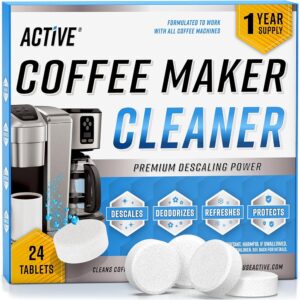
This is the descaler to buy if you want to know what you are putting through your machine. The published ingredient list is genuinely useful, the individually wrapped tablet format removes measuring errors, and 34 tablets at a sensible interval will outlast most machines. For a household with more than one brewer, a single box covers all of them. The ACTIVE descaler tablets are the closest competitor on format.
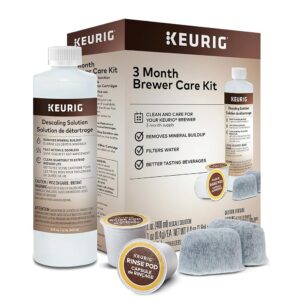
Look elsewhere if your manufacturer mandates its own descaler for warranty reasons, or if your machine manual specifies a citric acid only product, since this one includes sulfamic acid. If you own a Keurig and also want rinse pods and replacement water filters in the same purchase, a bundled brand kit covers more of the maintenance job at once. The Keurig 3 month brewer maintenance kit is that bundle.