Description
The Breville BES881 Barista Touch Impress is a bean to cup machine that still uses a portafilter. It grinds, doses and tamps under its own power, then hands the packed basket to the operator to lock into the group head. The specification sheet lists it at 13.62 inches deep by 14.09 inches wide by 16.42 inches tall, 24.2 pounds, on 120 volts, with a 54mm stainless steel portafilter, a 480 millilitre stainless milk jug, one cup and two cup baskets in both single wall and dual wall form, a water filter and holder, a water hardness test strip, the Razor precision trimming tool, cleaning tablets, a cleaning disc, a cleaning brush, a steam wand cleaning tool and descale powder.
That accessory list is the clearest statement of intent on the page. A machine shipping descale powder, a hardness strip and a dedicated wand tool is a machine whose maker expects it to be maintained, not just used. It sits at the top of the semi-automatic range rather than in the automatic category, and buyers considering the genuinely hands off alternative should look at the super automatic espresso machines covered here before deciding which kind of convenience they actually want.
Grinding, Dosing and Assisted Tamping
The manufacturer describes an integrated grinder with thirty grind settings feeding a puck preparation system that tamps with the equivalent of roughly 22 pounds of pressure, followed by a manual twist to finish the puck face. The Razor tool is supplied as well, so dose height can be trimmed to a repeatable level before the tamp.
Removing tamping force as a variable is a real gain. Inconsistent tamping is the most common reason two shots from the same grind taste different, and a mechanism applying the same force each time eliminates it. What no assisted tamper can fix is grind consistency or dose weight, so the ceiling on this machine is still set by the burrs and by how carefully it is dialled in. The same platform without the tamping assistance is the Breville Barista Express BES870XL, which is the reference point for judging whether the added mechanism is worth the difference in price.
Baskets and Dose Control
The included components field states one cup and two cup baskets in both single wall and dual wall form. That is worth noting because most listings in this category avoid the question entirely. Dual wall baskets create foam mechanically at a restrictor, which suits pre-ground coffee; single wall baskets create crema only through real extraction and demand a proper grind. Shipping both means the machine works immediately and still rewards a buyer who learns to dial it in.
Nothing in the block states the burr material, burr diameter or the dose range in grams, and nothing states the hopper capacity, so the amount of coffee sitting exposed to air between sessions cannot be judged from the page.
Milk, Steam and the Touchscreen
Milk texturing is automated. The manufacturer’s description covers adjustable temperature and texture, with the system varying its air injection for dairy and for plant based milks, and the touchscreen storing personalised drink settings alongside a set of preset cafe style drinks. In practice that turns milk from a skill into a setting, which is the strongest argument for this machine over the manual wand models below it.
The trade is that the milk path is now a system rather than a valve. A temperature probe, an air injection control and a purge routine are all components that can drift or fail, and published owner feedback mentions steam sessions cutting out on back to back drinks. A manual wand on a machine like the Breville Bambino BES450 has fewer ways to disappoint and fewer ways to help.
What the Listing Gets Wrong
The Operation Mode field reads Fully Automatic. It is not. A fully automatic machine, in the sense the rest of the category uses the term, grinds, tamps, brews and ejects the spent puck internally, and the user never touches coffee. This machine hands over a loaded 54mm portafilter that must be locked into the group by hand, and the milk jug must be placed and removed. Calling it fully automatic puts it in a comparison set it does not belong to, and a buyer who wants a machine that makes a drink untouched will be disappointed by a device that is otherwise excellent at what it actually does.
The Style field reads Modern, which carries no information. More seriously, the block states no water tank capacity at all on a 24.2 pound machine, no pump pressure, no wattage and no warranty term, while the listing for the maker’s own Barista Express states one year. Those are four figures a buyer at this price is entitled to see.
What the Specifications Do Not Settle
Grind retention is unstated, as it is on every machine with an integrated grinder, and it is the figure that decides how much of yesterday’s coffee ends up in today’s shot. Boiler or thermocoil type is unstated beyond the marketing name for the fast heating system, so recovery time between a shot and a steam cycle cannot be predicted, and neither can how many drinks can be made in a row before the machine needs to catch up. Group head material and temperature control method are not stated.
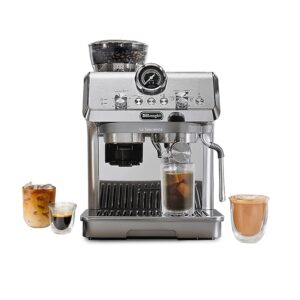
Service is the largest open question at this price. There is no gasket part number, no shower screen reference, no stated descaling interval despite descale powder being in the box, and no indication of whether the touchscreen assembly is a serviceable part. A machine with a screen, a grinder motor, a pump and an automated milk system has more failure points than a manual machine, and the listing does not say how any of them are supported. Buyers who want an integrated grinder with a simpler milk system might compare the De’Longhi La Specialista Arte Evo, which pairs a built-in grinder with a manual wand. The Breville Barista Touch BES880BSS is the earlier machine in the same line and leaves the same questions open.
Who It Suits and Who Should Look at Another Format
This machine suits a household making several milk drinks a day, with different people wanting different drinks, and with 14 inches of counter width and enough headroom above it. The saved profiles and automated milk make it genuinely usable by people who have no interest in learning espresso, while the portafilter and both basket types leave room for someone who does. Households that want the same grinder and screen without the tamping mechanism can compare the Breville Barista Pro BES878.
It suits nobody looking for a compact machine or a cheap one, and nobody who wants the puck handled entirely by the machine. Buyers who want a drink from beans with no portafilter at all should be in the super automatic category instead. Buyers who already grind fresh and enjoy the manual routine are paying for a grinder and a tamping mechanism they will not need, and would do better putting that money toward a stand alone grinder and a simpler machine.