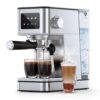

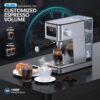
Description
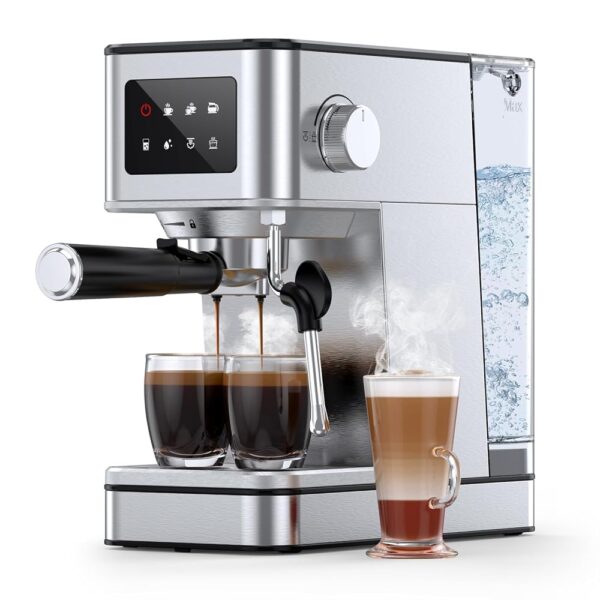
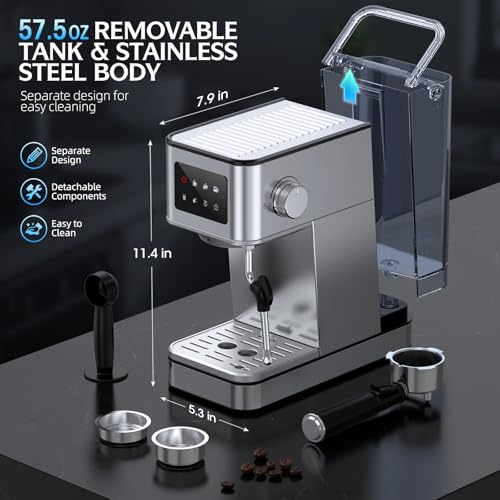
The QJA EM625 is a compact pump espresso machine distinguished from most of its price band by an LED touchscreen rather than mechanical buttons. The manufacturer specifies a 20 bar pump, 1400 watts, a 57.5 ounce removable water tank and a steam wand for milk. The body measures 7.89 inches deep, 5.3 inches wide and 11.4 inches tall, making it one of the narrower full portafilter machines available.
Two features set it apart from otherwise similar stainless boxes: the touch interface and an automatic cleaning cycle. Both are conveniences rather than changes to how the coffee is extracted, but on a machine that will live on a counter and be used daily, interface and maintenance are exactly the things that decide whether it keeps getting used. Against a capsule machine the EM625 asks you to grind and dose; against a bean to cup automatic it asks considerably more, and costs considerably less.
Brewing System and Pressure
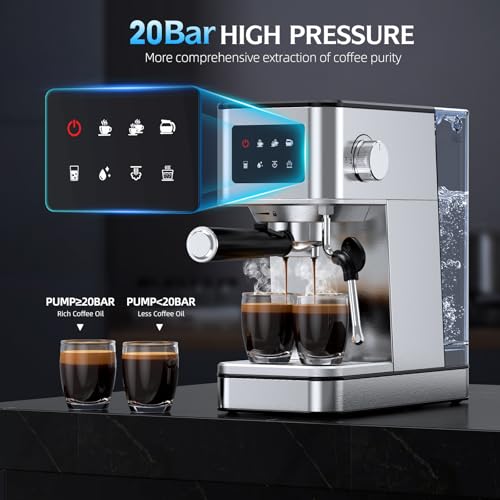
QJA quotes a 20 bar pump running at 1400 watts. As with every machine in this bracket, 20 bar is the pump’s maximum dead head rating, not the pressure at the coffee puck. Actual espresso extraction settles near 9 bar once water is flowing through the grounds, and a pressurised basket regulates much of the rest. The number tells you the machine uses a standard vibration pump rather than anything unusual, and nothing more.
The listing does not state the basket size, the portafilter diameter or whether the baskets are pressurised. In practice, machines sold at this price with a two minute learning curve almost always ship pressurised double wall baskets, which produce a crema layer regardless of grind quality. That makes the machine forgiving of supermarket pre ground coffee and correspondingly less rewarding for anyone dialling in fresh beans. For comparison, the Breville Barista Express ships both pressurised and single wall baskets specifically so the operator can graduate from one to the other.
The Touchscreen Interface
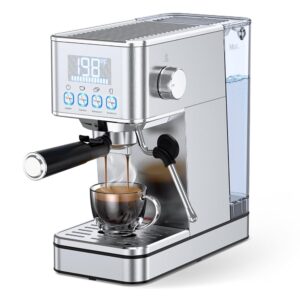
The LED touch panel is the headline feature. QJA describes it as simplifying the brewing sequence and saving time, which in practice means selecting shot size and steam from a flat capacitive surface rather than a rotary knob. The advantage is a flush face that wipes clean, with no gaps around a dial for coffee grounds to collect in. The disadvantage of capacitive panels on kitchen appliances is well known: wet or greasy fingers register unreliably, and there is no tactile feedback when the machine is behind you and steaming.
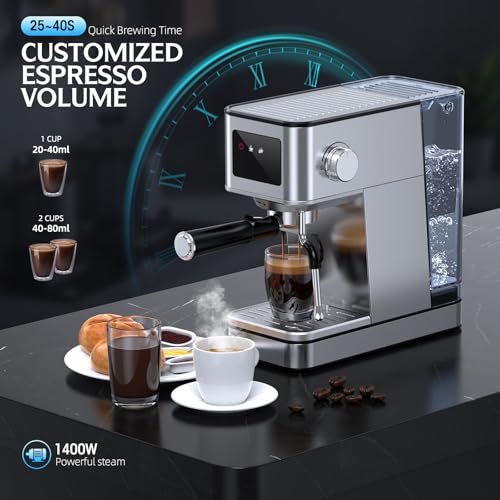
The listing does not say which parameters the screen exposes. There is no mention of programmable shot volumes, temperature adjustment or a shot timer, so it is safest to assume the screen selects preset functions rather than offering true customisation. Machines that do allow volume programming say so explicitly.
Water Tank, Cup Warmer and Auto Clean
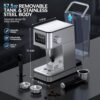
The tank is removable and stated at 57.5 ounces in the product title, then described as 58 ounces in the body copy of the same listing, with a separate attribute reading 1.72 litres. Those are the same figure rounded three different ways rather than a genuine conflict, and 1.7 litres is a large tank for a machine 5.3 inches wide. Fewer refills is a real daily benefit.
A cup warmer is listed among the special features. On machines of this size the warming plate is the top panel heated passively by the boiler beneath it, so it works but takes time from cold. The automatic cleaning function is more interesting: QJA describes a self cleaning cycle that flushes the group without the operator running it manually. The listing does not specify whether this cycle handles descaling as well, and it almost certainly does not. Scale still has to be removed chemically, and an affresh coffee maker cleaner or a dedicated descaler is what actually does that job.
Milk and Steam
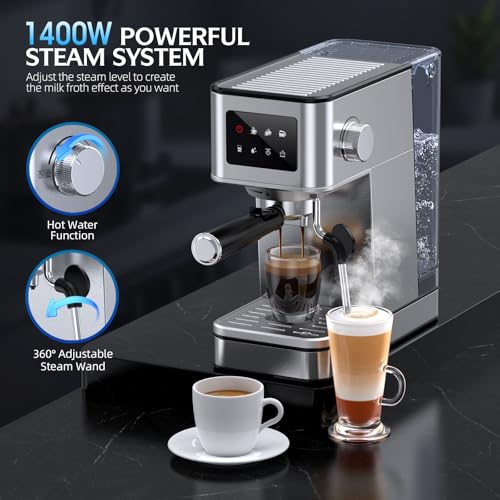
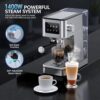
Milk is handled by a manual steam wand which QJA describes as offering stable steam control and enough output for latte art. As with all single boiler machines, brewing and steaming share one heating element, so the machine must switch modes and wait between the two. The listing does not give steam pressure, tip hole count or recovery time.
Published owner feedback on this model commonly mentions two things worth flagging. The first is that the supplied tamper is plastic and light, which makes consistent tamping harder than a weighted metal tamper would; a replacement tamper is an inexpensive fix. The second is that espresso can arrive cooler than expected, which is a common characteristic of small thermoblock and single boiler machines where the group head itself has not reached temperature. Running a blank shot through the empty portafilter to preheat it addresses most of that.
What the Specifications Do Not Settle
The structured data on this listing is unusually thin and partly corrupted. Two entries in the attributes table read as “Capacity 1.72 Liters” and “Wattage 1400 watts” in both the name and the value field, which is an importer parsing failure rather than product information. The manufacturer part number field is empty. There is no item weight anywhere in the data, no country of origin, no voltage and no first availability date, so there is no way to judge how long the model has been on sale.
Missing too are the brew temperature, the boiler type, the portafilter diameter, the basket dose in grams and any warranty term. The manufacturer does mention an overheat protection mode indicated by a status light, which implies a thermal cutout, but the listing does not explain what triggers it or how long the machine takes to recover. Anyone buying should expect to learn these things from the manual rather than from the listing. The same gaps appear on the CASABREWS CM5418, which is built to a similar specification.
Who It Suits
The EM625 suits a buyer who wants a narrow machine with a large tank and prefers a touch panel to a knob, and who is happy with pressurised baskets and pre ground or lightly dialled coffee. As a first portafilter machine for one or two people it covers espresso, cappuccino and latte at a low entry price, and the 1.7 litre tank makes it less tedious than most machines of the same width. Buyers comparing tank size in the same class can look at the Wirsh CM5418 espresso machine.
It is a poor fit for anyone chasing precision. Without stated temperature control, programmable volumes or single wall baskets, there is little scope to improve results beyond a certain point. Buyers who want that headroom should look at the semi automatic machines further up the espresso machine category, and buyers who want the drinks without the technique should consider a bean to cup automatic such as the De’Longhi Magnifica Evo, which grinds, doses and tamps internally.