





Description
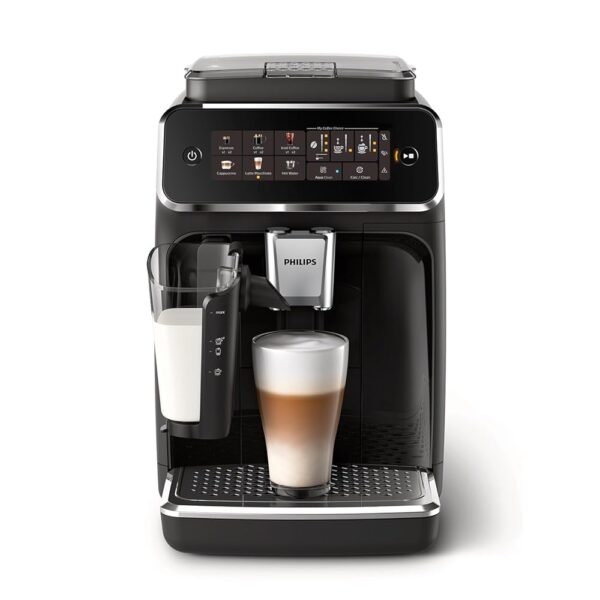
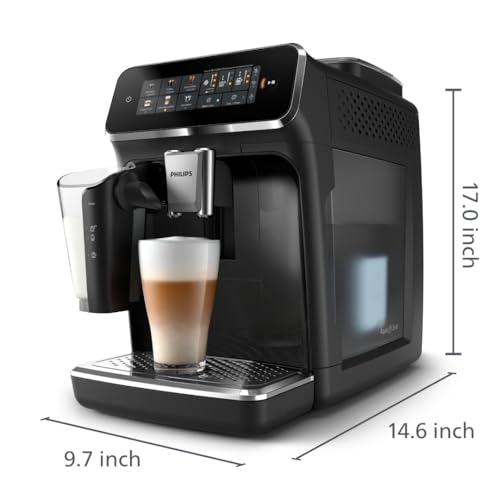
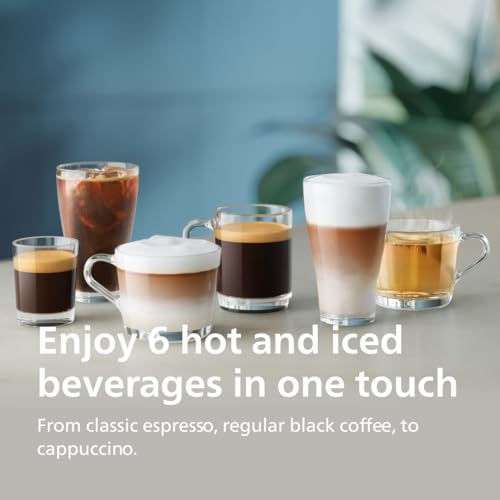
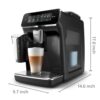
The Philips 3300 Series EP3341/50 is a fully automatic bean to cup machine with a ceramic burr grinder, a removable brew group and the LatteGo two part milk system. Philips lists six drinks: espresso, black coffee, cappuccino, latte macchiato, iced coffee and hot water for tea. It measures 9.68 inches deep, 17.04 inches wide and 14.6 inches tall, weighs 17.63 pounds, and is made in Romania.
The 3300 sits below the 4400 in Philips’ range and the difference is largely in the drinks list and the interface rather than in the underlying hardware. Both use the same chassis dimensions, the same ceramic grinder, the same AquaClean filtration and the same LatteGo carafe. For a buyer who does not need twelve recipes and two saved profiles, the 3300 delivers the important parts of the platform for less.
LatteGo and Why the Two Part Design Matters
LatteGo is a milk carafe made of exactly two moulded pieces with no tubes. Milk travels through a channel formed where the two parts meet, and they pull apart for rinsing. Philips states the whole assembly washes in under ten seconds, and the absence of tubing is the substantive point: tube fed milk systems trap residue in narrow silicone lines, which is the usual reason automatic machines start to smell sour after a few months.
Philips also states the system handles plant based milk alternatives. That is not a given. Many automatic frothers rely on dairy protein for stable foam and produce thin, collapsing bubbles with oat or almond milk. If plant based milk is your default, this is a specific reason to look at the Philips range over rivals. Owner feedback does note that LatteGo replacement parts are expensive and not always easy to source, which is worth factoring in over a machine’s life.
Ceramic Grinder and the Removable Brew Group
The grinder uses ceramic burrs rather than steel. Ceramic is harder, holds an edge longer and transfers less heat into the grounds, which is why Philips fits it across this range. Grind setting is adjustable, and an aroma seal on the hopper slows staling for beans left in the machine.
The removable brew group is the feature that determines whether this machine is still working in eight years. It lifts out for rinsing under a tap and regreasing, which is why Philips ships a grease tube in the box. Machines with sealed groups can only be cleaned chemically through a cycle and are far harder to recover once neglected. Nothing on the specification sheet signals this as clearly as it deserves, and it is the single strongest structural argument for the Philips platform over cheaper automatics.
SilentBrew and the Quiet Mark Claim
Philips claims SilentBrew technology using sound shielding and quiet grinding, states it is 40 percent quieter than earlier models, and says the machine is certified by Quiet Mark. Two things are worth separating there. The 40 percent figure is a comparison against previous Philips machines, not against the category, and no decibel figure is published anywhere in the listing.
Quiet Mark is a third party acoustic certification scheme, so that part of the claim is at least externally assessed rather than purely internal. Grinding remains the loudest moment in any bean to cup cycle regardless. Read the claim as a genuine relative improvement rather than as a quiet appliance in absolute terms. The Philips 4400 Series carries the same technology with a longer drinks list.
AquaClean, Descaling and Running Costs
Philips states that changing the AquaClean filter when prompted removes the need to descale for up to 5000 cups. That number is a maximum conditional on replacing the cartridge on schedule and on setting the machine’s water hardness using the supplied test strip. Skip the filter changes and the machine reverts to conventional descaling intervals.
The consequence is a recurring consumable cost that should be counted alongside beans. AquaClean cartridges are not cheap, and over a year of daily use they are a real expense. Against that, they do genuinely reduce scale, which is what ends the life of automatic machines. Guided descaling is built into the interface for when it is needed. Owners who skip the filters should budget for a proper descaler from the cleaning products range and run it on schedule instead.
Footprint and What the Listing Overstates
At 17.04 inches wide and 14.6 inches tall this is a full size counter appliance, not a compact one. It needs a permanent position, clearance above for the bean hopper lid and access behind for the water tank. Anyone measuring a kitchen should work from those numbers rather than from any adjective in the marketing copy.
Published owner feedback raises two further points. The machine runs rinse cycles at startup and shutdown that use a noticeable amount of water, which collects in the drip tray and means emptying it more often than the machine’s size suggests. And customisation is limited compared with machines that store multiple named user profiles; the 3300 adjusts strength and volume but does not offer the recipe library of higher models. Neither is a fault, but both shape daily use.
Six Drinks and Where the Range Divides
The six drink list covers espresso, black coffee, cappuccino, latte macchiato, iced coffee and hot water. That is the practical core of what most households order, and the machines above it in the range add variations rather than fundamentally different drinks. Anyone counting recipes should ask how many they will actually use before paying for twelve.
The iced coffee entry is worth a note. Brewing normally and pouring over ice produces a watery drink, so a properly implemented iced recipe adjusts the dose and volume to compensate. Philips lists iced coffee as a distinct recipe rather than a temperature setting, which suggests the machine does make that adjustment. Below this model, the Philips 1200 Series drops the milk system and the drinks list considerably while keeping the same removable brew group.
What the Specifications Do Not Settle and Who It Suits
The water tank capacity, the bean hopper capacity, the number of grind settings, the brew temperature and the wattage are all absent from the data. There is no stated warranty term. The human interface field reads touchscreen, where the 3300 uses a display with physical controls, so that field should not be relied on. Philips also promotes a companion app for recipes, which is a convenience rather than a machine function.
The EP3341/50 suits a household that wants espresso and milk drinks at one touch, values a milk system that rinses in seconds, and has the counter space for a full size automatic. Plant based milk drinkers are better served here than by most automatic frothers, and the removable brew group makes it a machine worth keeping. It is the wrong purchase for anyone who wants control over extraction, in which case the semi automatic machines in the espresso machine category offer far more, or for anyone wanting a wider recipe list, where the De’Longhi Magnifica Evo and the rest of the super automatic range are the comparison.


