



Description
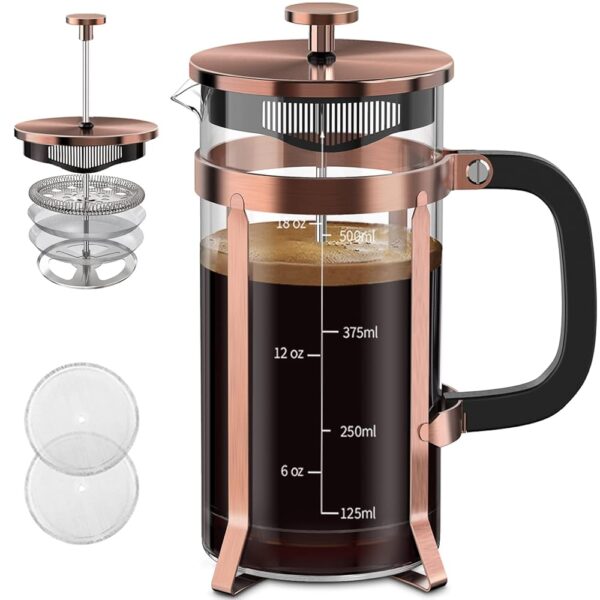
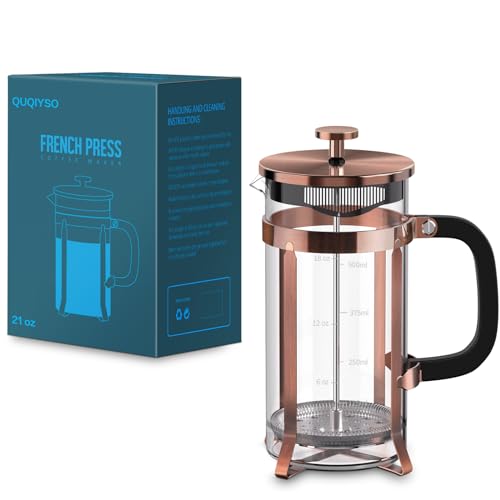
The QUQIYSO Copper-21 is a small French press with a borosilicate glass beaker, a 304 stainless steel frame in a copper finish and a plunger assembly built around a perforated plate and a fine mesh screen. It is listed at 20.69 dollars, weighs 1.26 pounds, measures 3.34 inches deep by 5.27 inches wide by 6.3 inches high and has been on this listing since June 2022. Capacity is 21 ounces, which is the model number.
Twenty one ounces is the detail that defines this press. Most French presses in this catalogue are 34 ounces; this is roughly two thirds of that, which makes it a one or two person press rather than a household one. That is a legitimate size to want. A press brews best when it is close to full, because a small dose of coffee in a large beaker cools faster and extracts unevenly, so a smaller press used properly beats a large press used half empty. Anyone brewing for three or more should be looking at the larger presses in this section instead.
The Filter Stack and a Contradiction About How Many There Are
QUQIYSO puts more emphasis on filtration than most presses at this price, and the mechanism it describes is a two stage one. A perforated plate catches the large grounds, and behind it an 80 mesh screen catches the fines. Eighty mesh means eighty openings per linear inch, which is a genuinely fine screen for a press and finer than the coiled spring screens many cheap presses ship with. If the number is accurate, this should give noticeably less sediment than a standard press.
The listing then contradicts itself about how many filter parts you get. The product title says with 4 Filter. Included components says French Press Coffee Maker x 1, Filter x 2, User Manual x 1. The description names two elements, the perforated plate and the 80 mesh screen. Two of the three statements agree on two, and the title says four. The most likely explanation is that the title counts each layer of a stacked assembly separately, or that spares are included, but the page does not resolve it and a buyer expecting spare screens may not get them.
Grind and Steeping
Coarse grind is essential in any press, and it matters slightly less here than usual because of the fine second screen, but it still matters. Fine grounds make the plunger hard to press, force fines through any gap at the rim, and over extract because they sit in water with far more surface area exposed. A burr grinder set coarse is the right tool, and the burr grinder coverage on this site explains why a blade grinder cannot produce the particle spread a press needs.
The listing gives no dose, no ratio and no steeping time, which is a gap on a product aimed partly at people new to the method. Four minutes is the widely used convention before pressing, and coffee should be decanted rather than left sitting on the bed, because immersion continues after the plunge and a press left standing turns bitter within ten minutes. A 21 ounce press produces roughly two mugs, so decanting is easy in practice.
Beyond Coffee
QUQIYSO lists a wide set of secondary uses: tea, hot chocolate, cold brew, frothed milk, almond milk, cashew milk, fruit infusions and herbal drinks. Most of these are genuine. A press is a steeping vessel with a strainer, so loose leaf tea and herbal infusions work naturally, and cold brew is simply a long steep at room temperature followed by a plunge.
Milk frothing is the odd one and it is worth being precise about it. Pumping the plunger in warm milk does aerate it and produce foam, which is a real technique, but it is not steamed milk and the texture is coarser and less stable than a steam wand produces. Nut milk making is also plausible, since the screen strains solids, but an 80 mesh screen is coarser than a proper nut milk bag and some sediment will pass. The claims are not false; they are broader than the equipment.
Build, Finish and Cleaning
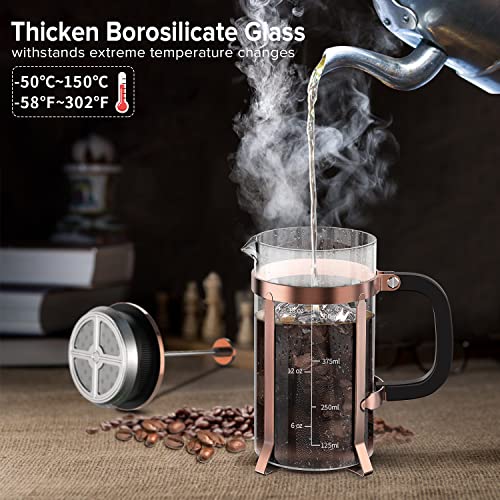
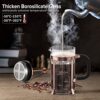
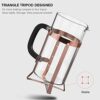
The frame and filter parts are 304 stainless steel with a copper coloured finish, and the beaker is borosilicate glass, which is the right choice for a vessel that takes water just off the boil. The care instruction is specific and worth following: the glass beaker, filter and plunger are dishwasher safe, but the lid should be hand washed with a mild detergent and a soft sponge, avoiding abrasive scrubbers that would scratch and dull the finish.
That split matters more than it looks. The copper finish is a coating, not solid copper, and coatings come off under abrasion or harsh dishwasher detergent. Cleaning the plunger after every use is also more important on a press than most owners realise, because coffee oils collect in the mesh and in the gap between the plate and the screen, and rancid oil in the filter taints every subsequent brew far more than the beaker does.
Loose Language on This Listing
Two things in the manufacturer copy are worth correcting. The description invites you to watch the crema after the coffee touches the water. Crema is the emulsified layer produced by pressurised espresso extraction, and a French press produces no pressure and therefore no crema. What you see is a bloom, the carbon dioxide escaping from fresh grounds, which is a different phenomenon and a useful one to watch, but the word is wrong.
The specification fields are similarly loose. Special feature reads Manual, which restates the operation mode field directly below it. Style reads french, in lower case, which is not a style. Specific uses for product reads Cold Brew, on a press whose main purpose is hot immersion coffee, while recommended uses correctly lists coffee, tea, cold brew and plant based drinks. Country of origin is China and the model number is simply the model name, Copper-21.
What the Specifications Do Not Settle
The listing never says whether the beaker is replaceable, which is the most important durability question about any glass press. It does not give a glass thickness or temperature rating. It does not state whether the 80 mesh screen is available as a spare, and a screen is a wear part that eventually distorts.
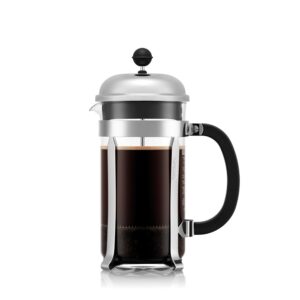
There is no dose, ratio or steep time. There is no warranty statement. Nothing explains whether the copper finish is plating, anodising or a powder coat, which determines how it will age and whether the dishwasher instruction for the plunger risks dulling it as well as the lid. The 21 ounce capacity is also given only in the title and model name, not in a capacity field, so it is worth confirming against the physical product. Owners who eventually want a larger vessel in the same style will find the Bodum Chambord at 34 ounces the obvious step up.
Who It Suits and Who Should Look Elsewhere
This suits one or two drinkers who want a full bodied cup, appreciate a finer screen than most cheap presses offer, and like the idea of a vessel that doubles for tea and cold brew. At around twenty dollars with borosilicate glass and 304 stainless it is well specified for the money, and the 21 ounce size is genuinely better than a large press for a single drinker. The Bodum Brazil is the plainer press at a similar level.
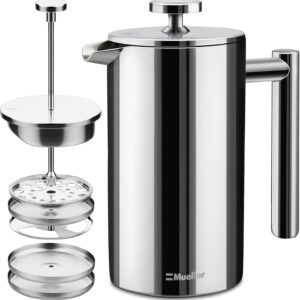
It suits you poorly if you brew for three or more, if you want a sediment free cup, or if you want heat retention, since single wall glass in an open frame holds nothing. It also suits you poorly if the finish matters to you long term, because a coated frame with hand wash only instructions on the lid will show wear. Anyone who wants insulation and no glass at all should compare it against the double walled stainless designs in the French press section. The MuellerLiving 20 ounce press is the double walled stainless option at the same size.