Description
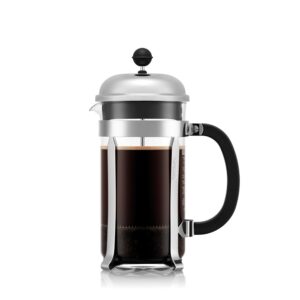
The Bodum Brazil is the entry level French press from the company that made the design a household object. It is a 34 ounce borosilicate glass beaker in a BPA free plastic frame, with a stainless steel plunger and filter and a domed lid. There is nothing electrical, nothing to program and nothing to replace but the glass.
Two facts in the recorded data set this apart from the field of near identical presses. It is made in Portugal rather than China, which is unusual at this price. And the attribute table records it as discontinued by the manufacturer, which belongs at the top of any review rather than buried in a specification list.
The Discontinued Status
The listing records this item as discontinued by the manufacturer. In practice that means remaining stock is what exists, and that replacement beakers for this specific model may become harder to source over time.
The glass is the only part of a French press that realistically fails, and it usually goes by being knocked against a tap while washing rather than by thermal shock. A press with a broken beaker and no replacement is scrap, so on a discontinued model it is worth checking whether a compatible beaker is still sold before buying. Bodum has produced 34 ounce presses in this shape for decades and beakers are often interchangeable across the range, but that is not something this listing confirms. The alternative is a current model from the French presses we cover, where parts availability is a live question rather than a historical one.
Made in Portugal
The product title states made in Portugal and the country of origin field agrees. That is worth noting because almost everything else in this price bracket is made in China, including the Utopia Kitchen press at a similar capacity.
What origin actually tells you about a French press is limited, since the object is a glass cylinder, a plastic frame and a wire mesh disc. Where it matters is glass consistency, which is a manufacturing tolerance question rather than a design one, and Portugal has a long established glassware industry. Treat it as a modest quality signal rather than a guarantee, and note that the two figures agreeing with each other is itself unusual in this catalogue.
The Filter and What A Press Does To Coffee
The plunger and filter are stainless steel, and Bodum describes them as preventing ground beans escaping when the coffee is poured. That is the standard single screen arrangement rather than the multi layer stacks some competitors advertise.
The more important point is what a metal filter does to the drink. Paper traps the coffee oils and the finest particles, producing a clean, light cup. Metal lets both through, producing a heavier, rounder cup with more texture and some sediment at the bottom. That is the whole reason a press exists as a category, and it is why the same beans taste noticeably different through a press and through a pour over cone. Neither is better; they are different drinks from the same coffee. Anyone who dislikes sediment is describing the reason paper exists.
Materials and Handling
The carafe is heat resistant borosilicate glass, which Bodum describes as non staining and as not altering the coffee flavour. Borosilicate is the correct material for the job because of its low thermal expansion, which is what lets it take boiling water without cracking.
The body, handle and domed lid are lightweight BPA free plastic. Plastic is the compromise at this price and it has one genuine advantage over metal: it does not conduct heat, so the handle stays cool. The disadvantage is that plastic frames scratch, discolour with age and are the part most likely to crack if the press is dropped. At one pound the whole assembly is very light. The recorded dimensions are 5.11 inches deep, 4.13 inches wide and 9.24 inches high, which are consistent with a one litre press and, unusually for this catalogue, appear on the correct axes.
Method, Grind and Capacity
The method is unchanged across every press ever made: coarse grounds in, hot water on, stir, wait around four minutes, press slowly. Coarse grind, roughly the texture of sea salt, is the target; supermarket pre ground coffee is too fine, which is why press coffee made with it tastes muddy.
The 34 ounce capacity is described as eight cups, which puts a press cup at a little over four ounces. In practice that is two large mugs or three modest ones. Decant what you are not drinking immediately, because coffee left on the grounds after plunging keeps extracting and turns bitter within twenty minutes. That is the behavioural difference from a drip machine, where the coffee and the grounds part company as soon as the cycle finishes.
Cleaning and Waste
Bodum states that the press is dishwasher safe and easy to clean, and makes an environmental point that is straightforwardly true: a press needs no paper filters and no plastic capsules, so the only waste is the grounds themselves.
The awkward part is getting rid of those grounds. A bed of wet coffee cannot go down a sink without eventually blocking it, so scraping into a bin or a compost caddy is the daily routine and it is the main reason people abandon presses. Grounds and paper lift out of a drip machine in one movement, which is the convenience the drip coffee makers we cover offer in exchange for a lighter cup. The plunger assembly should also be taken apart periodically, since oils accumulate between the screen and the plate and go rancid.
Contradictions In The Data
The attribute table contradicts the product description directly on the most important specification. The filter type is recorded as Paper, while the special feature field says permanent filter and the manufacturer description says stainless steel plunger and filter. There is no paper filter anywhere in a French press, and the description is correct.
Three other fields are wrong. The specific uses field reads Espresso, and a press produces no espresso because there is no pump and no pressure. The human interface input reads Buttons, and there are none. The department field reads unisex-adult, which is a clothing category. The UPC field also contains two separate barcodes. The one genuinely informative date is the first availability of June 2004, which marks this as a design with a very long production history.
What the Specifications Do Not Settle
No mesh count is given, so there is no way to compare it against presses that publish one. No glass thickness. No statement of whether replacement beakers remain available, which on a discontinued model matters most. No steeping time guidance.
The included components field simply repeats the product name rather than listing what is in the box, so whether a scoop is supplied is not established. And nothing addresses how the plastic frame ages, which is the part most likely to determine how long the press stays presentable.
Who It Suits
This suits somebody who wants the classic version of the format from the brand that defined it, prefers a simple single screen filter to a multi layer stack, and values the cool plastic handle over a metal frame. It is light, it is cheap, it is well proportioned and it has been made in essentially this form for decades.
The caution is the discontinued status. If long term parts availability matters, a current model is the safer purchase. And as with every press, skip it if sediment bothers you or if you want coffee ready without standing over a kettle, in which case a drip machine or one of the single serve brewers we cover is a different answer to a different question.