Description
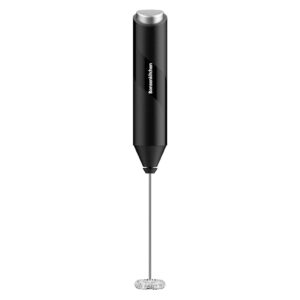
The PowerLix A03 is a battery powered handheld frothing wand, one of the oldest listings of its kind still in wide circulation; the catalogue record dates the product to January 2016. It consists of a plastic body holding a small motor and two cells, a steel shaft, and a coiled 18/10 stainless whisk described in the manufacturer copy as a dual spring spiral. A single button on the top runs the motor. There is nothing else to it.
Wands of this kind occupy the entry level of milk texturing. They aerate milk that has already been heated, they disperse powders such as matcha and cocoa, and they do neither job as well as a steam wand on a pump machine does the first one. The comparison worth making before buying is not against other wands but against the format above it, which is why the wider coffee accessory catalogue on this site is arranged to put frothers, pitchers and steam capable machines side by side.
The Whisk and the Dual Spring Coil
The whisk is the part that distinguishes one wand from another, and PowerLix specifies 18/10 stainless steel with a dual spring construction. The 18/10 designation refers to chromium and nickel content and is the grade normally used for cutlery, which resists pitting from salt and acid better than the cheaper 18/0 used on many kitchen accessories. Two coils rather than one give the head more surface to cut through milk, which is the mechanism behind the manufacturer claim of faster aeration.
The listed overall dimensions are 2.75 by 2.75 by 9.84 inches. Only the last figure describes the wand; the two matching 2.75 inch measurements are the footprint of the supplied stand rather than any part of the tool a hand touches. At 9.84 inches long the shaft reaches into a standard mug or a small pitcher comfortably, and the two weight figures given, 150 grams and 5.3 ounces, agree with each other, which in this catalogue is worth remarking on.
What 19000 in the Wattage Field Means
The specification block lists the wattage as 19000. A wand running on AA cells does not draw 19 kilowatts; that would be roughly the load of an electric shower and several times what a domestic ring main can deliver. The number is the motor speed the manufacturer advertises, 19,000 revolutions per minute, dropped into the power field because the listing template had nowhere else to put it.
The same claim appears in the special feature text, where it is stated correctly as rpm alongside a line about delivering double the power of other frothers. Motor speed with no load is not power, and an unloaded rpm figure tells a buyer nothing about how the whisk behaves once it is dragging through cold milk. It is a marketing number that has been promoted into a specification, and it should be read as the former. The Bonsenkitchen wand makes the opposite mistake, publishing a 10 watt rating that two alkaline cells cannot realistically sustain.
Batteries, Run Time and the Count Problem
Two fields in the same block disagree about the power supply. Number of Batteries is given as 2, while the batteries field states that one AA battery is required. Wands in this class almost universally use two cells in series for 3 volts, and the product copy refers to battery operation without settling the count. Neither field is trustworthy on its own, and the safe assumption before ordering is a pair of AA cells.
The cells are also not stated to be included. Run time is not published in any form, and no current draw is given that would allow an estimate. What can be said from the design is that alkaline voltage sags under load, so whisk speed falls gradually rather than stopping, and published owner feedback for wands of this type repeatedly describes that slow decline as the motor wearing out when it is usually the cells.
Size, Stand and Vessel Choice
A stand is included, which is what the 2.75 inch square footprint in the dimensions field describes. It matters more than it sounds, because the whisk head cannot be laid flat on a counter without transferring milk to it, and a wand rolls. The included components field reads Shade included, which appears to be a corrupted entry rather than a description of anything actually in the box.
Vessel choice governs the result far more than the motor does. A narrow, deep container keeps the coil submerged and gives foam room to rise, while a wide mug filled halfway lets the whisk break the surface and spray. A narrow stainless jug intended for the job solves that, and it also survives being warmed on a stovetop before the wand goes into it.
Care and Corrosion
The care instruction given is hand wash only, and for a device with a motor and battery contacts in the handle that is not optional. The steel parts benefit from being rinsed and spun dry immediately, since milk residue left in the coil dries into a film that resists later rinsing. Drying matters as much as washing on any steel accessory, because standing water is what eventually marks even a good grade of stainless.
There are no consumables beyond cells, no filters and nothing to descale. The failure points on a wand of this age of design are the switch, the battery contacts and the seal where the shaft enters the housing, and none of the three is documented as replaceable.
What the Specifications Do Not Settle
The listing does not resolve the battery count, does not state whether cells are supplied, gives no run time, and gives no genuine power figure. The color field reads A Black while the manufacturer feature text describes a body styled in red, so a buyer cannot tell from the page which finish arrives. The model name is given as A03 while the item model number is recorded as the single letter a.
Recommended Uses For Product is set to Commercial, which is not credible for a battery wand and would be a poor basis for a cafe purchase. Nothing in the block covers warranty terms, replacement whisk availability, water ingress protection or noise. The one thing the listing does establish clearly is age: a product first listed in 2016 has a long owner record behind it, which is a more useful signal than any of the numbers on the page.
Who It Suits and Who Should Look Elsewhere
This wand suits a household that already heats milk some other way and wants foam on top of drip or pod coffee, and it suits anyone mixing matcha, cocoa or protein powder where the task is dispersion rather than texture. The steel grade and the stand put it slightly above the cheapest wands, and the long listing history means the design is well understood by the people buying it. Buyers weighing near identical alternatives can compare it against the Peach Street PE-1029 or the YUSWKO MFSILVER1, both of which share the same basic layout.
It is the wrong purchase for anyone who wants pourable microfoam, anyone who wants milk heated and textured in one step, and anyone who would rather not buy cells. Those buyers should be looking at a machine with a steam arm, such as the IMUSA GAU-18202, and accepting the counter space and cleaning that a boiler brings with it.