Description
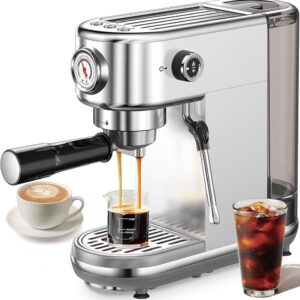
The Capresso Steam PRO, model 304.01, is a four cup steam espresso and cappuccino machine in a stainless steel and black finish. The listing gives dimensions of 9.75 by 7.5 by 13.25 inches and a weight of 5 pounds, with a reusable metal filter, a frothing wand, a coffee and steam selector and a hot water function for tea, americanos and hot chocolate. It has been listed since February 2014.
The most important thing to establish is the brewing method, because the listing calls it an espresso machine and that word carries expectations the hardware cannot meet. This is a steam pressure machine: water is heated in a sealed vessel until steam pressure pushes it through the grounds. Pump machines, which make up most of our espresso machines category, use an electric pump and produce a measurably different drink.
Steam Pressure and What It Produces
A steam machine works at roughly 1 to 3 bar. Espresso as a category is defined at around 9 bar. That gap changes the extraction rather than merely reducing it: water moves through the bed more slowly and with less force, giving a drink stronger than drip coffee but thinner in body than espresso, with a light crema that does not last.
Water temperature is the second difference. Because the pressure is generated by boiling, water leaving the machine is close to boiling rather than the 92 to 96 degrees Celsius pump machines target, and hotter water extracts more bitterness. A coarser grind and a darker roast take some of that edge off. Neither the pressure nor the temperature appears anywhere on this listing, and the coffee maker type field simply reads Espresso Machine, which does nothing to signal the difference to a buyer comparing on price.
The Coffee and Steam Selector
The selector is the machine’s main control: it directs the boiler’s output either through the group to brew or out through the wand to steam. That is how every steam machine works, and understanding it explains the format’s central constraint.
Steam pressure builds while the boiler heats and is spent as it is used. If you brew first and then want to steam milk, the pressure available for the milk depends on how much is left, and it falls away if you wait. That is why timing matters on these machines in a way it does not on a pump machine with a separate steam function: you cannot pause between the coffee and the milk. The practical routine is to have the milk in the pitcher and ready before you start, and to move straight from one to the other. The listing does not explain this, and it is the single behaviour most likely to frustrate a new owner.
The Frothing Wand
The wand is fed from the same boiler and the same selector. Where a steam machine genuinely beats a budget pump machine is raw steam volume, because a boiler exists to make steam and does not need the recovery period a small thermoblock imposes. Where it loses is control and duration.
The foam produced is coarse and bubbly, suited to a traditional cappuccino rather than a latte, and latte art is not achievable. The wand needs purging and wiping immediately after use, since dried milk in a steam channel is hard to clear. The listing does not describe the tip type, whether a frothing sleeve is fitted, or the wand’s range of movement, which determines whether you can get a pitcher under it comfortably.
Milk volume is the other constraint. A small boiler holds a limited quantity of water, and steaming consumes it, so a large jug of milk will exhaust the available steam before it reaches temperature. Working with a small pitcher and a modest quantity of milk is not a preference here; it is what the boiler capacity allows.
Errors in the Listing Data
Two classification fields on this page are wrong. The operation mode reads Fully Automatic. In coffee terminology that means a bean to cup machine that grinds, doses and brews unattended. This machine has no grinder, no brew unit and no automation: you load ground coffee into a portafilter, fill the boiler, select and switch on. It is a manual steam machine.
The special feature field reads Programmable. There is nothing programmable on a steam machine; there are no volumes to set and no presets to store, because the machine brews the water you loaded until the pressure is exhausted. Both fields appear to have been populated from a template written for a different class of product. The listing also gives no boiler capacity, no wattage and no pressure figure, and its included components field says only Espresso and Cappuccino Machine, so what accessories arrive in the box is unknown.
What the Specifications Do Not Settle
Beyond the missing pressure, temperature and wattage figures, the listing does not state the boiler capacity in millilitres, the filter basket size, the portafilter diameter, whether a tamper or a measuring scoop is included, the carafe material, the cup clearance, or the warranty term. Published owner feedback commonly reports that there is no water level window, so the tank content cannot be judged without opening the machine, and nothing on the listing contradicts that.
The portafilter on this model carries a thumb guard, a hinged tab that holds the filter basket in place while you knock out the used grounds. That is a small but genuinely useful detail on a machine where the puck comes out wet, and it is one of the few features that separates this from the older Capresso 303.01 in the same family. There is no grinder, so ground coffee or a separate grinder is required.
Who It Suits
This suits someone who wants a strong coffee and a frothed milk drink for very little outlay and who is not chasing espresso in the technical sense. It suits making two to four small drinks at once rather than one, it takes very little counter space at 7.5 inches deep, and there is almost nothing on it to fail. The stainless and black finish is a step up in appearance from the all plastic machines at the same price. The KRUPS FND111 is the closest rival working on the same steam principle.
It suits you poorly if you want espresso proper, because the format cannot make it. It suits you poorly if you want to brew and then steam at your own pace, given how quickly steam pressure falls away. And it suits you poorly if you have a burr grinder and want to taste the effect of dialling it in, because a steam machine flattens those differences. In that case a pump machine such as the De’Longhi EC155 is the natural next step, and a machine with an integrated grinder from our super automatic espresso machine section removes the grinder question entirely. The Mr. Coffee 2132815 is another steam machine at the same level.