Description
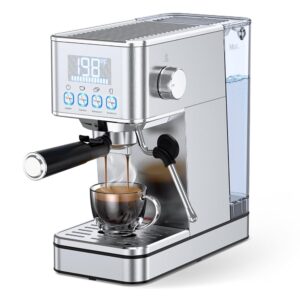
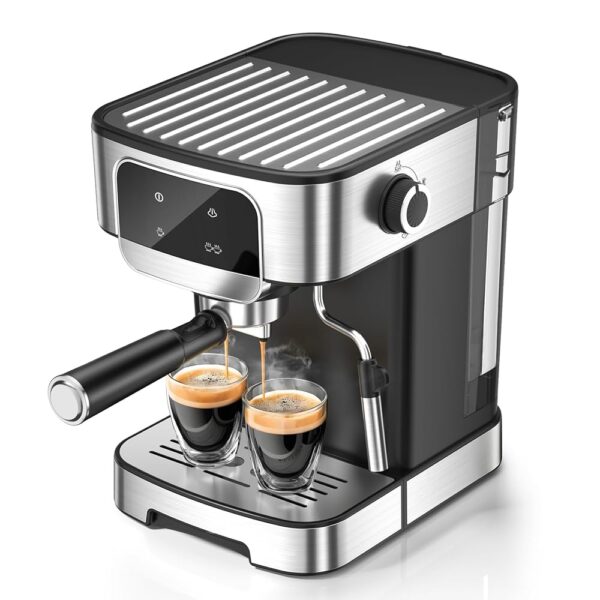
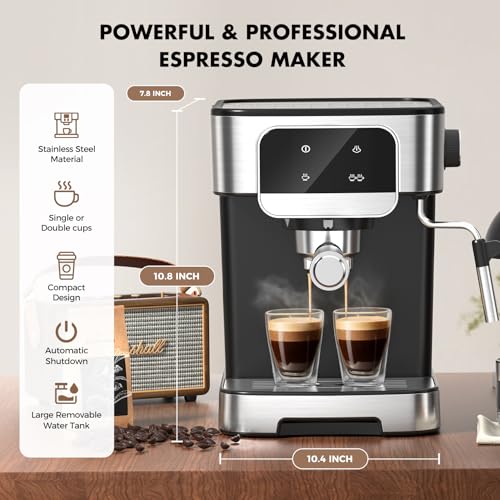
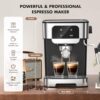
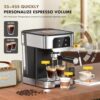
The LERTIN EM615 is a compact espresso machine listed with a 20 bar pump, an LED touch panel and a 61 ounce removable water tank. The specification sheet gives the dimensions as 7.83 inches deep by 10.51 inches wide by 10.86 inches tall and the item weight as 8.68 pounds, with a black finish, manufacture in China and a first listing date of October 2024. The model number is recorded as EM615 in both the model name and item model number fields, which is more consistency than several rivals in this price band manage.
What arrives with it is far less clear. The included components field contains a single word, Filter, on a machine whose own title promises a milk frother and a removable tank. There is no mention of a portafilter, a tamper, a milk jug or a cleaning tool, and no indication of how many baskets are supplied. Anyone comparing this against the better documented models in the espresso machine archive will notice immediately how much of this listing is missing rather than wrong.
Pump Pressure Against Brew Pressure
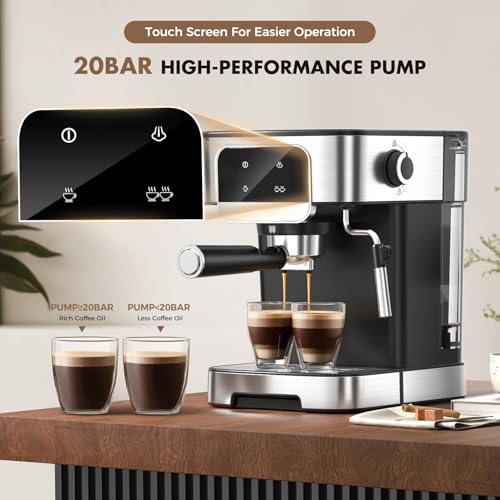
Twenty bar is the headline, and it describes the pump’s maximum output at zero flow rather than the pressure at the coffee bed. Espresso is conventionally extracted near 9 bar, and machines of this type reach it through an over pressure valve that dumps the surplus. A higher bar number on the box therefore does not mean a stronger or better shot, and there is no gauge on this machine to show what is actually happening during extraction.
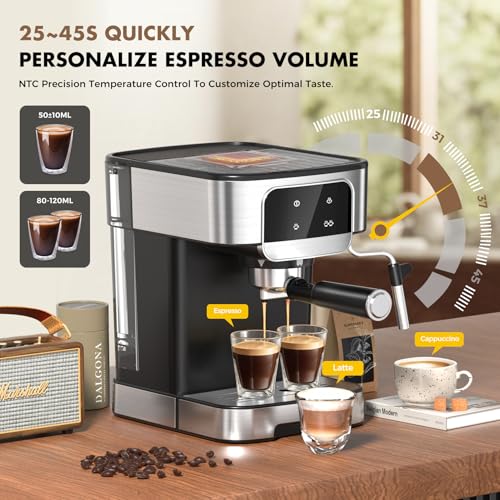
Published owner feedback describes fixed preset shot volumes selected from the touch panel, with limited scope to change extraction time. That is a meaningful constraint for anyone who wants to dial a shot in by adjusting both grind and time, and it is the sort of behaviour a specification block should record and this one does not.
The Milk System the Listing Never Describes
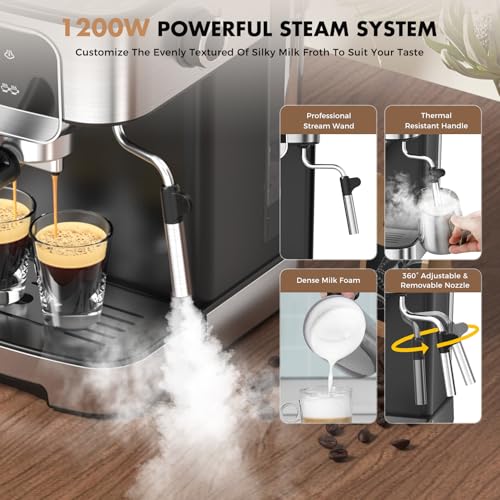
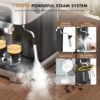
The product title claims an automatic milk frother. No field in the specification block describes the milk system at all, beyond Milk Frother appearing in a list of special features. That gap matters because the two possibilities behave nothing alike. An automatic frother senses milk temperature and stops on its own; a manual steam wand runs until the operator closes the valve and requires the jug to be positioned and moved by hand. Published owner feedback describes a wand that rotates through a wide arc and is operated by hand, which is not what the word automatic normally means.
Nothing states the steam pressure, the tip design or whether the wand purges itself after use. Milk residue left inside an unpurged wand hardens and blocks the tip, and no cleaning tool is listed anywhere in the accessories.
Water Tank and Daily Handling
The 61 ounce tank is the largest in this group of compact machines and roughly double what several rivals offer. That reduces refill frequency, but it also changes the machine’s balance. Sixty one fluid ounces of water weighs close to four pounds, and the machine itself is listed at 8.68 pounds, so a full tank adds nearly half the machine’s own weight and most of it sits high in the cabinet.
Published owner feedback mentions suction style feet that hold the unit firmly to the counter, which helps when twisting a portafilter home but makes the machine awkward to reposition for refilling. The same feedback repeatedly mentions a drip tray that fills quickly and needs emptying often, and twist lock filter baskets that are difficult to remove while still hot.
Controls and What a Touch Panel Buys
The interface is an LED touch panel rather than mechanical switches. Touch controls wipe clean easily and give a modern look, and they are also a sealed assembly: when a capacitive panel or its controller fails, the repair is a board rather than a switch. On a machine with no stated warranty term, that is a real consideration rather than a theoretical one.
The listing names iced coffee, espresso, mocha, latte and cappuccino among the specific uses. Those are drinks the operator assembles rather than programmes the machine performs, so the list should be read as marketing rather than as a menu of automated recipes.
What the Listing Gets Wrong
The single largest problem is omission. There is no voltage field on a mains powered appliance sold into a 120 volt market. There is no wattage, no operation mode, no warranty description, no boiler or heating element detail and no portafilter diameter. Portafilter size is not a minor specification: it decides whether any aftermarket basket, tamper or distribution tool will fit, and the common sizes of 51mm, 53mm, 54mm and 58mm are not interchangeable by even a millimetre.
The Included Components field reading Filter is the clearest sign that this block was filled in carelessly rather than that the box is empty. The Filter Type field reads Reusable without saying reusable what. Nothing records whether the supplied baskets are pressurised dual wall types or single wall, which is the difference between a machine that flatters pre-ground coffee and one that demands a burr grinder.
What the Specifications Do Not Settle
Temperature behaviour is entirely unstated. There is no heat up time, no indication of whether a thermoblock or a boiler is fitted, and no statement about recovery between brewing and steaming, which on a single heater machine is the practical limit on making two milk drinks in a row. Noise is unstated, and a vibration pump in an 8.68 pound cabinet is not a quiet component.
Longer term ownership is the weakest area of all. The listing gives no warranty term, no part numbers, no gasket dimension and no descaling schedule, and the model has only been on sale since late 2024, so there is no established aftermarket to fall back on. Buyers who care about being able to replace a gasket or a shower screen in three years should compare what is documented here against the parts listed across the espresso machine parts and accessories section before committing.
Who It Suits and Who Should Look Elsewhere
This machine suits a buyer who wants a compact, wide and shallow cabinet that needs under eight inches of counter depth, a large tank so refills are rare, and a simple touch panel with preset volumes rather than a set of controls to learn. It sits at the budget end of the category and does not pretend otherwise.
It suits nobody who needs to know what they are buying in advance. Anyone planning to add a tamper, a precision basket or a bottomless portafilter should not buy a machine whose portafilter size is unpublished. Buyers who want the same shape of product with a fuller specification should compare the LERTIN EM626 and the CASABREWS 3700 Essential, both of which state more about what is in the box. Buyers who want an integrated grinder in the same appliance should step up to something like the Kismile espresso machine with grinder instead, and anyone unwilling to grind fresh at all will get a more consistent drink from a capsule brewer.