

Description
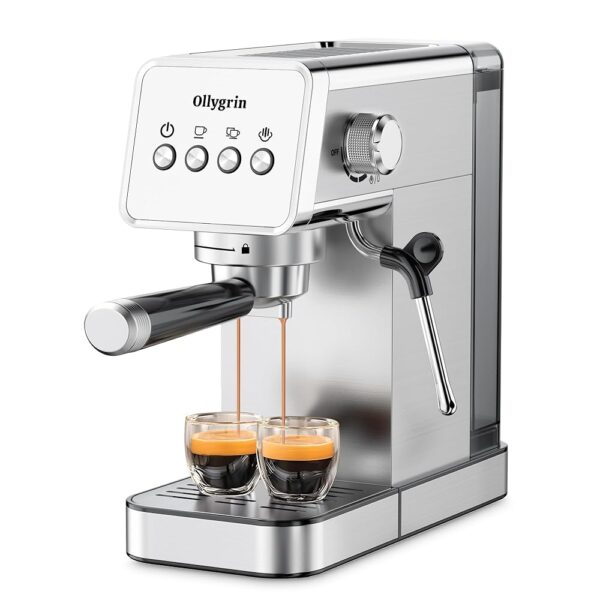
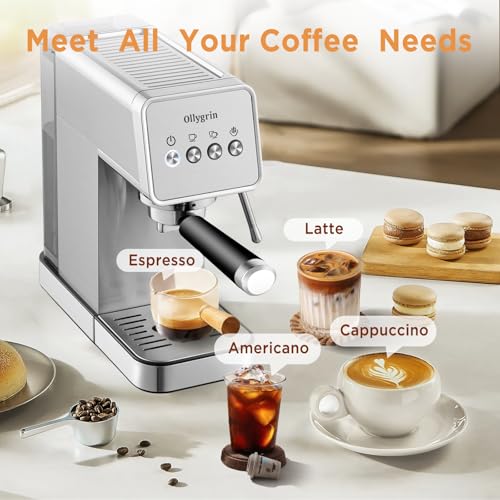
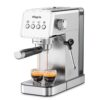
The Ollygrin AEK-US-EM1502 is a semi automatic pump espresso machine in a stainless steel body, specified with a 15 bar pump, a 1350 watt heating element, a manual steam wand and a 40 ounce removable water tank. It measures 11.78 inches deep, 5.16 inches wide and 11.93 inches tall, and the listing gives the weight as 7.66 pounds.
Notably, the operation mode field on this listing reads semi automatic rather than the fully automatic label that the importer has stamped on most comparable machines in this catalogue. That is the correct description: there is a portafilter, a steam wand and no grinder or brew group, so the operator controls grind, dose, tamp and milk. At 5.16 inches wide it is among the narrowest portafilter machines listed here, which is the main reason to consider it over an equally cheap but wider rival.
Brewing System and Pressure
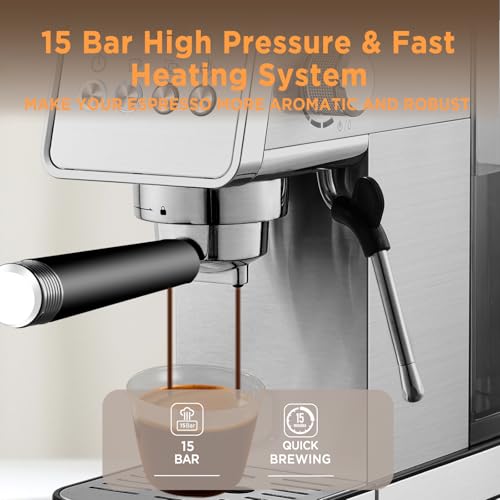
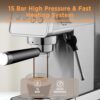
Ollygrin quotes 15 bar rather than the 20 bar figure most competitors print. That is not a disadvantage. Both numbers describe the pump’s maximum output against a closed valve, and both settle to roughly 9 bar at the puck once water flows. If anything, a 15 bar rating is the more honest of the two conventions, since it is closer to what the machine actually needs to do.
The listing does not state basket size, portafilter diameter or whether the supplied baskets are pressurised. The included components field lists only a filter and a milk frother, which is unusually sparse; most machines at this price ship two baskets, a tamper and a scoop. Buyers should confirm what is actually in the box before assuming a tamper is included. If a bundled set of accessories matters, the CASABREWS CM5418 lists its inclusions in far more detail.
Temperature and Heat Up
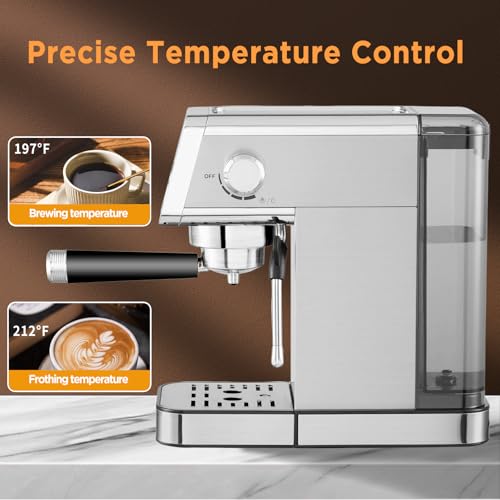
The manufacturer describes fast heating with accurate temperature control for a balanced flavour, but gives no setpoint, no stability figure, no heat up time and no indication of whether the machine uses a thermoblock or a small boiler. At 1350 watts in a body this narrow, a thermoblock is the likely arrangement, which typically means quick heat up and a lower thermal mass than a brass boiler, so temperature can drift more between consecutive shots.
Without published figures none of that can be stated as fact about this specific model. What can be said is that machines in this configuration reward preheating: running water through the empty group and portafilter before the real shot brings the metal up to temperature and makes the first drink of the day resemble the second. That habit matters more here than on a machine with a heavy boiler.
Milk and Steam
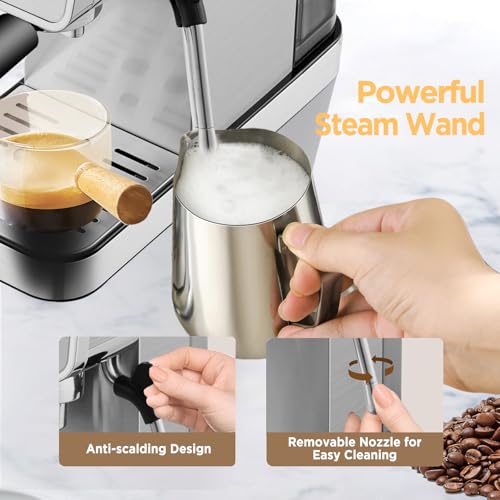
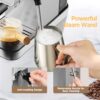
The steam wand is manual and fed by the same heater that handles brewing, so the machine switches between modes rather than doing both at once. Ollygrin claims creamy, rich texture suitable for lattes and cappuccinos, which is a capability claim rather than a performance figure. No steam pressure, tip design or recovery time is given.
Published owner feedback on this model raises a specific ergonomic point worth repeating: the wand is short, which limits how deeply it can be inserted into a taller milk pitcher and makes it awkward to work with larger jugs. On a narrow machine that is a predictable consequence of the body shape. Anyone who mostly makes 12 ounce milk drinks should factor that in, and consider a shorter, wider pitcher rather than a tall one. If milk is the priority rather than an afterthought, an automatic milk system such as the one on the Breville Bambino Plus removes the technique question altogether.
Water Tank, Build and Cleaning
The 40 ounce tank is removable, as is the drip tray, and both are the components that need regular attention. Forty ounces is a reasonable volume for a machine this narrow and should cover several drinks between refills. The exterior is stainless steel with the style listed as modern, and the filter type is reusable, so there is nothing consumable to buy beyond coffee and descaler. That last point is worth weighing against a capsule machine, where the recurring cost of pods over a couple of years usually exceeds the price of the machine itself, and against a bean to cup automatic, where water filter cartridges are a scheduled expense.
Owner feedback commonly notes that the portafilter handle feels light in the hand, which is consistent with a 7.66 pound machine using a lighter portafilter than a commercial 58 mm unit. That affects perceived quality more than function, but it also means the machine can shift slightly when the portafilter is locked in, so a stable counter position helps. The same feedback notes there is no adjustable water flow, so shot volume is controlled by starting and stopping manually rather than by a programmed dose. The similarly priced Lertin EM615 is worth comparing on exactly this point.
What the Specifications Do Not Settle
A good deal is missing. There is no brew temperature, no boiler or thermoblock designation, no basket dose, no portafilter diameter, no voltage figure, no warranty term and no descaling interval. The excerpt copy on the original listing refers to getting from grinding to sipping quickly, which is misleading: this machine has no grinder, and grinding is a separate step with separate equipment.
The other significant gap is track record. The model reached the market in November 2024 under a brand with little history and carries only a small number of published reviews, which is far too few to say anything about durability. Where a machine from an established line can be judged partly on how its predecessors aged, there is no such record here. That is not a criticism of the product; it is a statement about how much the available evidence can support. Anyone weighing this against a known quantity should factor that uncertainty in explicitly. A longer running machine of the same width, such as the Wirsh Home Barista CM5418, carries the owner history this one lacks.
Who It Suits
This machine suits a buyer whose constraint is counter width, who wants a real portafilter workflow rather than capsules, and who already has a grinder. Correctly labelled as semi automatic, with a 40 ounce tank and a straightforward manual steam wand, it does the basic job at a low price and takes up very little space doing it.
It is not the right choice for anyone making large milk drinks, given the short wand, nor for anyone who wants documented temperature behaviour or a long service history to lean on. Buyers in that position should look at the established models in the espresso machine category, where there is enough owner history to know how the machine ages. Buyers who want minimal involvement should skip the portafilter format entirely and look at capsule or bean to cup machines instead. Buyers who want published temperature control in the same band can compare the Spacekey CM5080.