Description
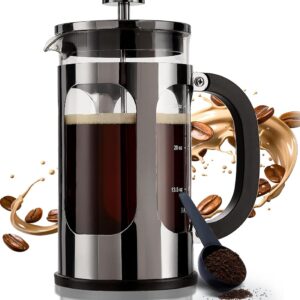
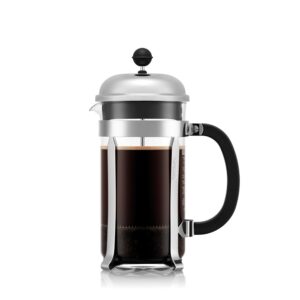
The Utopia Kitchen UKFRENCHPRESSPRNT is a 34 ounce French press with a borosilicate glass beaker, a black frame and a four sieve filter stack built around an 80 mesh screen. It sits at the cheapest end of the press market and it does the one thing a press does: immersion brewing through metal, which keeps the coffee oils that paper filters trap.
What separates it from the field is a published mesh figure, which is rare in this category. Most press listings describe their filter as fine or superior without ever stating a number, and a number is the only thing that lets you compare one against another.
The 80 Mesh Figure
Mesh count describes how many openings there are per linear inch of screen, so a higher number means a finer filter. Eighty mesh is a genuinely fine screen for a French press, considerably finer than the loosely woven discs used on the cheapest presses.
What it achieves is fewer fines in the cup. What it does not achieve is a sediment free brew, because immersion produces particles smaller than any practical mesh. Utopia describes the result as residue free coffee, which overstates it. Pressing slowly matters as much as the mesh does: pushing the plunger fast drives fines past the edge of the screen regardless of the weave.
The Four Sieve Stack
Beyond the mesh screen, Utopia describes a four sieve system with an improved piston plate. The layers in a press plunger do different jobs: the screen filters, a spring or coiled edge keeps the assembly pressed against the glass so grounds cannot escape around the rim, and the plates hold the screen flat under pressure.
The rim seal is the part that matters most in practice, and it is the commonest failure on cheap presses. A screen that does not sit flush against the beaker lets a channel of grounds through no matter how fine the weave is. It is also the part that loosens with age, so a press that started clean and gets gritty after a year usually has a tired spring rather than a worn screen. That is worth knowing because the plunger assembly is normally the cheapest part to replace, if replacements are available.
Method and Grind
Utopia gives the method in four steps: add coarse ground coffee, add hot water and stir, wait a few minutes, then press. That is correct and it is more instruction than most press listings provide.
Grind is the variable that decides whether press coffee is good or disappointing. Coarse, roughly the texture of sea salt, is the target. Too fine and the fines slip past the screen and the plunger becomes hard to push; too coarse and four minutes is not long enough to extract properly. Supermarket pre ground coffee is ground for drip machines and is too fine for a press, which is why press coffee made with it tastes muddy. A grinder changes press coffee more than any upgrade to the press itself, and the burr grinder we cover is the relevant tool. The stir after adding water is not optional: without it the top layer of grounds floats dry and never extracts.
Capacity and the Cup Count
The beaker holds one litre, stated as 34 ounces, and Utopia describes that as eight cups. That works out at a little over four ounces per cup, which is the conventional press measure and is not a mug.
In practice a full press makes two large mugs or three modest ones. The habit worth building is decanting what you are not drinking straight away, because coffee left sitting on the grounds after plunging keeps extracting and turns bitter within twenty minutes. That is the behavioural difference between a press and a drip machine, where the grounds are separated as soon as the cycle ends. The recorded dimensions read 9 inches deep, 6 inches wide and 6 inches high, and the height figure cannot be right for a one litre press, which stands around nine inches tall with the plunger seated. The axes have been transposed: read the 9 as the height.
Beyond Coffee
Utopia points out that a press is not only a coffee brewer, and this is one of the better arguments for owning one. The same immersion and filter arrangement works for loose leaf tea, for herbal blends, and for cold brew left in the fridge overnight.
The cold brew use is the most valuable. Coarse grounds, cold water, twelve hours in the fridge, then plunge and decant produces genuine cold brew for the cost of the coffee alone, a fraction of what a dedicated cold brew maker costs. Loose leaf tea works too, though a press used for both carries coffee oils into the tea unless cleaned thoroughly.
Cleaning and Care
The care instructions recommend hand washing the lid with a light detergent and avoiding abrasive scrubbers to keep the finish unscratched. The beaker and plunger stack come apart for cleaning, which matters because coffee oils accumulate between the filter layers and turn rancid if they are left.
The daily job is dealing with a bed of wet grounds, which cannot go down a sink without eventually blocking it. Scraping them into a bin or a compost caddy is the routine, and it is the main reason people abandon presses. A drip machine lifts the paper and the grounds out together in one movement, which is the convenience the drip coffee makers we cover offer in exchange for a lighter, cleaner cup.
Errors In The Attribute Table
Three fields in the recorded data do not describe this product. The human interface input reads Buttons, and there are no buttons on a manual glass press. The model name field reads PARENT, which is a listing structure token from a product family rather than a model name. And the specific uses field describes the press as a machine for a completely different category of drink, one that involves dissolving powder in hot water rather than brewing ground coffee at all.
The included components field lists only a plunger, although the description states that a coffee spoon is supplied. The filter type is correctly recorded as stainless steel, and the coffee maker type correctly reads French Press, so the classification fields are sound and the marketing fields are not.
What the Specifications Do Not Settle
No glass thickness is stated. No statement of whether replacement beakers or plunger assemblies are available, which determines whether this is a repairable object or a disposable one. No maximum water temperature. No steeping time recommendation beyond a few minutes. No indication of the frame material, which affects how hot the handle gets.
The description is also cut off partway through its final care instruction in the recorded data, so whatever it was about to say about the glass is lost. And the residue free claim, as discussed above, overstates what any metal filter can do.
Who It Suits
This suits somebody who wants the fuller bodied cup a press gives, is willing to grind coarse and deal with wet grounds, and wants to spend as little as possible finding out whether they like the format. The 80 mesh figure is a real specification rather than a claim, and doubling as a cold brew vessel and a teapot makes it a more useful object than its price suggests. The Bodum Brazil is the long running press to compare it against. The Secura SFP-34DS is the stainless version of the same idea.
Skip it if sediment bothers you, since every press produces some. Skip it too if you want coffee waiting for you when you get up, because a press needs a kettle and four minutes of attention. And anyone taking it outdoors should weigh the glass beaker against a stainless percolator, which is the traditional answer to brewing coffee away from a kitchen. The COLETTI Bozeman percolator is that stainless option.