




Description
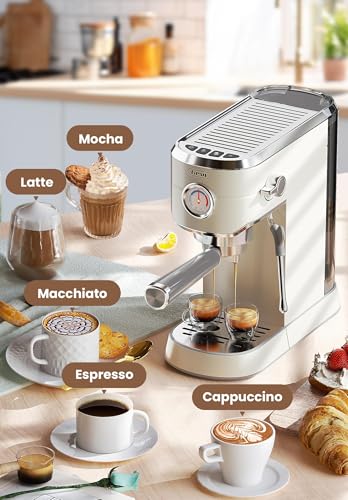
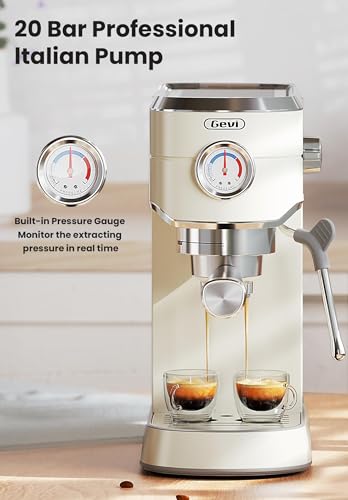
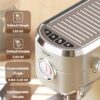
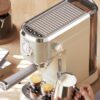
The Gevi ECMG0 is a semi automatic pump espresso machine with a 20 bar pump, a pre infusion cycle, NTC temperature control, a pressure gauge on the front and a steam wand with a removable frothing nozzle. The body is stainless steel, the footprint is narrow, and there is a hot water function for americanos, tea and warming cups before pulling a shot.
The word commercial appears in the product title and it should be treated as marketing rather than specification. Gevi’s own bullet points describe the machine as ideal for home or office use and as a compact machine suited to kitchens of any size, and the listing repeatedly positions it as a gift. A genuine commercial machine has a plumbed water line, a heat exchanger or dual boiler and a 58mm portafilter, none of which are claimed here. Read this as a domestic machine competing with the rest of the espresso machine category.
What 20 Bar Actually Means
The 20 bar figure leads the listing and it is the most misunderstood number in this category. Espresso is extracted at around 9 bar at the coffee bed. That is the industry standard and it is what every commercial machine targets. A pump rated at 20 bar is quoting its maximum unloaded pressure, not the pressure that reaches the grounds.
Machines advertising 15, 19 or 20 bar all use the same class of vibratory pump and all regulate down to something closer to 9 bar at the group by means of a relief valve. A higher headline number is not a higher quality machine and it is not a stronger shot. What it does indicate is a pump with enough headroom to work with a pressurised basket, which is the type most machines at this price ship with. The pressure gauge on the front is the more useful feature, because it lets you see what is actually happening rather than what the box claims.
Pre Infusion and Temperature Control
Pre infusion wets the coffee bed at low pressure before the full pump pressure arrives. It matters because a dry puck hit at full pressure channels, letting water find a path through one part of the bed and leaving the rest under extracted. A brief low pressure soak lets the grounds swell and settle first. Having it on a machine at this price is genuinely worth something.
NTC temperature control refers to a thermistor based thermostat regulating the boiler. That is a step above a simple bimetallic thermostat and a step below the PID control fitted to machines several times the price. What the listing never gives is a temperature in degrees, a stability tolerance, or any indication of how long the machine takes to come up to temperature. On an espresso machine, brew temperature is the specification, and its absence here is the most significant gap in the record.
Steam Wand and Milk
The steam wand is described as powerful and as turning milk into silky smooth microfoam quickly, with a removable froth nozzle for cleaning. The removable nozzle is the practical detail: milk residue bakes onto a wand tip and a fixed tip on a cheap machine is a permanent cleaning problem.
What the listing does not say is whether the wand is a true steam wand or a panarello style frothing aid. Panarello attachments inject air automatically and produce a stiff foam suitable for a cappuccino but not for latte art; a bare wand gives you control but demands technique. The reference to a removable froth nozzle suggests an attachment over a bare tip, but the record does not confirm it either way, and the difference determines what kind of milk drink the machine can actually make.
The Hot Water Function
The listing lists a hot water function for americanos, tea, soups and pre warming cups. On a single boiler machine this normally means routing steam boiler water out through the wand, which is convenient but means you cannot pull a shot and draw hot water at the same time.
Warming the cup before a shot is the use worth taking seriously. A double shot is around two ounces of liquid and a cold ceramic cup drops its temperature immediately, which is why cafes keep cups on top of the machine. The attribute table also lists a cup warmer as a feature, though no bullet point mentions one, so it is unclear whether the top plate is actively heated or simply warm from the boiler beneath it.
Where the Record Contradicts Itself
The Color attribute reads Beige and the Style attribute reads 20 Bar Espresso Machine Beige, while the listing title and every bullet emphasise a full stainless steel housing and the product identifier on this site indicates a white finish. Those cannot all describe the same unit, and the colour you receive is not determinable from this record.
The category assigned in the imported data is Food Service Equipment and Supplies while the retailer’s own category path says Home and Kitchen. The Special Feature field contains a typographical error, reading Buit-in Pressure Gauge. The product description itself contains three: the machine is called an expresso machine twice and an expressions machine once. None of these change what the machine does, but a listing with this many errors is not one whose specifications should be taken on trust.
Formatting That Breaks the Page
Every bullet heading on this listing is written in mathematical bold Unicode characters rather than in ordinary letters with formatting applied. It looks like bold text in a browser and it is not: to a screen reader it is a string of mathematical symbols, and to a search engine it is not the word it appears to be.
That is worth pointing out because it tells you something about how the listing was assembled. A seller reaching for Unicode tricks to make headings stand out is optimising for the appearance of the page rather than for the accuracy of what is on it, and the errors elsewhere in the same copy are consistent with that.
What the Specifications Do Not Settle
There is no brew temperature, no wattage, no water tank capacity, no portafilter diameter and no statement of whether the baskets supplied are pressurised or non pressurised. That last point determines whether the machine can be used with your own grind or only with a basket that manufactures crema artificially, and it is the single most consequential unknown for anyone buying their first espresso machine.
Nothing states the boiler type or material, the heat up time, or whether a bottomless portafilter or third party baskets will fit. The dimensions of 12.3 inches deep by 5.5 inches wide by 12 inches high describe a very narrow machine, which is credible for a single boiler unit and is a genuine advantage on a crowded counter. The warranty is stated as 12 months with lifetime technical support.
Who It Suits
This suits someone taking a first step into pump espresso who wants a pressure gauge and pre infusion without paying several times as much, and who has a narrow counter. The gauge in particular is a real learning tool, because it shows you what your grind and dose are doing rather than leaving you guessing. The CASABREWS CM5418 is the other narrow machine bought at this level.
Look elsewhere if you want a documented brew temperature, a known basket type or anything that would justify the word commercial. The De’Longhi Stilosa is the established budget alternative, the stainless version of this same Gevi platform is worth comparing on finish, and the Breville Barista Touch shows what a fully specified machine publishes about itself. The Spacekey CM5080 publishes a PID system and a heat up figure in the same bracket.

