Description
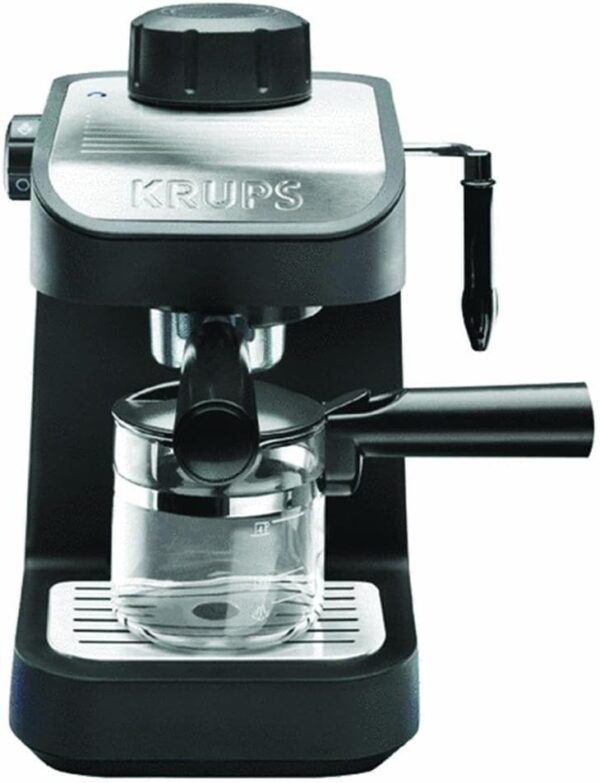
The KRUPS XP1020 is a steam pressure espresso and cappuccino machine with a four cup glass carafe and a frothing wand. The listing gives dimensions of 8.5 by 9.38 by 11 inches, a weight of 6 pounds, a reusable filter and a carafe among the included components, and dates the product to April 2008. Earlier copy describes a 750 watt steam driven system and a supplied 7 gram coffee scoop.
The brewing method is the thing to understand before anything else, because the listing calls this an espresso machine and the word carries expectations the hardware cannot meet. A steam machine heats water in a sealed vessel until steam pressure forces it through the grounds. Pump machines, which make up most of our espresso machines category, use an electric pump and produce a measurably different drink.
Steam Pressure and What Reaches the Cup
A steam machine generates roughly 1 to 3 bar. Espresso as a category is defined at around 9 bar. That is not a small shortfall, it is a different extraction: water moves through the bed more slowly and with less force, giving a drink stronger and more concentrated than drip coffee but thinner in body than espresso, with a light crema that collapses quickly.
Temperature is the second difference. Because the pressure comes from boiling, water leaving the machine is close to boiling rather than the 92 to 96 degrees Celsius pump machines target, and hotter water pulls more bitterness from the grounds. A slightly coarser grind and a darker roast take some of that edge off. Neither the pressure nor the temperature appears anywhere on this listing, and the 750 watt figure from earlier copy is a manufacturer claim rather than a confirmed field.
The Four Cup Carafe
Four cups means four small espresso cups rather than four mugs, and the glass carafe is confirmed in the included components. The format brews the quantity of water you load rather than stopping when you decide: you fill the boiler for the number of cups you want, switch on, and the machine runs until the pressure is spent. There is no volumetric control and no stop button.
That makes the machine most efficient when you want two to four small drinks at once, and least efficient for a single cup, because the boiler cycle is the same length either way. The supplied 7 gram scoop is how the dose is measured, and 7 grams is a single shot by modern standards. A glass carafe is also a consumable in practice: it is the part most likely to break, and on a design dating to 2008 replacement availability is worth checking before buying.
The Frothing Wand
The wand is where a steam machine genuinely outperforms a cheap pump machine. A steam boiler exists to make steam, so there is plenty of it, with none of the recovery wait a small thermoblock imposes between brewing and steaming. Published owner feedback for this model is consistently positive about the foam it produces.
The texture is coarse rather than the flowing microfoam a latte or flat white needs, so this produces a traditional bubbly cappuccino foam and latte art is not achievable. The wand must be purged and wiped immediately after use, because dried milk in a steam channel is difficult to clear once set. The listing does not describe the tip type, whether a frothing sleeve is fitted, or the wand range of movement.
The Fixed Water Tank
The water tank on the XP1020 is not detachable. That is a real limitation rather than a detail, and it has two consequences. Filling means pouring from a jug into an opening on the machine rather than carrying the tank to the tap, which is more spillage and more care. Cleaning means reaching into a fixed reservoir, which is difficult to do thoroughly without a bottle brush.
The second consequence matters more over time. Steam machines scale faster than pump machines because the water is boiled rather than heated, and a tank you cannot remove is a tank you cannot inspect properly. Descaling on a regular schedule with a product from our cleaning and descaling section is what determines how long a machine of this type lasts, and there is no descale prompt to remind you.
Contradictions in the Listing Data
This listing contradicts itself on the most basic question about the machine. The style field reads Semi-Automatic. The operation mode field reads Fully Automatic. Both cannot be true and in fact neither is: semi-automatic means a pump machine with programmable shot volumes, fully automatic means a bean to cup machine that grinds and doses for you, and this is a manual steam machine with a switch.
The department field reads Cookware, which is a retail taxonomy category rather than a product characteristic. The exterior finish field reads Stainless Steel while the product title describes the machine as black, and no colour field is present to resolve it. The product dimensions are given as three numbers with no axis labels, so which is width and which is depth is not stated. And there is no wattage field, no pressure figure, no boiler capacity and no water tank capacity anywhere on the page.
What the Specifications Do Not Settle
Beyond the above, the listing does not state the filter basket size, the portafilter diameter, the cup clearance, whether a tamper is included, the heat up time, the cycle time, or the warranty term. Earlier copy refers to a one year limited warranty, which is a claim rather than a confirmed field.
Most importantly, nothing on the listing signals that this is a steam machine rather than a pump machine. The coffee maker type reads simply Espresso Machine and the recommended uses field reads espresso based beverages. A buyer comparing this on price against a pump machine is comparing two products that make different drinks, and the page does nothing to flag it. There is also no grinder, so ground coffee or a separate grinder is required.
Who It Suits
This suits someone who wants a strong coffee and a frothed milk drink for very little money, in a small kitchen, and who is not chasing espresso in the technical sense. It suits making two to four small drinks at once, and its simplicity is genuinely an advantage: with a boiler, a switch and no electronics, there is very little on it to fail. The steam supply makes milk easier than on budget pump machines. The KRUPS FND111 is the earlier machine of the same type from the same brand.
It suits you poorly if you want espresso proper, because the format cannot produce it. It suits you poorly if you want one quick cup, given the boiler cycle. And the fixed tank makes it a poor choice in a hard water area unless you are disciplined about descaling. Anyone wanting the next step up should look at a pump machine such as the De Longhi EC155, and anyone comparing within the steam format should read our Capresso 303.01 review. The Capresso Steam PRO 304.01 is the other machine to weigh inside that format.