Description
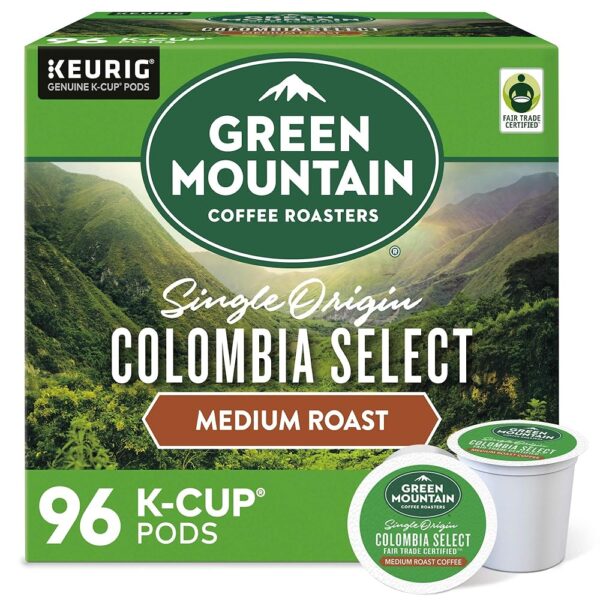
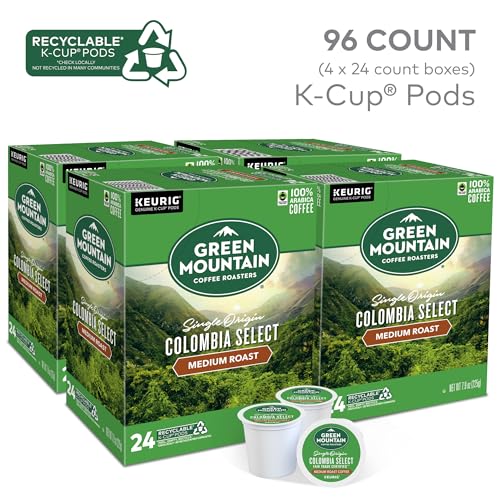
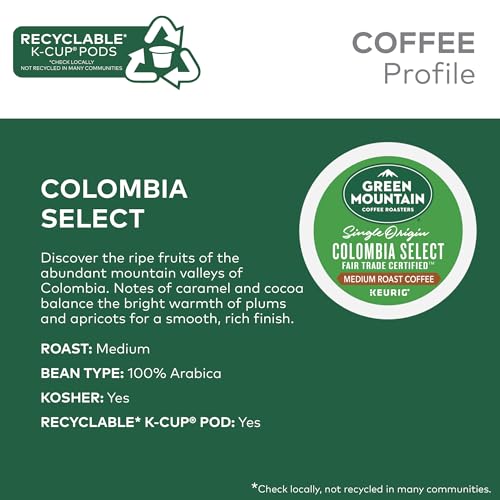
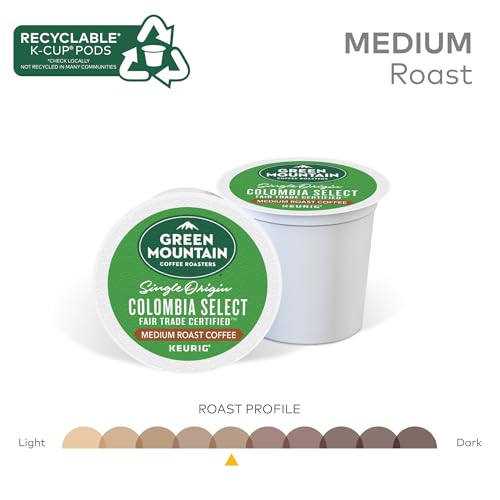
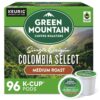
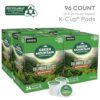
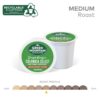
Green Mountain Coffee Roasters Colombia Select in Keurig K-Cup format is a 96 count box listed at 38.49 dollars, a medium roast made from 100 percent Arabica, certified Orthodox Union Kosher and, unusually for this category, Fair Trade Certified. Green Mountain describes notes of caramel and cocoa balanced against the brightness of plums and apricots. At 96 pods for 38.49 dollars it works out at about 40 cents a cup.
Two things make this listing stand out from the dozens of medium roast pods in the pod category. The first is that it names an origin, where most name only a blend. The second is that it carries a third party certification rather than a company programme. Between them they make it the best documented pod covered on this site, and at 40 cents a cup it is also among the cheapest, which is an unusual combination.
Fair Trade Certified, and What It Guarantees
The sustainability bullet reads Fair Trade Certified, with the explanation that farmers receive a fair price for quality products and can reinvest in their crops, communities and quality of life. That is a genuine third party certification and it is worth understanding what it does and does not cover.
Fair Trade certification sets a minimum price floor that buyers must pay regardless of where the commodity market sits, which protects growers when prices collapse. It adds a social premium paid on top, which cooperatives vote on how to spend, typically on infrastructure, education or processing equipment. It requires democratic organisation among smallholders and prohibits certain labour practices. It is audited by an external body against a published standard.
What it does not do is certify quality, environmental outcomes beyond a defined set of prohibited practices, or the share of the retail price that reaches the farm. It is an economic and social instrument rather than a quality mark. That distinction matters because it is often read as a proxy for good coffee, and it is not. What it does mean is that the claim on this box rests on external auditing rather than on Green Mountain’s own criteria, unlike the responsibly sourced language on the company’s Breakfast Blend pods.
The Origin Is Misspelled on the Page
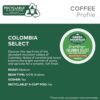
The product is called Colombia Select, spelled correctly, and the tasting bullet invites you to discover the ripe fruits of the abundant mountain valleys of Columbia, spelled with a U.
Colombia is the country. Columbia is a district in Washington, a river in the Pacific Northwest, a university in New York and a great many other things, but it is not where this coffee comes from. The error is common enough to be unremarkable in casual writing and less so on a product whose entire selling point is its origin, appearing three words after the correctly spelled version in the product name. It changes nothing about the coffee and it does tell you how carefully this page was proofread.
The Tasting Notes and Whether They Fit
Caramel and cocoa balanced against plums and apricots, finishing smooth and rich, is a more detailed note than almost anything else in this category offers, and it is broadly consistent with what Colombian coffee at a medium roast produces.
Colombian arabica is typically washed, which produces clean acidity rather than the fermented fruit character of natural processing. Caramel and cocoa are roast derived and develop reliably at medium levels. Stone fruit acidity, which is what plums and apricots describe, is a genuine characteristic of Colombian coffee from higher altitudes and it is the thing a medium rather than a dark roast preserves. The description is doing real work rather than reaching for pleasant words.
What Select means is not defined anywhere. It is not a grading term with a fixed meaning in the way that Supremo or Excelso are in Colombian coffee, where the designations refer to screen size. Treat it as a product name rather than a specification.
Brew Size and Getting the Note Out of the Pod
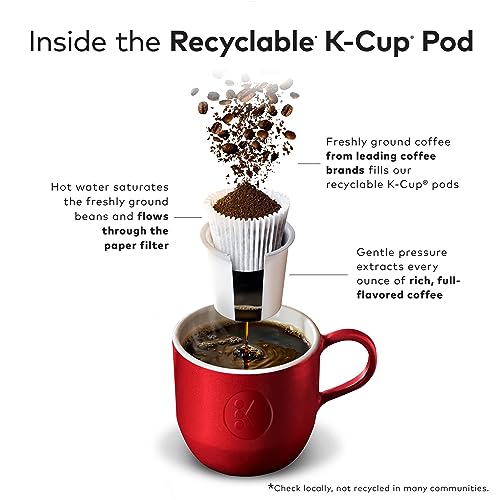
The pod dose is fixed at somewhere between nine and twelve grams and the machine varies only the water. On a coffee sold on the strength of stone fruit acidity and cocoa depth, that matters more than it does on a generic blend, because both of those characteristics are diluted rather than concentrated by a larger brew.
Eight ounces is the size at which a standard pod produces something close to conventional filter strength. At 12 ounces the caramel and cocoa survive as a general impression and the brighter fruit notes largely disappear, which means paying for a documented single origin and then brewing away the part that distinguishes it. If you want a large mug of this, brewing 8 ounces and topping up with hot water gives a better result than brewing 12, because it preserves the extraction ratio while adding volume.
What the Specifications Do Not Settle
The specification block runs to five category labels: brand, item form, flavour, caffeine content and roast level. There is no weight, no dimensions, no country of origin for the packaging and no date first available. For a product whose whole proposition is that it comes from somewhere identifiable, that is a thin data sheet.
Within Colombia there is no region, no altitude and no farm or cooperative named, so single origin here means country level rather than anything narrower. There is no dose per pod in grams and no caffeine figure. There is no processing method, which for a coffee sold on acidity is a meaningful omission. The recyclability bullet is present and correctly qualified with the check locally caveat, which is more than several competing listings manage, and the kosher and Fair Trade marks are both named external certifications rather than self declarations.
Who It Suits and Who Should Look Elsewhere
This suits someone who wants a pod that tastes of somewhere rather than of nothing in particular, and who would rather buy certified coffee than take a company’s word for its sourcing. At 40 cents a cup it is near the bottom of the price range in this category while carrying more documentation than anything above it, which makes it the easiest recommendation among the pods covered here. Ninety six pods is around three months for one daily drinker. The San Francisco Bay pods are another mainstream medium roast to weigh against it.
It suits you poorly if you want a dark, heavy cup, since a medium roast Colombian is built around balance rather than intensity, and the Dark Magic pods from the same range are the alternative. It suits you poorly if you brew 12 ounce mugs, because the brightness is the first thing dilution removes. And it suits you poorly if Fair Trade certification is being read as a quality guarantee, which it is not. Anyone wanting more origin detail than a country name will not find it in pod format at all and should be buying whole beans with a refillable pod filter instead. The GoodCups reusable filter is the accessory for that.